Madrid/“The crisis has no time to hit rock bottom and there are no possible solutions in the short and medium term.” The conclusions of the most recent report by economist Pavel Vidal, head of the Observatory of Currencies and Finance (OMFi), published this Tuesday, do not allow palliatives. The Cuban Government’s own mid-year analyzes, says the specialist, “although without showing data on the economic situation in 2025, confirm that the recessionary trajectory continues.”
The dollar in the informal market also continues to rise rapidly, which causes the economy to worsen and private companies and households to continue to become poorer, explains the Cuban economist living in Colombia. “The partial increases that have been applied to salaries and pensions are far from compensating for the accelerated loss of purchasing power that they have been suffering since 2020 and that continues under the current inflation and depreciation rates,” specifies the economist, referring to the salary increase of which the regime has boasted and that, precisely due to the inexorable increase in prices, it actually remains a decline.
Vidal presents, by the end of this October, two scenarios on the informal currency market. One, moderate, is that the dollar reaches 473 pesos and the euro, 539. However, it proposes a “more extreme scenario”, given that “the exchange rate is not moving only due to fundamental factors that come from internal and external imbalances, but rather has a growing component that responds to expectations”: that the dollar reaches 501 CUP and the euro, 551.
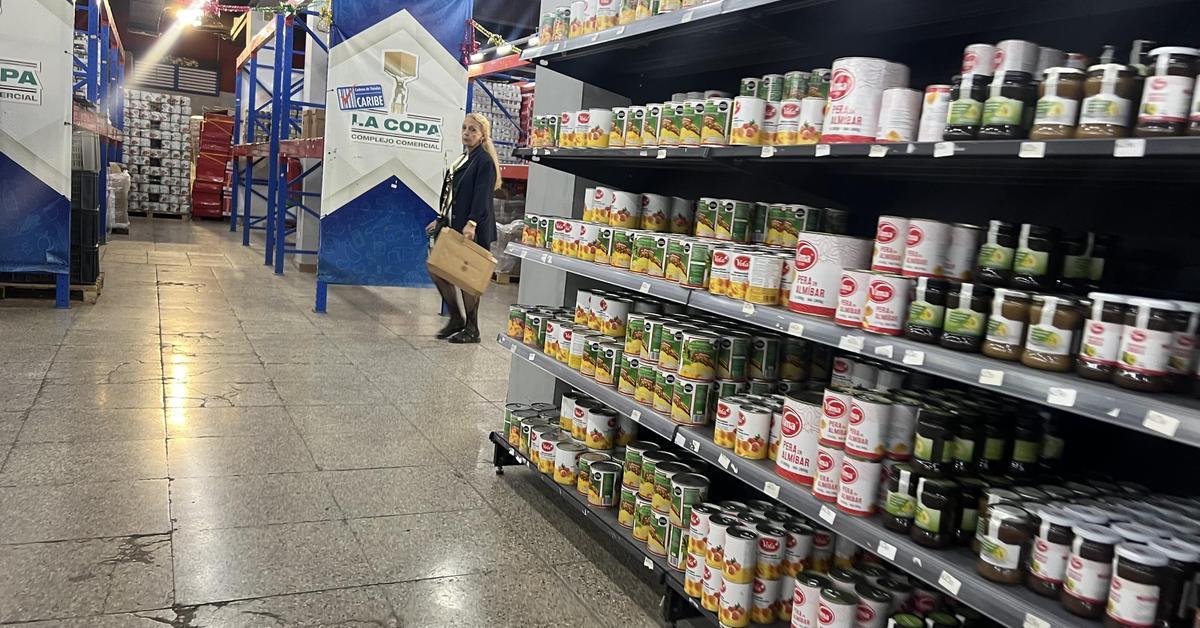
Having ‘green’ is the only way to be able to buy in dollarized stores, which are increasingly more
In his report, the economist offers several reasons for the increase in demand for dollars which, consequently, causes the Cuban peso to continue losing value on the black market. The first of them concerns day-to-day life: having green It is the only way to be able to buy in dollarized stores, of which there are more and more. “The official dollarization of consumption and the collapse of the MLC [moneda libremente convertible] They are behind an exchange rate that is close to 500 CUP,” he indicates.
The second is that the energy crisis and the “very limited access” to inputs and financing negatively affect production, which increases dependence on imports. “The demand for foreign currency from MSMEs to pay for international purchases is growing,” he therefore concludes.
Two other reasons are “distrust in the future of the economy and in the Government’s ability to confront the crisis”, which causes capital flight and “accumulate savings” in hard currencies, and the persistence of fiscal deficit in relation to the gross domestic product, which is being financed with more money issuance in national currency.
“When households, importers, MSMEs, traders and other market participants go out to buy dollars, euros and other currencies, they perceive that their availability is even lower this year,” says Vidal, which leads him to mention a new element for the imbalance in the informal currency market: “The dramatic drop in tourism income.”
When analyzing the exchange rate movement in the black market, the economist asserts that last September the depreciation of the peso increased more than expected, doubling the dollar/peso percentage rate, from 3% to 7.3%. “The forecasts for September 2025 were not met,” says Vidal, who details: “In year-on-year terms (compared to the informal rate of September 2024), the Cuban peso accumulates a depreciation of 37.5%.”
“They are incorrigible. Price caps do not cause an increase in agricultural production”
This was influenced, he says, by “a group of irregular offers,” which “affected the information that the models took for the forecasts.” In the previous report, remember, the OMFi warned of the presence of “messages that were proposing the dollar at 395-398 CUP while the majority of the market was located around the median (410-414 CUP).” Hence “the dollar histogram became bimodal” at the beginning of September. The economist assures: “The atypical pattern of the offers and other analyzes allowed us to conclude that these were irregular offers that tried to artificially move the market in an opposite direction, which they did not succeed.” These users, he says, were excluded from the sample and “the filters were reinforced to minimize the possibility of it being repeated in the future.”
On the other hand, the euro – which came to 500 peso barrier in the informal market at the end of September and is listed this Tuesday at 522 pesos– increased its rate with respect to the CUP by 8.7% last month and accumulates a year-on-year increase of 49.3%. The MLC, although it stopped its decline in September, maintained a rate against the dollar above 2. “While the official rate is at parity 1 MLC = 1 USD, in the practice of the informal market it is necessary to pay more than 2 MLC to buy a dollar,” he recalls.
The graphs presented by the Observatory show the imbalance between the market and the demand for foreign currency, which has accelerated the depreciation of the national currency. “To the demand for foreign currency for more commercial reasons (imports, travel, consumption in dollarized markets, etc.), speculative purchases have been added that respond to pessimism and distrust about the future of the economy and official economic policies,” Vidal insists.
Outside of the experts’ analysis, the Cuban Government seems to insist on all the measures that have proven in the past not only useless but also harmful. For example, the decision to limit prices again of some agricultural products, at the end of last month, for which control is being strengthened from this monday.
The Cuban economist residing in the United States Pedro Monreal has attacked the news, expressing in his X account: “They are incorrigible. Price caps do not cause an increase in agricultural production. Effective consumer defense involves increasing supply that reduces prices. Another thing is economic obscurantism.”