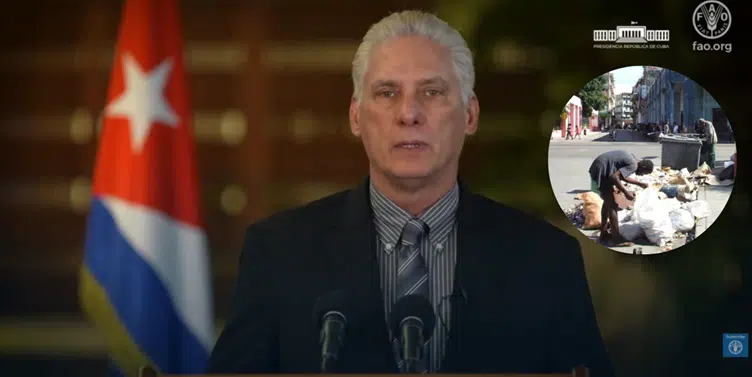
While millions of Cubans survive without access to basic foods, Díaz-Canel spoke about food sovereignty at the World Food Forum.
MADRID, Spain.- Cuban dictator Miguel Díaz-Canel once again resorted to his narrative of “blockade” and “international solidarity” this Monday, when speaking at the World Food Forum 2025 in Rome, organized by the Food and Agriculture Organization of the United Nations (FAO). He did so within the framework of the institution’s 80th anniversary, from a scenario that became a loudspeaker for cynicism: talking about “food sovereignty” in the name of a country that is suffering from one of the deepest hunger crises in its history.
“I am honored and encouraged by the invitation to be one of the speakers at the World Food Forum, representing a founding country of the FAO, an organization to which we are united by strong and historical ties of cooperation and common objectives in the battle for the eradication of hunger, agricultural transformation and sustainable rural development,” said Díaz-Canel at the beginning his intervention.
As he spoke those words, the majority of Cuban families continue to spend their entire salary trying to find food. 42% of households spend their entire income on food and one in four Cubans is forced to skip dinner due to lack of resources, according to the report “There is hunger in Cuba” published in 2024 by Food Monitor Program. Eight out of ten households are on the margins of survival and seven out of ten people admit to stopping breakfast, lunch or dinner due to lack of food or money. None of that was mentioned in Rome.
A speech full of hypocrisy
Díaz-Canel evoked the emergence of the FAO after the Second World War and praised the work of the organization for eight decades: “It is impossible to forget at this time that the FAO emerges in a post-war context, with Europe devastated and hunger threatening millions of human beings who survived the conflict. The tragic thing about this story is that the challenge that the world faced then continues: achieving a world free of hunger and malnutrition, where food and agriculture contribute to sustainably improving the living standards of all people.”
And he added that the organization “has been a pillar of support for Cuba, providing technical assistance and resources necessary for the country’s agricultural development.”
But the reality is different: The regime allocates barely 3% of its state budget to the agricultural sectorwhich has caused a dramatic drop in domestic production. Today, Cuba depends more than 80% on imports to cover basic food needs. The country imports rice, milk, meat and oil in insufficient quantities, while maintaining rigid state controls that discourage private production and suffocate any independent initiative.
Díaz-Canel spoke of “transforming agri-food systems to achieve the Sustainable Development Goals” while, in practice, his government maintains an economic model that has pushed millions of people to depend on remittances or the informal economy to survive.
The dictator also once again blamed the United States embargo for the hunger in Cuba: “Unilateral coercive measures such as the criminal blockade of Cuba, which lasts more than six decades and is continually intensifying, betting on the surrender of our people due to hunger and needs,” he stated.
What he omitted, as always, is that hunger on the island is not the product of an embargo, but of an inefficient and authoritarian economic system that has made sustainable national production impossible. The embargo does not prohibit Cuba from importing food or receiving humanitarian donations; In fact, the United States has been one of its main agricultural suppliers in the last two decades.

An international podium for impunity
The regime’s cynicism would perhaps be less scandalous if it did not have the complacency of international organizations. The FAO not only invited Díaz-Canel to be a speaker at a forum on food security, but applauded his speech.
Díaz-Canel’s intervention before the FAO is a reminder of how international diplomacy often prefers to look the other way in the face of repressive and failed regimes. While Cuba sinks into misery, the dictator walks around international forums talking about “sustainability” and “cooperation,” without anyone holding him accountable.
The FAO, by giving him that podium, legitimizes a discourse that denies the reality of millions of Cubans. And it does so at a historic moment: when hunger on the island has become a structural phenomenon, not a temporary one.
A country that is dying of hunger
The contrast between the discourse in Rome and the Cuban reality is brutal. According to the Cuban Observatory of Human Rights, 89% of households live in extreme poverty. 55% cannot cover the essentials and 78% of citizens want to emigrate or know someone who wants to do so. The country faces prolonged blackouts, runaway inflation and virtually empty state markets.
The testimonies of the population are increasingly desperate: mothers who cannot guarantee milk for their children, elderly people who survive on bread and coffee, and workers who spend entire days waiting in lines to get rice, sugar or eggs.
Gourmet festivals in the midst of the crisis
In the midst of this food emergency, the regime finds time and resources to organize luxury banquets, such as its annual white dinner (“Le Dîner en Blanc”), with a cost that ranges around $530 per couple and a menu of lobster, lamb and champagne. An event reserved for the elite connected to power, while the rest of the country survives with rationed rations and endless lines.
Last September, at the Plaza América Convention Center, the XV Varadero Gourmet International Festival under the motto “Flavors without borders”. The meeting brought together businessmen and chefs to celebrate “the magic of fusion cuisine with a Cuban soul.” Fresh ingredients and imported wines were served in a country where most markets do not offer milk, meat or oil.
This scandalous contradiction reveals that the food crisis in Cuba is not only an economic tragedy, but also a political one: there is food for some, while the majority remains hungry.
The legacy of empty rhetoric
During his speech at the World Food Forum, Díaz-Canel also resorted to the memory of Fidel Castro to give a historical veneer to his speech: “Our historical leader, Commander in Chief Fidel Castro Ruz, was present at the inauguration of the current FAO headquarters in the country in 1992,” he said, before quoting Castro’s speech in 1996: “The bells that toll today for those who “They die of hunger every day, they will double tomorrow for all of humanity if it did not want to, did not know how or could not be wise enough to save itself.” The quote, uttered almost three decades ago, is a hollow slogan in a country that never managed to guarantee its population access to basic foods.
The scene is almost grotesque: a dictator ruling a starving country talking about “eradicating hunger” in the name of the FAO. An international organization that applauds. And a town that survives between blackouts, lines and empty stomachs.