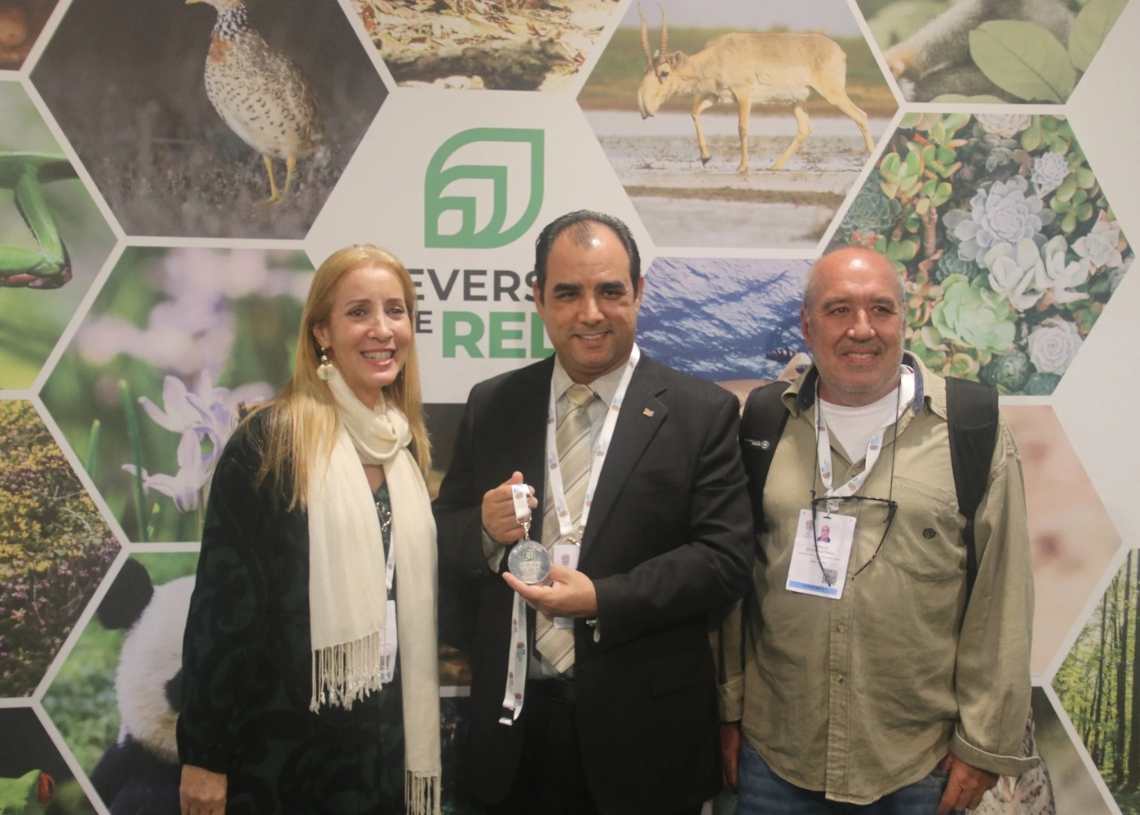
Cuba was awarded the prestigious Reverse the Red International Award 2025one of the highest recognitions in biodiversity, for its National Biological Diversity Program until 2030.
The recognition was presented during the World Conservation Congress of the International Union for Conservation of Nature (IUCN), which has been held since last October 9 in Abu Dhabi in the United Arab Emirates.
The Cuban ambassador to that country, Norberto Carlos Escalona Carrillo, received the award on behalf of the nation, which was also represented by the Cuban delegation of the Antonio Núñez Jiménez Foundation for Nature and Man, headed by its president Liliana Núñez Velis.
Reverse the Red recognizes national efforts to recover species, based on strategies and action plans aligned with international standards.
Cuba received the “NBSAP Reverse the Red 2025” Medal that awards @IUCNin recognition of the excellence of our National Biological Diversity Program, based on science, citizen participation and conservation actions. Congratulations to all our environmentalists! pic.twitter.com/7wBG2R6c0y
— Miguel Díaz-Canel Bermúdez (@DiazCanelB) October 11, 2025
On this occasion, twenty-six countries were distinguished. Cuba stood out for the quality of its National Biological Diversity Plan (EPANB), built on scientific bases, citizen participation and concrete conservation actions.
Within Cuba, the NBSAP is much more than a document: it is part of the comprehensive environmental policy. It is interwoven with the Life Task, the National Environmental Strategy, Law 150 of the Natural Resources and Environment System, and the National Economic and Social Development Plan until 2030.
According to the IUCN, the evaluation was based on criteria such as transparency, scientific rigor, participation of the sectors involved and correspondence with the global biodiversity objectives contemplated in the Kunming-Montreal Global Biodiversity Framework.
This award reinforces Cuba’s image on the international stage as a nation committed to the conservation of its nature in the midst of growing challenges, and underlines the importance of solid environmental policies supported by scientific evidence.