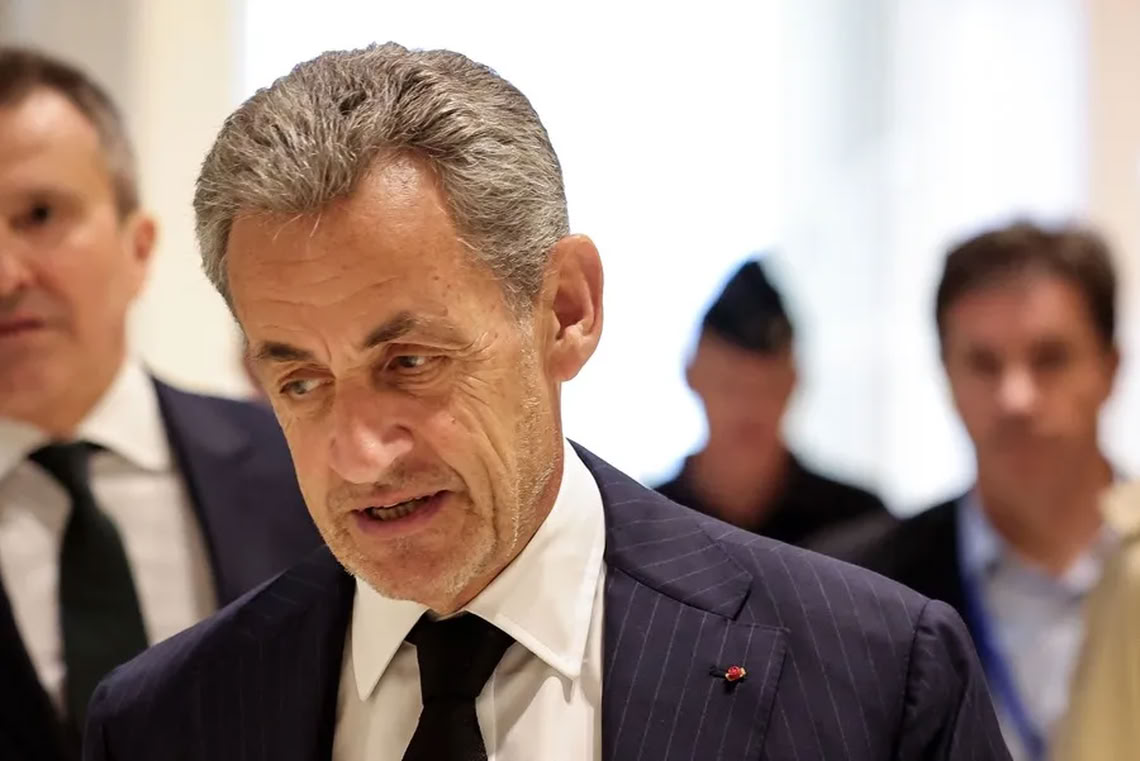
In an unprecedented event, the former president of France Nicolás Sarkozy will enter La Santé prison, Paris, on October 21 to serve a five-year sentence for conspiracy to commit a crime linked to the illegal financing of his campaign in 2007 with funds from the Libyan regime of Muammar Gaddafi.
The news marks a milestone in the history of the Fifth Republic, which began in 1958, when Sarkosy was the first former French head of state to go to prison after leaving the Elysée.
Sources close to the case revealed the date and the prison center to French media after the Paris Criminal Court handed down the sentence in September and the National Financial Prosecutor’s Office notified Sarkozy of the details this Monday.
La Santé and Fleury-Mérogis: location options
The choice of La Santé as a place of execution responds to the need to guarantee the safety of high-profile figures and, according to some reports, could have been part of an evaluation of the appropriate conditions for a high-profile prisoner.
Although there are alternative options, including solitary confinement or vulnerable wards, the judicial office has indicated that the execution of the sentence will be carried out provisionally given the possibility of requesting conditional release measures within the framework of the law.
In this context, Sarkozy could face a procedure to review the conviction on appeal, the process of which could extend for several months. “This ruling is not the end of the story; freedom is subject to appeals and the decisions of higher courts,” said a defense spokesperson, noting that the process will continue on appeal.
Political and legal reactions
The news has sparked intense political debate in France. Sectors of the right and the extreme right have denounced an alleged politicization of justice, while other political actors see the ruling as a consequence of institutional responsibility and the legal processes that accompany public responsibility.
Meanwhile, Sarkozy has maintained his position of innocence and insisted that this is “political revenge” against him.
In a statement released after the September sentencing, he commented: “I am convinced of my innocence and I will defend it with all the legal tools at my disposal. This is not the last word.” His friends and followers have shown their support, underlining his political legacy and his defense of national security and stability.
The appeal and the legal environment
Appeals and appeals can last for months. Sarkozy’s legal team has expressed its intention to present appeals to try to avoid the execution of the sentence or explore possible modalities of conditional release.
The French legal framework provides for the possibility that citizens over a certain age or with specific health conditions may benefit from alternative compliance measures, although the ultimate decision rests with the competent judicial authorities.
The confluence of judicial processes
In addition to this case, Sarkozy could face other pending verdicts related to previous campaigns.
In particular, the judicial sphere is closely observing the Supreme Court’s verdict in the case of illegal financing of his 2012 campaign. Its result could have new repercussions on the former president’s political career.
This episode comes at a time when France, and Europe in general, is going through a period of intense debates about transparency in campaign financing and the accountability of political leaders.
Regardless of the reading of the ruling, Sarkozy’s case has highlighted tensions between the defense of democratic legitimacy and criticism of the instrumentalization of justice for political purposes.
Various analysts point out that the case could influence the upcoming elections and public perception of the institutions.
Immediate days for the former president
In the short term, Sarkozy is expected to actually enter prison and the start of a process to review his legal situation.
In the medium term, appeal trials and possible parole agreements could develop if conditions permit, in addition to continued media coverage and public debate about the role of justice and political accountability.
Furthermore, the case could have implications for Sarkozy’s historical legacy and his influence on French conservatism, of which he is one of its champions.