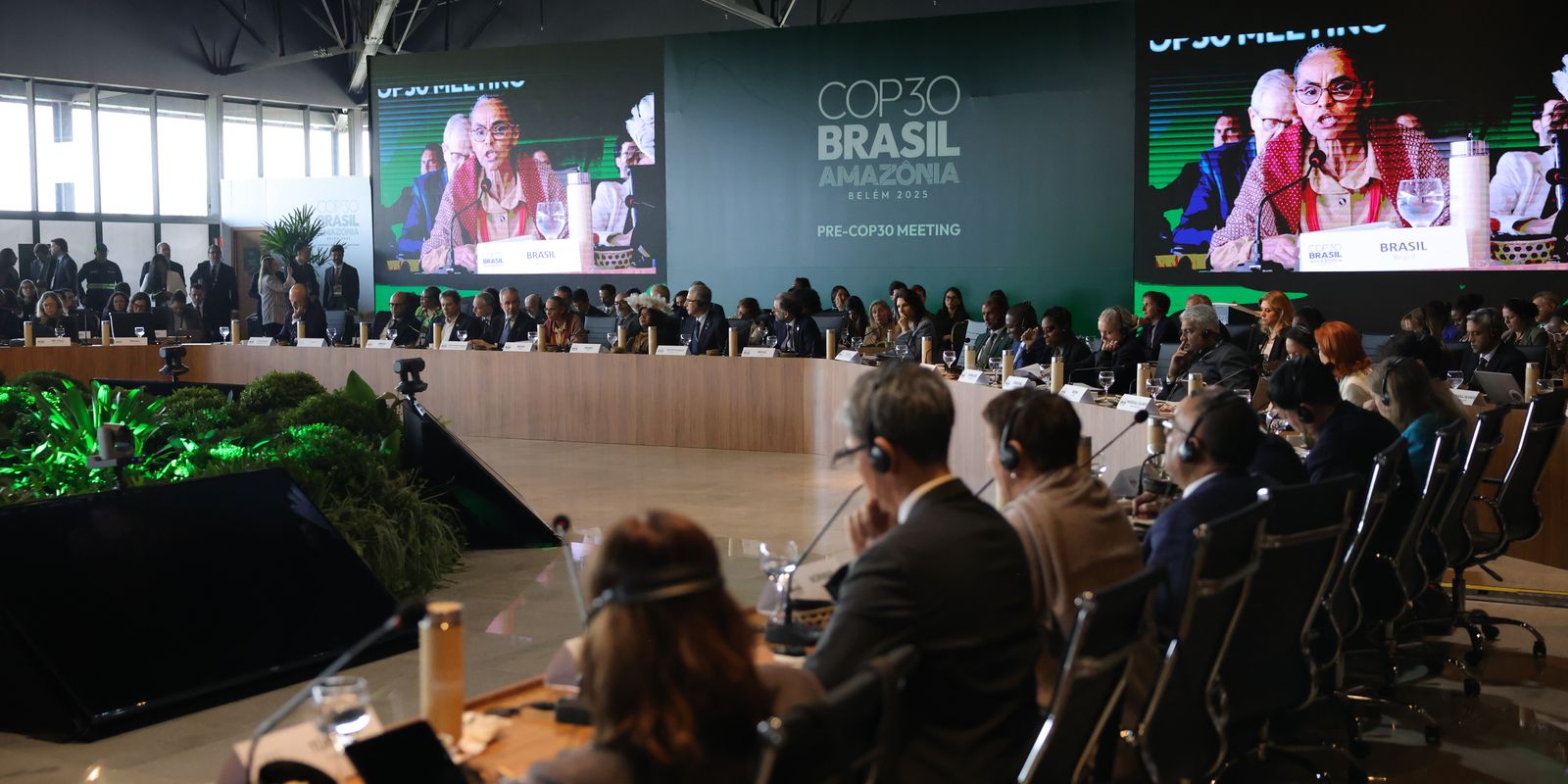
In the first of two days of Pre-COP debates, a preparatory event for the 30th United Nations Conference on Climate Change (COP30), which will take place a month from now, in Belém, the Brazilian delegation highlighted the urgency of financial resources so that the goals of mitigation, adaptation and fair socioeconomic transition can be achieved for the planet in the face of global warming.
The Pre-COP continues until this Tuesday (14), in Brasília, with the participation of negotiators from 67 countriesamong diplomats, ministers and other employees of national governments.
“For decades, we extracted from nature the resources that drove economic development. Now, it’s time to reverse this logic: redirect human, financial and technological resources to preserve, restore and use, in a sustainable way, the natural resources we still have. We need to change before we are changed by the climate emergency”, stated the Minister of Environment and Climate Change, Marina Silva, when opening the segment on Nature and Climate of the Pre-COP, this afternoon Monday (13).
Marina Silva highlighted the estimated need of US$280 billion per year just to protect forests, four times more than what is available at the moment. Another US$16 billion a year is needed, according to her, for ocean conservation.
At the opening ceremony of the Pre-COP, in the morning, the Minister of Finance, Fernando Haddad, who leads the Circle of Finance Ministers, also highlighted the debates about the expansion of climate financing in developing countries as one of the priorities of this COP, especially around the so-called Road Map from Baku to Belém. A political initiative to reach US$ 1.3 trillion in resources per year by 2035.
Reform of multilateral banks, greater flow of investments to those in need and mobilization of the private sector are among the topics of conversation.
Strengthening multilateralism
During the ministerial round table, which brings together representatives of the countries and is not open to the public, the convergence around the need for multilateral solutions, especially on the topic of adaptation, was reinforced, according to the report of the designated president of COP30, ambassador André Corrêa do Lago.
“I think you could feel a great alignment with the desire to strengthen multilateralism, there is no doubt about that. The theme of adaptation was very emphasized. Overemphasized. Adaptation from rich countries to small islands, medium-sized countries, adaptation [foi] general consensus”, he said in an interview with journalists.
To date, 62 countries out of 195 have formally submitted their Nationally Determined Contributions (NDCs), representing just 31% of global emissions.
Large regions that pollute the atmosphere, such as the European Union and India, with delegations present at the Pre-COP, have not yet renewed these commitments, which are precisely those agreed upon since the Paris Agreement, 10 years ago, to ensure that the planet’s temperature does not exceed 1.5ºC by the end of the century.
“It is essential that Pre-COP conversations encourage greater ambition, adequate climate commitments and, above all, the necessary financing to enable real advances”, pointed out Gustavo Souza, senior director of Public Policies and Incentives at Conservation International (CI-Brazil).
Social pressure
Pressure from civil society was also noted at the Pre-COP in Brasília. Representatives of around 40 civil society organizations, from different regions of the planet, delivered a letter to the COP30 Presidency calling for the provision of US$86 billion per year until 2030 in adaptation actions, aimed especially at the most vulnerable communities and susceptible to the effects of climate change.
“COP30 arrives at a historic moment of convergence: science, vulnerable countries and civil society are saying the same thing, it is time to act for adaptation with the same ambition dedicated to mitigation”, said Natalie Unterstell, president of the Talanoa Institute – one of the signatory organizations of the letter.
“Although Belém is already making progress on the topic, with the completion of the Global Adaptation Goal indicators, the implementation of adaptation actions depends on predictable financing. Placing adaptation at the heart of negotiations could make COP30 a watershed in tackling the climate crisis”, reinforced Natalie.
Another point that may emerge from the negotiations that will continue until Belém, also based on pressure from civil society, refers to the demand for the establishment of formal spaces, inside and outside the COP, to facilitate paths for the so-called “Just Transition”, which guarantee a dignified future for communities that will need to transform their ways of life.
The initiative, which is being called the Belém Action Mechanism (BAM), is driven by the Climate Action Network (CAN), a global network of more than 1,900 civil society organizations in more than 130 countries, which work together to combat the climate crisis.
“CAN, unions, feminist groups, the climate justice campaign and youth groups have started to push once again the idea that dialogues are not enough to implement a real just transition. We understand that it is necessary to establish this stable entity”, says Anabella Rosemberg, specialist in social justice and environmental policies at CAN.
The idea of a multilateral mechanism to accelerate and support national transition efforts, facilitating financing and technical support, would be a maturity of the Just Transition Work Program (JTWP), created by the United Nations Framework Convention on Climate Change (UNFCCC) implemented at COP28, in Dubai.
In addition to the institutionalization of this mechanism at the COP, the organizations defend the conceptual standardization of what a Just Transition is, which covers not only the energy issue, but all the social and economic effects that climate transformation is causing.