Despite the entry into force since Friday of the ceasefire agreement between Israel and Hamas, hospitals in the Gaza Strip have received 7 bodies of Palestinians who died in the last 24 hours, in addition to 33 wounded, as reported this Saturday by the Gaza Ministry of Health.
The official balance also includes the recovery of 117 bodies from the rubble during the day on Saturday, victims of previous Israeli attacks.
Gazan authorities warn that there are still bodies trapped under the rubble and in the streets, which rescue teams have not been able to access due to security conditions.
Since the start of the Israeli military offensive in October 2023, the total number of deaths in Gaza amounts to 67,806, including more than 20,000 children, while the injured exceed 170,000. The famine in the north of the enclave has claimed the lives of 463 people, including 157 children.
In addition, Gazan authorities, under Hamas control, have also begun repairing water and electricity services despite the widespread devastation, reopening streets and restoring pipes and sewers.
Generalized drama
The devastation is immense. It is estimated that 85% of Gaza’s territory, measuring just 365 square kilometers, is in ruins.
“Mohammed Dwahreh, 48, took two hours to recognize his house. Finally, among the mountains of ruins, he saw some doors of the same color and shape as those of his home and also identified the remains of some furniture. He had arrived at his old neighborhood, in Khan Yunis, in the south of the Strip,” says a reportage published in the Spanish newspaper The Country.
“God is enough for us, God is enough for us,” Dwahreh repeated to himself. “They destroyed us, they destroyed our homeland, our lives, our homes, our past and our future,” said this father of seven children, sobbing, in front of the ruins of his house.
Disarmament of Hamas
The peace plan, designed by Washington, includes the disarmament of the Islamic Resistance Movement, Hamas, which came to power in Gaza in 2006 through democratic elections.
The Islamist militia assures that no one has the right to take away their weapons while the Israeli occupation lasts, because it will leave them defenseless.
In the memory of many is the massacre of Palestinian refugees in Sabra and Shatila by the Lebanese phalanxes while the Israeli troops, at least, looked the other way. It happened in 1982, just after the then Government of Menachem Begin forced thousands of militiamen from the Palestine Liberation Organization to flee to Tunisia, he noted. The Country.
This Saturday, in an interview with the American network Sky News, one of the members of the Hamas political bureau, Bassem Naim, reiterated that rejection.
“We are not going to be disarmed […] until we have an independent and sovereign State that can defend itself,” Naim said.
In parallel, Israeli Prime Minister Benjamin Netanyahu insists almost daily that he will never allow its creation and this Saturday he made it clear that, if Hamas does not accept disarmament “the hard way”, Israel will take care of doing it “the hard way.”
Israeli troops partially withdrew on Friday to the so-called ‘yellow line’ of Trump’s plan, controlling more than 53% of Gaza territory but abandoning most urban areas, such as the capital or the Netzarim corridor that isolated it from the rest of Gaza.
However, the occupiers are still present in Rafah (south), but also in the little that remains standing in the northern cities: Jabalia, Beit Hanun and Beit Lahia, among the cities hardest hit by the Israeli offensive.
Humanitarian aid arrives in Gaza
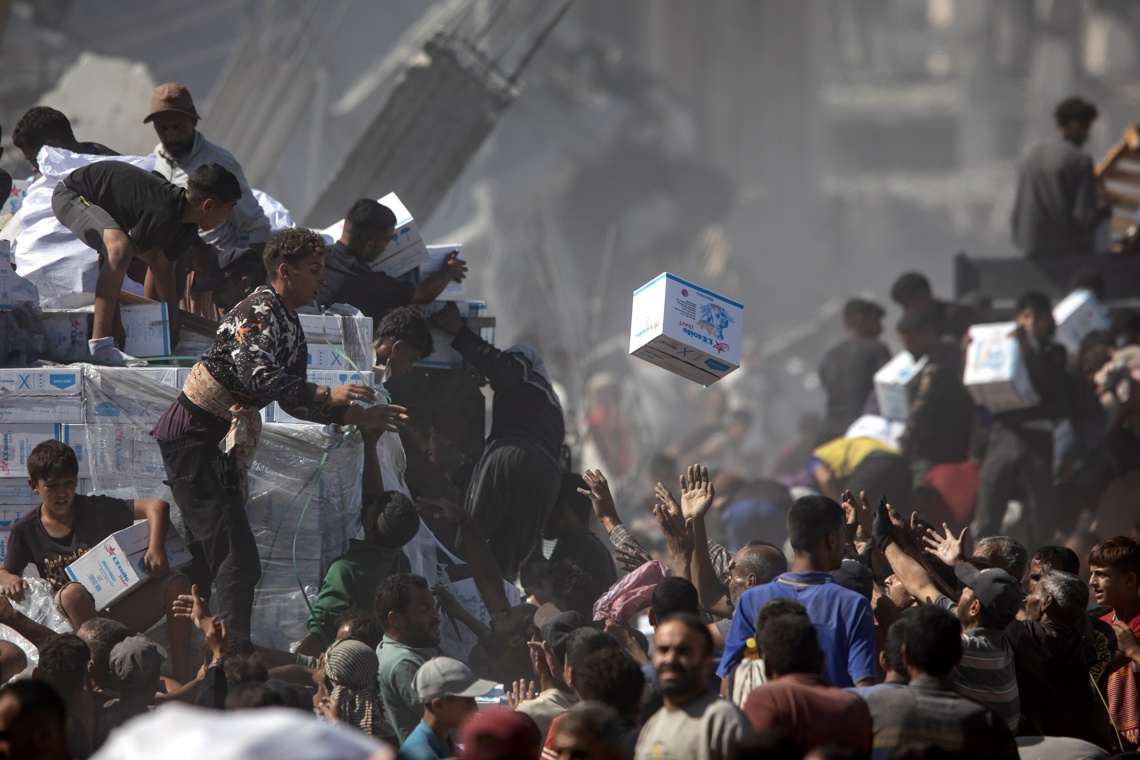
In an effort to alleviate the humanitarian crisis, hundreds of trucks with aid began entering the Gaza Strip from Egypt this Sunday, in compliance with the ceasefire agreement.
According to Egyptian media, some 400 trucks loaded with food, medicine and other supplies are expected to cross the Kerem Shalom and Al Awja border crossings, controlled by Israel.
This is the largest amount of aid that has entered Gaza since the start of the conflict. In addition, tankers with fuel have been observed preparing to cross into the enclave, which could improve the living conditions of thousands of Gazans facing electricity and water cuts.
International summit in Egypt
Egypt will host an international summit this Monday in Sharm El-Sheikh, with the participation of more than 20 world leaders, including the president of the United States, Donald Trump, who will speak in the Israeli parliament (The Knesset) this Sunday.
The goal of the meeting is to reach an agreement to end the war in Gaza and move towards a lasting political solution.
The city of Sharm El-Sheikh was the scene last week of indirect negotiations between Hamas and Israel, which allowed the ceasefire agreement and the exchange of prisoners to be reached.
Egypt, along with Qatar, Türkiye and the United States, has played a key role as a mediator in these diplomatic efforts.
Meanwhile, Pope Leo
The Holy Father’s words took place this Sunday after the Mass for the Jubilee of Marian Spirituality, in which he also asked for “a just, lasting peace that is respectful of the legitimate aspirations of the Israeli people and the Palestinian people.”