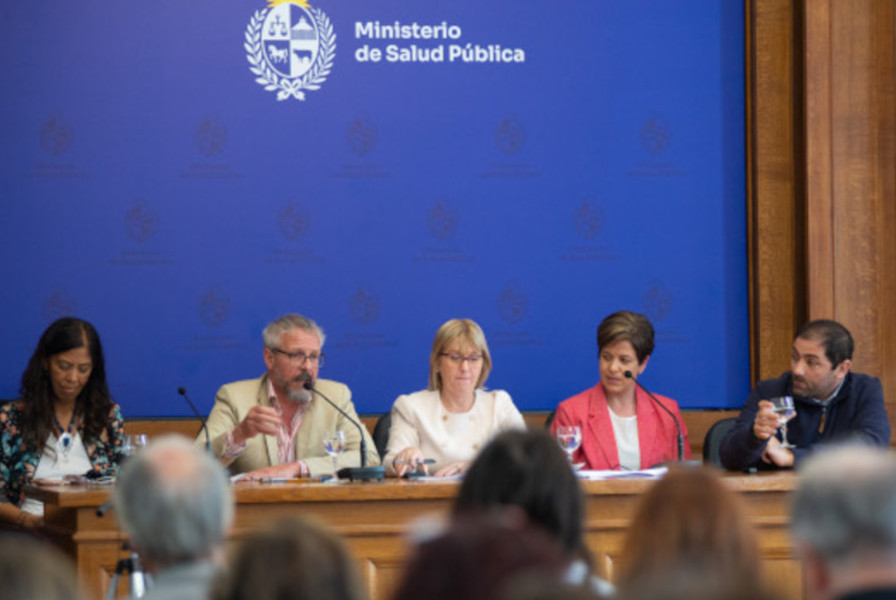
According to data from the study carried out by Cifra, 24% of the population is at the highest level of the loneliness index and 29% shows a low perception of well-being. Lustemberg pointed out at a press conference that “those under 30 years of age are the ones who feel the most alone,” and that among them 28% declare some loneliness and 35% “a lot of loneliness.”
The minister explained that the perceived problems vary depending on age. In those over 45 years of age, depression appears as the most mentioned disorder, while anxiety predominates among young people.
“These data will allow us to make decisions that improve access and quality,” he said, while highlighting that the ministry works together with the National Public Education Administration, the Ministry of Social Development and the Ministry of Education and Culture to address mental health from an intersectoral approach.
During the presentation of the data, Lustemberg referred to the difficulties of accessing the system and the waiting lists in mental health. He reported that, currently, there are some units of the State Health Services Administration (ASSE) with a waiting list of 30,000 people to be seen by a mental health team.
“What cannot happen to us is that we have places without the human resources to deal with these situations,” he expressed.
The report presented by the Ministry revealed that 13% of the population declares they have a problem linked to mental health, while another 13% stated that the problem is suffered by another member of their household.
Almost all of those who reported having a problem consulted a health professional, mainly psychologists or psychiatrists, although those who seek care at ASSE must wait longer to get a consultation.
More than 300 initiatives will design public policy on mental health
This initiative is part of the national strategy defined to organize, articulate and strengthen public mental health policies with the active participation of organizations, groups and actors working in the territory. Along these lines, the Ministry of Public Health (MSP) convened mental health organizations, institutions and groups from all over the country. The objective was to compile their experiences in the territory so that they participate in the design of public policies based on human rights, equity, universality and non-stigmatization.
The 300 projects that registered will participate in discussion groups and outline specific lines of action that will be presented on November 10.
The Minister of Public Health highlighted that the national government’s priority is to address mental health challenges in a comprehensive and sustainable way, through community participation and intersectoral coordination. In this sense, he indicated that the integration of users, workers, academia and all government entities involved is essential for the design of this public policy.
Likewise, he assured that the National Budget project assigned priority resources for this area with the objective of building the new care model promoted by the Mental Health Law, thus ensuring that all Uruguayans have comprehensive and quality care. “The design of the national budget does not make sense if it does not contemplate a significant change in the quality of life of Uruguayans,” he assured. And he indicated that they seek to expand coverage, create alternative devices to hospitalization throughout the territory, strengthen the first level of care to address acute problems and develop specific departmental plans that respond to local needs, for which a general coordinator will be appointed for each department.
Regarding Country Action, he stressed that it has the purpose of generating real transformations in the short, medium and long term, with a focus on rehabilitation, comprehensive care and equity in access to these benefits. He added that it is essential to build together and draw on community experiences that have proven to be successful.
UyPress – Uruguayan News Agency