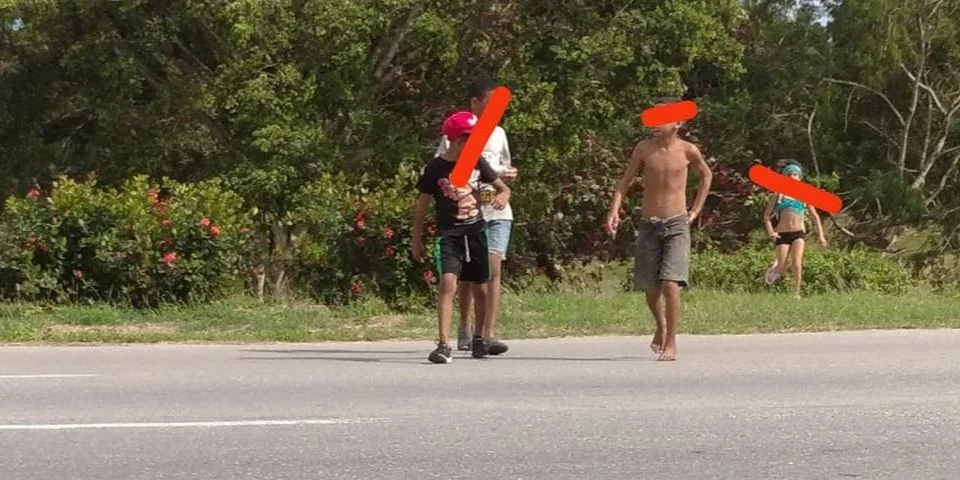
On the streets of Cuba, especially in tourist areas, an uncomfortable reality becomes increasingly visible: children and adolescents asking for money or food.
HAVANA, Cuba. – Child begging, a phenomenon that the Cuban regime has historically denied or minimized, is unquestionable today. Many minors are found wandering to get money or food in different areas of the city, not necessarily tourist areas or main roads.
Behind these, there are desperate or opportunistic families and a failed social protection system, added to an economic crisis that pushes the most vulnerable to the most stark survival.
According to the National Office of Statistics and Information (ONEI), year-on-year inflation in Cuba closed 2024 at 24.88%. This in a country where food shortages are increasing and salaries for the most part do not exceed 7,000 pesos per month.
According to the annual report (2024) on child nutrition in the world, from the United Nations Children’s Fund (UNICEF), 9% of children in Cuba suffer from food poverty.
This agency of the United Nations Organization defines child food poverty as the inability of children to obtain and consume a nutritious and varied diet in early childhood (that is, in the first five years of life).
Added to this is that extreme poverty escalated in Cuba, in 2024, to 89% of the population, according to estimates from the Cuban Observatory of Human Rights (OCDH).
“My nine-month-old son and I sit on any busy street to ask for money or food, because it is not enough for me to support ourselves with what Social Security gives me,” confesses Yanay, a 19-year-old woman from Havana, with no academic studies or fixed job location. “Sometimes the most I can get is bread or a little rice given by those who pass through the area around the Sports City,” he adds.
At different points on 26th Avenue, especially near businesses and traffic lights, it is common to see it. His clothes, faded and damaged, bear obvious marks of prolonged use.
“Life hasn’t been easy,” she confesses as she gently rocks her young daughter astride her.
While she looks attentively at everyone around her, she tells of her “misfortunes,” including giving birth. “I’ve never thought about getting rid of it.” [de su hija]. I have even prostituted myself with men, all Cubans, who have offered me fruits, food and money – 2,000 pesos maximum,” she clarifies.
Their home, in one of the so-called “come and go” areas of the capital, lacks many basic amenities. The boards pretending to be walls show cracks; The small space is reduced to the essentials: a bed, a small stove on a paint tank and some kitchen utensils and clothing.
“With what people give me on the street and some occasional work cleaning floors, I’m surviving,” he explains. “The hardest thing is not being able to offer my daughter what she deserves, like peace of mind.”
Minors in the streets: between abandonment and exploitation
Although there are no official figures, non-governmental organizations and independent media report that hundreds of children in Cuba are homeless or begging. Some do it accompanied by their parents; others, alone, exposed to dangers such as sexual abuse.
On the Malecón in Havana, Michel, 12 years old, says that he has been asking for money or “sneering” for almost a year. “Sometimes they give me, at most, 100 pesos or food that passers-by take from their containers. I’m from Batabanó, but I hang around the entire La Rampa area and I sleep in a garage near Línea and L.”
“Where are your parents?” I ask him.
―My mother lives with my stepfather. They made my life impossible. They demanded that he look for money and nothing else. She defended him when I complained about his offenses and treatment.
-Have you received government or authority help? I insist.
-Not at all. Only the police harass me and make me run from one place to another.
The Cuban regime insists that its social protection system guarantees child well-being. However, programs such as the Children’s Homes without Family Protection are insufficient or are marked by poor admissions procedures.
Children who beg on the streets not only lose education, but also childhood.
As long as the Cuban Government continues to boast about its supposed “achievements” and does not launch real policies that combat poverty, child begging will continue to grow, and with it, a forgotten generation.
Many of those who beg today are victims of a vicious cycle of poverty that transcends politics. Entire families, without support networks, fall into this situation out of extreme necessity, not by choice.
The question then arises: Where are the social workers, created with so much fanfare by the State to “protect families”? What do the CDRthe FMC and other mass organizations, which in theory should ensure community well-being?
While state institutions are conspicuous by their inaction, civil society is trying to fill the void. Churches, independent activists and other solidarity groups organize distributions of food and basic necessities, although their activists are often persecuted or accused of “destabilizing” internal order. Their work, silent but constant, is the only relief for many Cuban families.