3 of 5|
Christopher Columbus When on August 3, 1492 he began his journey from the town of Palos in Huelva, across the Atlantic Ocean, he had a clear destination in his mind: that he would reach an unknown continent.
The admiral had privileged information about the existence of that continent, because he had access to maps and nautical charts from the archive of his father-in-law Bartolomeu Perestrello, who was a Portuguese nobleman and an expert navigator.
Perestrello was knowledgeable about Atlantic navigation, the colonization of islands and routes to Africa.
You may also be interested in:
With all this data gathered and his contacts with the circle of Portuguese explorers, Columbus was certain that by sailing west he would reach islands rich in gold and silver and with human beings who could be used as slaves.
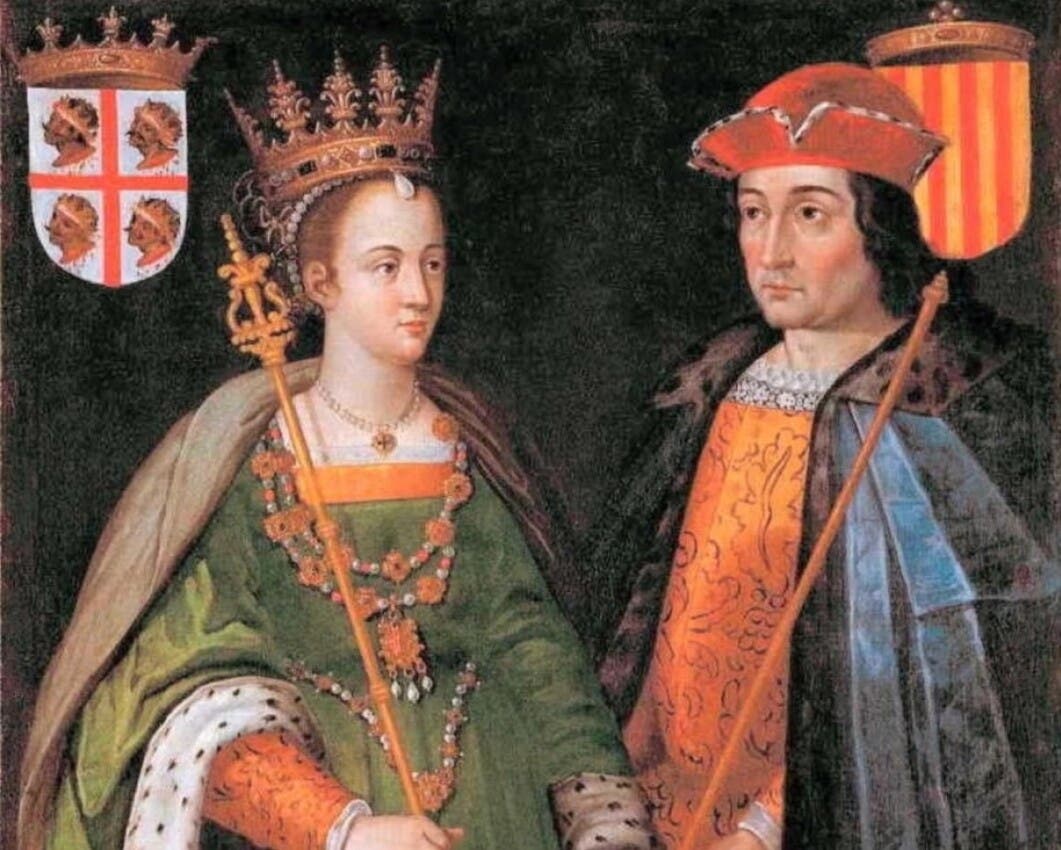
He was not in search of spices nor on a shorter maritime route to reach the East, Asia, which was the project that the navigator promised to the Catholic kings, Queen Isabella I of Castile and King Ferdinand II of Aragon, whose marriage in 1469 dynastically unified their kingdoms and marked the beginning of the formation of Spain.
It was the 15th century and the Catholic Monarchs sponsored Columbus’ project because they were very interested in finding a closer route to reach Southeast Asia (the Moluccas Islands) and India, at that time the center of the spice trade, where valuable products such as cloves and nutmeg came from.
These demands for spices reached Spain through complex land and sea trade routes that crossed the Middle East, and which had been complicated by Ottoman control of Constantinople, forcing that country to seek new routes to Asia.
Spain (still with separate kingdoms: Castile and Oregon) and Portugal competed in the 15th century for the control of maritime trade routes, territorial expansion and the search for new sources of wealth, especially in the Atlantic and Africa, which led to a direct rivalry for colonization and economic supremacy in Europe.
Portugal’s objective was to divert the spice trade towards the Atlantic bordering Africa, while Castile entrusted Columbus with finding new routes to Asia.
Both powers sought to gain a commercial advantage and monopolize trade routes to Asia. Portugal had already explored much of the African coast, while Spain sought to establish itself in other areas, especially after sponsoring Columbus’s voyage.
This competition was also for control of new lands and obtaining political and economic power in Europe.
The Portuguese already had significant experience in Atlantic exploration, including the colonization of the islands of Madeira and the Azores, and had explored the African coast as far as the Cape of Good Hope.
Columbus was a skillful negotiator who exaggerated and hid information to convince the Catholic Monarchs to approve his project.
He boldly presented a shorter and more viable trip than it actually was, with erroneous but convincing figures to gain support.
In his memorials to the Catholic Monarchs and in the Capitulations of Santa Fé, which was signed in 1492, he offered the monarchs direct access to the Indian women and their riches of spices, gold and slaves.
According to many historians, Columbus knew he was lying, but he did it strategically so that they would accept his trip.
Several modern historians maintain that Columbus knowingly falsified or manipulated his calculations to convince the Catholic Monarchs. Among them we have the American naval historian Samuel Eliot Morison, author of the book Admiral of the Ocean Sea, in 1942. Morison points out that Columbus deliberately reduced the figures of the earth’s circumference and the distance to Asia to make his project viable.
The Spanish historian, a specialist in Columbus, also affirms that the navigator hid and arranged the data to make his plan attractive.
For his part, the Spanish professor and historian Juan Manzano y Manzano, author of the book Columbus and his Secret, 1976, wrote that Columbus knew perfectly well that he was not going to reach Asia and that he was hiding a secret about the existence of intermediate lands, inspired by rumors or maps.
In historical terms it can be said that Columbus was not completely honest with the Catholic Monarchs, because he faked data for them to approve his company and other more radical ones point out that he was an agent of the King of Portugal, John II, and that he had the task of diverting the attention of the monarchs in their desire to achieve a closer route to Asia.