
In groups and on social networks, teachers from Rio de Janeiro, both from the capital of Rio de Janeiro and from other cities in the state, exchange information about private schools. In addition to publicizing job opportunities, they warn each other about institutions from which, as the messages say, teachers should escape. Agência Brasil had access to a list circulating in the groups, with more than 100 schools that pay late or fail to pay salaries and other labor charges to teachers. The list even includes schools in the south zone, a prime area of the city of Rio.
Next to the schools there are comments that specify non-compliance with labor standards such as:
“Pays late, makes you sign as if you had received it correctly and the owner practices moral harassment”; “doesn’t sign a card… is late and doesn’t pay… the coordinator who makes Pix directly from his personal account”; or “Run away, don’t pay, when a teacher shows up to collect unpaid wages, the owners leave the school before the teacher shows up.”
An expanded version of the list, which has been circulating since at least 2024, contains more than 150 schools, but many of them have already closed their doors. Most of those still listed as in operation are located in the north of Rio.
Professor João* is one of the teachers who faced delays in payments. He says that he has already been to two institutions that did not pay due labor charges. The first one that worked accumulated successive delays until it closed its doors for good. “We worked for free”, he reports.
“This leads to high turnover at the school. They don’t pay their salaries. Teachers end up resigning and students have more than one teacher in the same year. This is also bad for students’ teaching and learning,” he says.
The second school, in the south of Rio, also delayed payments. The educational institution’s monthly fee starts at 2.4 thousand per student. The teacher’s salary for the entire month worked is almost the same, R$2,500. He also says that neither of the two schools even paid for transportation to get to the classrooms. “At both schools, I had to pay to work.”
Working conditions
According to the Teachers’ Union of the Municipality of Rio de Janeiro and Region (Sinpro-Rio), João’s situation is not isolated. Currently, the union is filing 36 collective and around three thousand individual lawsuits due to non-compliance with labor standards in both schools and colleges, all private.
For the director of Sinpro-Rio Afonso Celso Teixeira, not valuing teachers is treating education as a commodity.
“It is a problem that we are facing and that is even causing teachers to become mentally ill, because when you consider education as a commodity, treat students and their families as customers who are consuming a product, you no longer have the issue of human relationships and the liberating aspect of education”, he says.
In 2022, the Rabbit Group, which provides consultancy in educational management released a survey which shows that, on average, teachers in private schools receive salaries lower than the national minimum for teaching in public schools. That year, the minimum was R$3,845. The lowest average salaries, in private institutions, among early childhood education teachers, for example, was R$2,250.
“It’s disrespectful to the profession”, reinforces Teixeira.
Debt of private schools
In Brazil, around one in every five (20.2%) students is enrolled in a private school, according to data from the 2024 School Census. While enrollments in public schools decreased by 0.4% compared to 2023, enrollments in private schools increased by 1%. Rio de Janeiro appears in second place with the highest percentage of students in the private network (30.9%), behind only the Federal District (32.3%).
Despite the expansion of the sector, not all schools are doing well financially, according to the president of the Intermunicipal Federation of Unions of Private Educational Establishments of the State of Rio de Janeiro (Fisepe/RJ), Lucas Machado. He says that each school has a specific situation, depending on the region where it is located, the socioeconomic profile of the students it serves and the size of the educational institution itself.
According to Machado, in Rio de Janeiro, 70% of schools are considered small, that is, they have less than 300 students. “It is clear that the difficulty of these small schools is greater even in terms of economic capacity”, he says.
This, however, according to the president of Fisepe/RJ, is not a reason to devalue teachers. “The teacher there is a key player in us being able to do a good job in these schools. So, if you get to the point of having some type of debt with that teacher, whether it’s delayed salary or a benefit that isn’t being fulfilled, that school is already in the debt process.”
Application of fine
Delay in paying employees constitutes a labor irregularity and the school may be fined and may even have to pay double the late salary, according to the Public Ministry of Labor in Rio de Janeiro (MPT-RJ).
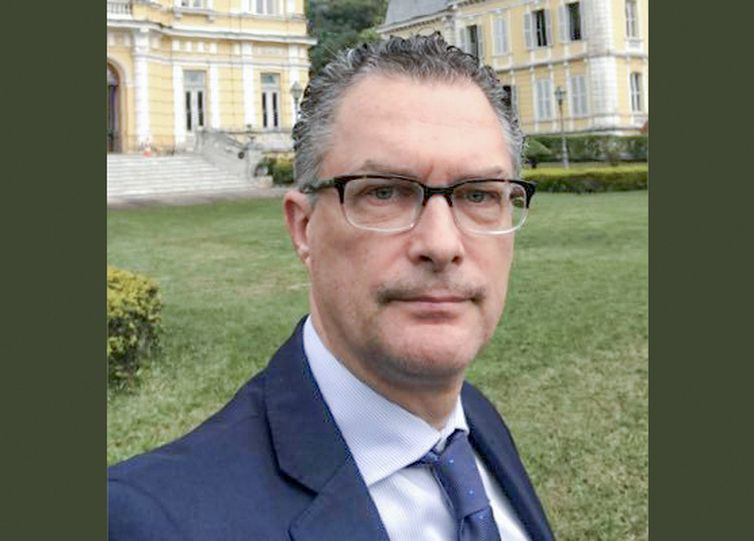
Brasília (DF) 10/10/2025 – For MPT-RJ promoter Cassio Luis Casagrande, salary must be paid by the fifth working day after the end of the month worked. Photo: Cassio Luis Casagrande/X – Cassio Luis Casagrande/X
“The salary must be paid by the fifth working day after the month worked. If there is a delay of more than these five working days, there is already an irregularity and the school can be fined by the Ministry of Labor”, says MPT-RJ labor prosecutor Cassio Luis Casagrande.
“The school may be ordered to pay double outstanding salaries. Because non-payment of salaries, if not paid in court, results in double payments, with a 100% fine”, he adds.
Casagrande emphasizes that teachers are workers like any other and that, therefore, they are subject to the same laws and protections. They therefore have the right to demonstrate and strike.
“Regardless of whether it is a school or not, labor legislation will be applied,” he says. “There is no different treatment in the law because they are teachers, including for strike purposes. Teachers can go on strike in private schools, there is no obstacle”, he explains.
What can be done
Sinpro-RJ’s guidance for teachers who are in this situation is to contact the union. The entity will be responsible for listening to teachers to understand the situation and provide the appropriate referral for each case. The union will also seek out each school to try to negotiate. If this doesn’t work, the way forward will be to open a lawsuit and, if necessary, activate the MPT.
“If the school wants to solve the problem, but is not in a position to do so immediately, we will negotiate, trying to reach a proposal that is considered reasonable”, says the director of Sinpro-Rio Afonso Celso Teixeira. He adds that those who have the final say are the teachers, who will judge whether the proposal meets their needs.
Having the union’s intermediation can help in fulfilling the agreements, according to the director. “Why is union mediation important? Because if the school doesn’t comply, we always impose a fine for non-compliance, as the contract is approved in court”, he explains.
On the schools side, Fisepe/RJ also recommends that institutions seek out employers’ unions that operate in the region, as they will obtain legal, accounting and economic guidance. “Unions have the possibility of providing and training educational entities for better decision-making”, says the president of Fisepe/RJ, Lucas Machado.
Machado adds that the problems caused by non-payment can be many, as can the possible solutions. “One thing is the problem of lack of students, that’s a problem, another thing is a problem of debt due to tax issues, it’s another completely different conversation. We would need, case by case, to identify what the problem is”, he says.
The non-payment of teachers’ salaries is, according to him, an extreme measure. “If there is a margin for the possibility of cost cutting, this margin has to be seen first. Not paying your teacher is an extreme issue. And the extreme issue has to be negotiated in an extreme way as well. With the help of the unions’ advisors, a better decision can be made”, he emphasizes.
MPT-RJ labor attorney Cassio Luis Casagrande explains that the MPT is activated when there is a collective problem, a mass dismissal, for example, and non-payment of due charges. The body does not act in individual situations.
“In this situation [coletiva]workers who have been affected, either because they are not receiving a salary or because they were fired without receiving labor funds, they can file a complaint at the website of the Public Ministry of Laborreporting the facts and identifying the employer. A civil inquiry will then be opened to investigate whether this is actually happening”, he advises.
*The name of the teacher has been changed to protect the identity of the interviewee