Venezuelan opposition leader María Corina Machado She is the new Nobel Peace Prize winner.
The Norwegian Nobel Committee awarded him recognition this Friday “for his tireless work in promoting the democratic rights of the people of Venezuela.”
María Corina Machado Parisca, 58, is the main voice of resistance to the Chavista government led by Nicolás Maduro and which has governed Venezuela for decades.
There have been arrest warrants and threats against Machado, while she has been disqualified from holding public office.
However, these obstacles have not prevented her from continuing to exercise politics, until she finally established herself as the undisputed leader of the opposition in Venezuela.
From hiding, where he has remained since the elections of July 28, 2024, he reacted to the award by saying that he had no words for such news.
“Thank you very much, but I hope you can understand that this is a movement, this is an achievement of an entire society, I am just one person, I definitely do not deserve this.”
At BBC Mundo we review 3 milestones that define the political career of the so-called “black beast” of Chavismo, now recognized with the Nobel Peace Prize.
1. The meeting with George W. Bush
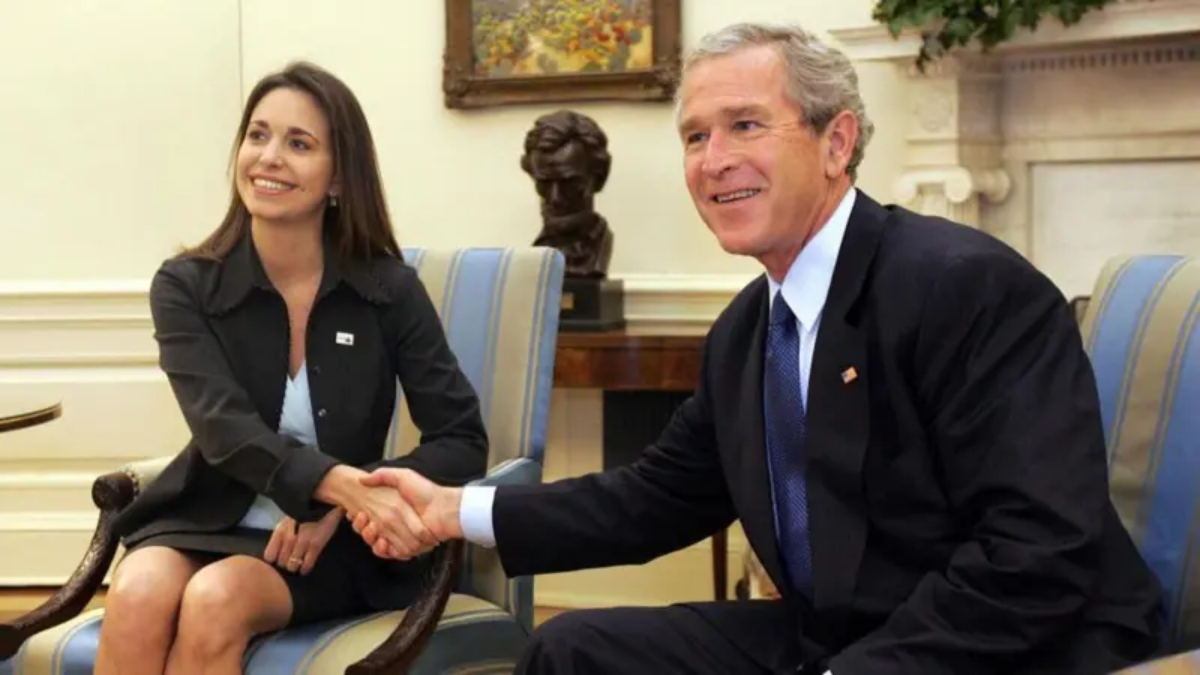
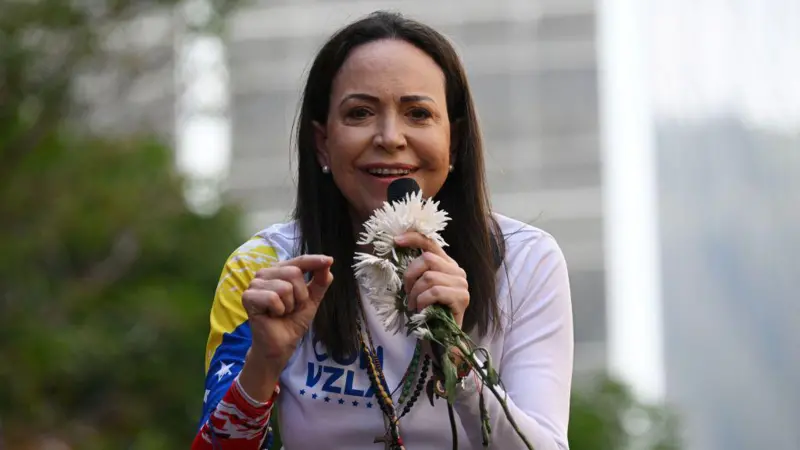
In 2005, Machado, then 37 years old, was received by US President George W. Bush in the Oval Room of the White House.
An industrial engineer with a specialization in finance, Machado attended that meeting as founder and director of the non-governmental organization Súmate, which she founded in 2002 to defend civil rights in Venezuela.
The image with Bush put Machado in the crosshairs of the Venezuelan government, which at that time was led by Hugo Chávez.
From that meeting, the ruling party accused her of being at the service of the CIA and of collaborating with the “imperialist coup” that according to Chavismo is carried out by the United States, a country where Machado lived and with which he maintains political ties and connections to the present.
The Venezuelan government also accused her of illegally receiving money from US foundations and banned her from leaving Venezuela for three years.
After the photo with Bush, the opponent became increasingly prominent in Venezuelan politics.
Five years later, in 2010, she was elected as a deputy to the National Assembly in elections in which she obtained the highest number of votes.
And in 2011 she ran as a candidate in the primaries of the opposition platform Democratic Unity Roundtable, which she lost to opposition leader Henrique Capriles in 2012.
That same year he founded the Vente Venezuela party and starred in another moment that was recorded in the memory of Venezuelans.
2. The duel with Chávez
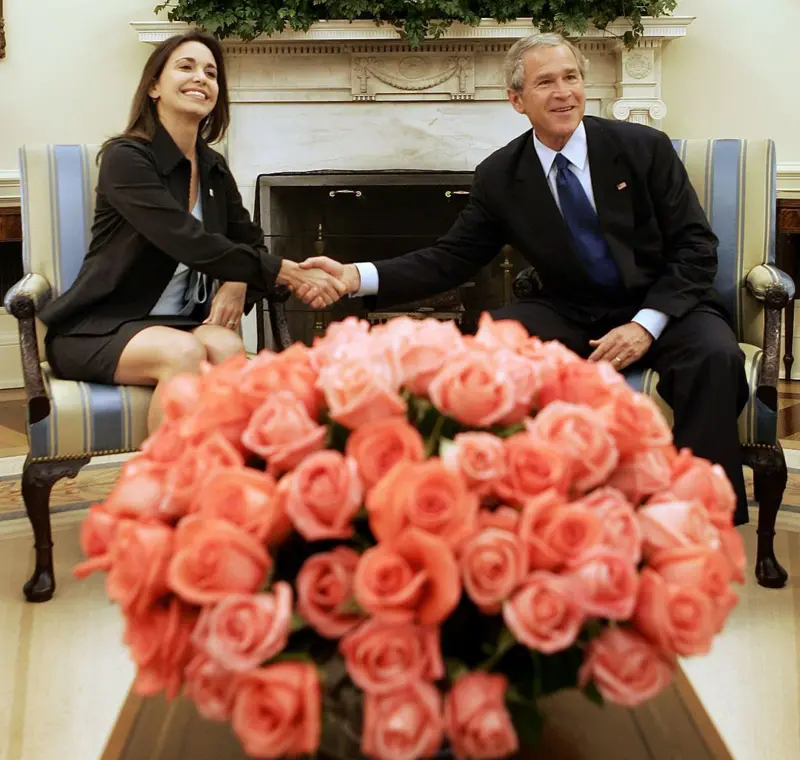
During a parliamentary session, from his seat and after an eight-hour speech by Hugo Chávez, Machado took the microphone and interrupted the then president.
“President, we have eight hours listening to you describe a country very distant from what all Venezuelan women and mothers are feeling,” said Machado while being booed by the Chavista bench.
“How can you say that you respect the private sector in Venezuela when it has dedicated itself to expropriating, which is stealing?” he continued. “Their time is up, it is time for a new Venezuela.”
From the speaker’s lectern of the National Assembly, Chávez responded: “I first suggest that you win the primaries. Win the primaries first, because you are out of the rankings to debate with me.”
Amid the applause and ovations of the Chavista deputies, the president said: “Since you even called me a thief, you called me a thief in front of the country, I am not going to offend you. Eagle does not catch flies, deputy.”
For years, Machado has been known for her strong opposition to Chavismo and was involved, for example, in the controversial session in which several parliamentarians were beaten in 2013.
At that moment, Machado was injured in the face and reported that she had been attacked by a Chavista deputy, while the then president of Parliament and now Minister of the Interior, Diosdado Cabello, witnessed the beating.
Machado was one of the first to describe Maduro’s government as a “dictatorship”, rejected attempts at negotiation with the ruling party and even defended the use of force to remove the president from power.
These calls frequently made her the target of criticism within sectors of the Venezuelan opposition, who saw her as a radical.
In his strategy of maximum pressure on the Maduro government, he promoted political initiatives such as the protests in 2017 and 2019, along with other opposition leaders such as Leopoldo López.
She was nicknamed “the iron lady” for insisting on remaining in Venezuela despite threats of arrest.
As opposition leaderships such as Capriles, López or Juan Guaidó wore down, Machado emerged as the last and clearest card to confront Maduro.
He has recently expressed his support for the military operations ordered by President Donald Trump off the coast of Venezuela.
“This is about saving lives. Not just Venezuelan lives, but American lives,” he told Fox News last month, after the United States began bombing boats suspected of transporting drugs.
3. The 2024 voting minutes
Despite being disqualified from holding public office and being a candidate, Machado toured Venezuela from end to end during the months prior to the July 28, 2024 elections after winning the opposition primaries, as Chávez had demanded years before.
She was received in streets packed with people who supported her, along with the official opposition candidate, Edmundo González Urrutia.
For the first time in many years, and partly thanks to Machado’s leadership, the opposition came to the race in a unified manner.
For critics of the Chavista regime, it was a unique opportunity for a change of government.
But on July 28, the National Electoral Council, controlled by the ruling party, declared Maduro the winner.
These elections, whose minutes were not published by the electoral authority, are rejected by the opposition and Machado, who managed to prove that they were the winners, with the publication of more than 80% of the electoral ballots.
International organizations and multiple governments therefore question Maduro’s supposed victory.
Since then, numerous protests have broken out against Maduro in Venezuela.
Thousands of people were arrested under NGO complaints that many detentions were arbitrary.
And the ruling party began a campaign against Machado and González.
The opposition candidate went into exile in Madrid, Spain, and Machado continued to live clandestinely in Venezuela.
The Nobel Peace Committee noted that from there he inspires “millions of people.”