The recent update by Dane on monetary and extreme monetary poverty, with a gender focus in Colombia, confirmed that this scourge is not distributed equally in the regions, nor between men and women, and that the debates that have taken place in the country on the autonomy of departments and municipalities, or about female empowerment, require a deeper vision of their origins.
According to the statistical authority, the highest levels of poverty continue to be concentrated in the same territories and among the same groups; leaving women, indigenous communities and Afro-descendants, and migrant households; as the main protagonists in this issue.
More information: Anniversaries: 50 years ago the first ATM was installed in Colombia
Likewise, it shows that structural gaps remain, especially in the Caribbean and Pacific regions, where female heads of household face the greatest difficulties in overcoming the poverty line.
Women, the hardest hit
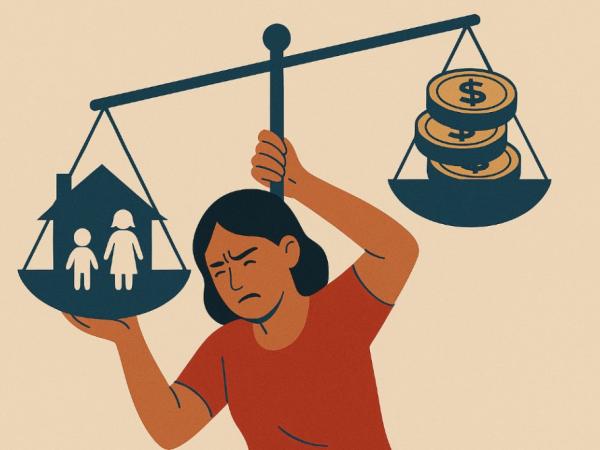
At the national level, monetary poverty in 2024 affected 28.4% of households headed by a man and 36.1% of households headed by women, which means a gap of 7.7 percentage points. In simple terms, Colombian women are significantly more likely to live in poverty, even when they work or are heads of households.
Poverty in Colombia continues to affect women more.
Image from ChatGPT
The differences are even deeper in the cities of the Caribbean and the Pacific; where Dane found that Quibdó registered the highest gap between men and women, with 17.5 percentage points of difference, followed by Riohacha (16.4), Valledupar (15.4), Cartagena (15.3), Florencia (15.1) and Popayán (13.4); while Bogotá was the capital with the smallest gender gap, with 3.4 percentage points.
On the other hand, in the national aggregate, the monetary poverty gap between sexes is replicated in extreme poverty, given that while households headed by men registered an incidence of 9.8%, those directed by women reached 14.0%, with a difference of 4.2 percentage points.
You may be interested in: Colombia would be on its way to its fifth year outside the inflation target range
The situation worsens in rural areas and in historically lagging departments such as Chocó, for example, where the gender gap in extreme poverty reaches 18.8 percentage points, one of the highest in the country. Similarly, in Cauca, although the levels of extreme poverty are lower, inequality between men and women persists, with a 2.5 point difference.
The report also shows that, in terms of general monetary poverty, the greatest contrasts They are presented in Caquetá (17.7 points), where women heads of household face almost twice the probability of living in poverty compared to men; confirming a kind of “feminization of poverty”, since households led by women endure more precarious economic conditions due to labor inequalities, educational barriers and unpaid care responsibilities.

Poverty in Colombia continues to affect women more.
Image from ChatGPT
Ethnic inequality: a historical debt
Dane’s analysis also addresses the ethnic-racial component, and the results reveal that poverty continues to have color and territory; given that in 2024, 59.8% of the indigenous population in Colombia was in a condition of monetary poverty, compared to 42.6% of the Afro-descendant population and 29.5% of people who do not recognize themselves as belonging to an ethnic group.
Simply put, the gap between indigenous people and the non-ethnic population was 29.2 percentage points, while the difference between Afro-descendants and the non-ethnic population was 13.6 points; generating a pattern that is repeated in a good part of the departments of the Pacific coast, the southwest and the Caribbean, which concentrate the greatest inequalities.
Check here: Electoral Peace Marathon: commitments for the 2026 elections
Here it is worth mentioning that Chocó, with an incidence of 96.3% among the indigenous population and 59.4% among the Afro-descendant population, presents the highest gap in the country, with a 56.2 pp difference compared to those who do not identify themselves ethnically. In Boyacá, where 85.7% of the indigenous population lives below the poverty line, the gap reaches 13.6 pp, while in Córdoba and Santander the differences exceed 14 percentage points.
When extreme poverty is analyzed, the gaps widen even more, since 38.1% of indigenous people and 18.9% of Afro-descendants live in extreme poverty, compared to only 9.8% of the population without ethnic self-recognition; while the indigenous gap reaches 28.3 percentage points, and the Afro-descendant gap, 9.1 points.

Poverty in Colombia continues to affect women more.
Image from ChatGPT
In this part, women, again, concentrate the highest levels of vulnerability if it is highlighted that in indigenous households headed by women, monetary poverty was 4.9 percentage points higher than that of those headed by men and that among Afro-descendants, the gap rises to 15.1 points.
Poverty in transit
The third component of the report addresses the situation of the migrant population, a group that, in the last decade, has transformed the demographic and labor composition of the country. According to Dane data, in 2024 monetary poverty among migrants was 42.5%, which is equivalent to a gap of 10.9 percentage points compared to the non-migrant population (31.6%) and In the case of Venezuelan migrants, the incidence rose to 48.0%, with a difference of 16.4 points.
Also read: Atera, a subsidiary of Celsia, sees business potential that reaches 1,000 million dollars
The situation is even more critical when looking at the head of the household, given that households headed by migrants have a poverty rate of 43.2%, and those headed by Venezuelan migrants, 50.0%, that is, 18.4 points more than non-migrant households.
There, migrant women continue to be the most affected. In 2024, poverty monetary among migrant women was 45.4%, compared to 39.6% of men. In the case of Venezuelan migrants, the difference was similar, with 50.5% in women and 45.3% in men.

Poverty in Colombia continues to affect women more.
Image from ChatGPT
The same pattern is repeated in extreme poverty, where it is observed that among migrants, 15.8% live in this condition, compared to 11.6% among non-migrants. In Venezuelan migrant households, the figure rises to 18.4%, with a gap of 6.8 percentage points compared to non-migrants.
Finally, Dane also points out that households headed by migrant women have a higher incidence of extreme poverty (20.1%) than those headed by men (13.4%), which reflects a gap of 6.7 percentage points; confirming that the migrant population, especially those from Venezuela, continues to face greater precariousness in terms of income, employability and access to basic services, even after several years of residence in the country.
Other news: JP Morgan warns that fiscal policy threatens the fight against inflation
In this way, the debate is reopened in which, despite the stability of national figures and methodological advances in measuring poverty, gender, ethnicity and migration gaps continue to be structural and territorial. Beyond a statistical fact, this reality represents households with less income, children with less access to education, and communities that are still waiting for the opportunities that the country’s prosperity promises, but fails to deliver.
DANIEL HERNÁNDEZ NARANJO
Portfolio Journalist