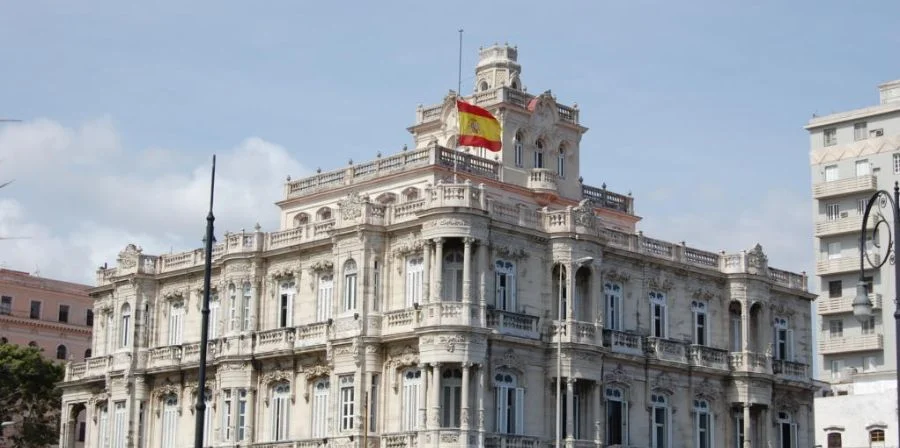
The delays in the Civil Registry offices, the blackouts, the geographical fatality, the economic deficiencies, the lack of knowledge of procedures and multiple other factors have delayed the procedures for many Cubans.
SANTA CLARA, Cuba. – There are only a few days left until the possibility of submitting files to opt for the Democratic Memory Law, better known as the “Grandsons Law”, ends, which until last July had benefited thousands of descendants of Spaniards living in several nations. Exactly on October 22, 2025, at 11:59 p.m. (Cuba time), the enabled computer platform will stop registering new requests. That is the ultimatum for those who have not yet managed to enter the system to request the so-called credentials.
The delays in the Civil Registry offices, the blackouts, the geographical fatality, the economic deficiencies, the lack of knowledge of procedures and multiple other factors They have delayed the procedures for many Cubans who may not be able to gather their documentation in time to benefit from the law. The WhatsApp group enabled by a “manager” from Santa Clara dedicated to advising those interested in Spanish citizenship, has not stopped receiving messages this week. In the small living room of her house, Liset – this is how she identified herself – attends in person to another large group of people who arrive, even from remote municipalities in rental cars or by their own means, overcoming countless setbacks.
“They are desperate and it is understandable, because the vast majority have invested a lot of money,” he confirmed to CubaNet. Although the woman does not have a license to practice such management, she has proven knowledge on the subject and a considerable number of clients who have already been granted a volume and folio, and who are waiting for their Spanish passports. “I know very humble people, who even by meeting for years will not be able to buy a ticket, but they still try to apply with the hope of ‘becoming Spanish’ and one day being able to leave here. Some have also even gotten sick from nerves due to the anxiety that these procedures generate.”
At the request of his clients, Liset last month gathered their names and signatures to send a request to the Spanish Consulate in Havana to allow a possible extension of the law, although he acknowledges that it will be in vain. In fact, in recent days the Minister of Territorial Policy and Democratic Memory of Spain, Angel Víctor Torres, told the newspaper Clarion that the deadline to apply for nationality had already been extended when it was considered necessary. “We would have liked to have more options to continue extending, but there are certain limits,” he said.
According to Liset’s experience, in recent days, many of her clients “are going to be left out,” especially because they did not receive the literal birth certificates of their ancestors in time, the main requirement to opt for the law. Precisely, one of the cases that she attended to that morning is that of a great-granddaughter who requested by email months ago the departure of her Spanish ancestor, but was denied through that official means, because according to her, they alleged “lack of legitimate interest.” “At this point you can’t do anything, not even with money involved,” laments Liset.
Earlier this year, the Consulate General of Spain in Havana announced the transition to the new digital system to manage appointments for nationality applicants. The current platform requires fewer documents than those that had to be provided through the previous route: those who reside in Cuba now only have to attach in their application the literal birth certificate of the family member of Spanish origin, the specific annex that corresponds to their case, and a selfie-type photo of the applicant along with their official identification.
However, for Cubans who apply from other countries, the requirements are much stricter, since they must provide certifications of the direct line of descent, that is, their birth and that of their parent. “I have not been able to send my application yet because I am presenting myself as the eldest daughter [de una bisnieta] from Cuba, but my mother, who is the great-granddaughter, is in Miami,” says Dayanara Alonso, a client of this manager, who must wait for her mother to first request her credentials and then proceed to enter her data before October 22. “They ask her for the legalized birth of my grandfather, and I still don’t have it in my hands, because it had to be corrected and this has been an odyssey in the Civil Registry.”
In your case, there are all those applicants who present themselves through Annex III, who must include in their files other additional demonstrative documents to bring to the appointment, such as the alienation and immigration certificates that prove that the Spanish citizen did not renounce their nationality when settling in Cuba or others that, if not, prove that, in fact, the ancestor entered the Island as an exile.
In addition to overcoming the entire series of cumbersome procedures required to request certifications, correct them and legalize them, many Cubans are still unable to apply for the law because their identity documents were expired or because their data did not exactly match those of the family line. According to the experience of this manager, some of her clients had to take their elderly relatives and even those with certain illnesses typical of their advanced age, almost at the last minute, to the procedures offices to renew their cards, since the Spanish Consulate has insisted that the procedures can only be carried out with updated documents. Those who live in municipalities, where electricity almost always fails, are in a worse situation.
Of “migrations” and recent rejections
In recent days, the desperation of Cubans has been seen in the dozens of groups that coexist on social networks about the LMD. The main reason is not only the end of the law, but the recent warning from the Spanish Embassy in Cuba about a new mandatory requirement to opt for nationality before the deadline expires.
The Consulate’s statementwhich has been shared on the official page and on its WhatsApp channel, recently enabled, clarifies that those who attend the appointment must carry a printed receipt with the Secure Verification Code or CSV, a document that the new platform generates automatically, but that many of those who presented themselves through the previous system did not receive and now must request it through a specific link.
“It is not about going with the email received, but with the two-page PDF document that is obtained at the electronic headquarters by entering the Secure Verification Code or CSV obtained by email,” the Consulate insisted in response to the multiple questions received.
In addition, the Consulate pointed out that interested parties who received a rejection email of the “Migration” type, as long as they have also received their respective CSV in another message, are “within the system” and “will receive their credentials (username and password) to request the appointment in a timely manner.” However, those who have received a rejection email of the “Form” type after the aforementioned CSV were excluded and, therefore, must register again, which will further extend their possibility of obtaining an appointment taking into account the slowness in granting credentials.
“My mother, brother and I had been waiting for credentials for more than 15 months,” says Cuban Ricardo Díaz, a member of the Facebook group managed by the profile, about his case. Emigrate Nowwhich hosts more than 60,000 members. “On September 29 we received the rejection with all the documentation correct and now we went from being at the point of receiving the credentials to being one of the last. Total lack of respect.”
Another woman, identified as Zoe Carrillo, questioned in the same publication: “Not all of us have knowledge, not all of us have resources, so we have to go to other people, ask for help. Someone has to hear us. Someone has to care.”
Given the situation of debate generated in the group itself, Emigrate Now spoke about it on behalf of the hundreds of descendants who continue without receiving a response, without having been granted credentials and facing “a process marked by errors, silences and institutional contradictions,” they wrote. “The Consulate has spoken, but the reality is different: How is it possible that a system that was supposed to guarantee justice and transparency is generating more uncertainty than solutions?”














