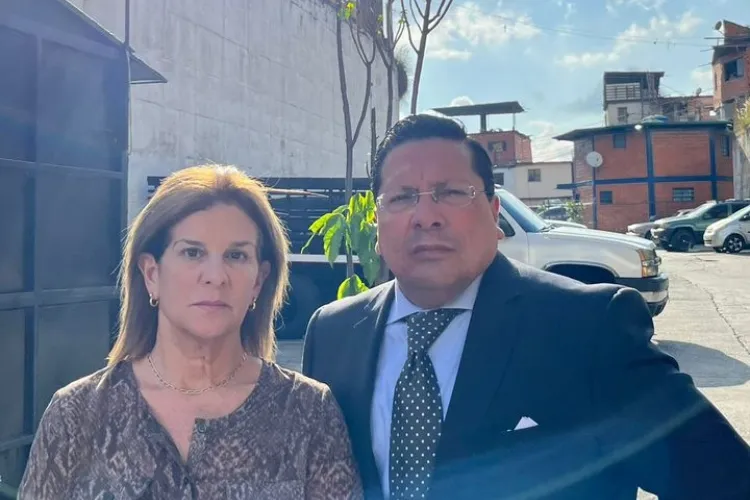
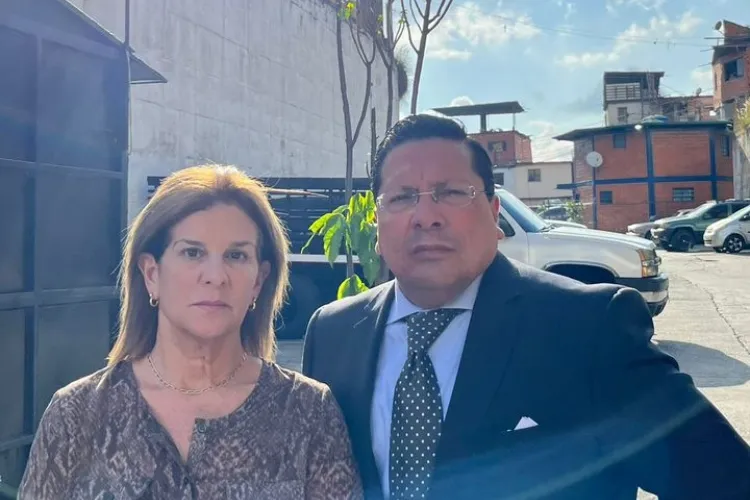
“After a year, a month and eleven days I was able to visit Perkins Rocha and we gave each other the long-delayed hug.”. With those words, María Constanza Cipriani described the moment she saw her husband again at El Helicoide, headquarters of the Bolivarian National Intelligence Service (Sebin) in Caracas, on Wednesday, October 8, after remain incommunicado.
“He called me himself on Tuesday from a phone inside El Helicoide, on loudspeaker. There they informed me that I could go the next day, with a white shirt and some food to share. The visit would be from 10:00 am to 4:00 pm,” Cipriani said in an interview with The National.
The opposing lawyer’s wife arrived before 10:00 am, but access was delayed. “We entered around 11:00 am, after routine checks. The treatment was distant, but respectful,” he said. Finally, the reunion occurred in a large room with air conditioning, plastic and wooden tables, under security cameras. “We talked for about four and a half hours. It was not a hostile environment,” he said.
“He is thinner, but strong and serene”: this is how he describes Perkins Rocha
Cipriani She described her husband as visibly thinner, although with a good appearance.. “He has lost between 10 and 15 kilos, but he doesn’t look sick. He is strong, serene, firm,” he said.
He explained that in the absence of medical care, Rocha has devised his own health monitoring system: “He does memory and motor exercises to check that his brain and body are working well. He self-monitors because he suffers from hydrocephalus and has had meningitis.”
The lawyer, who was deprived of liberty on August 27, 2024, has not had an external medical evaluation since then. “There is no doctor to check him, but he takes care of himself, he does the exercises that his therapist taught him when he recovered from meningitis,” said his wife.
During the visit, Rocha also clarified doubts about medications requested on his behalf. “He confirmed to me that he doesn’t need the drugs that someone asked for. He told me: ‘What you send me is what it is. If it doesn’t come with my handwriting, don’t accept it’. That calmed me down a lot,” Cipriani said.
A prior video call and a message of encouragement
The day before the visit, hours after the first call, Cipriani received a surprise video call from Rocha from the same detention center. “He asked me to incorporate our children. One of them managed to connect and was able to see him. It was a strong impact to see him so thin, but with a lot of integrity,” he said.
Rocha took advantage of that contact and the subsequent visit to send a message to Venezuelans. “He asked me to thank the journalists. He told me that when from within they find out that someone is talking about them, that they don’t forget them, that is an immense encouragement. He also asked that we all maintain strength, serenity and faith”said his wife.
Before leaving, Cipriani asked if there would be other visitors. “They told me yes, that they would inform me the night before. It seems that there is some openness, and that is encouraging,” he added.
She assured that the hug with her husband filled her with strength: “Nothing erases the horror, but seeing him so strong, so convinced, renews my hope. He is still him, and that gives me the drive to continue fighting for him and for all the political prisoners.”
One year of incommunicado detention
Perkins Rocha, opposition lawyer, legal advisor of the Democratic Unitary Platform and close collaborator of Edmundo González Urrutia and María Corina Machado, He was arrested by Sebin on August 27, 2024. The Prosecutor’s Office accused him of terrorism, treason, conspiracy, criminal association and instigation of hatred.
Since then, he remained held in El Helicoide, incommunicado from his family and lawyers. “He has never been able to swear in a trusted lawyer, nor do we have access to the file to know the alleged evidence,” Cipriani denounced.
Rocha’s arrest occurred after the attorney general, Tarek William Saab, linked him to the disclosure of the electoral records published by the Democratic Unitary Platform after the presidential elections. According to the ruling party, these documents are false.
Rocha suffers from hydrocephalus controlled by a cerebral valve and a history of cerebral tuberculosis. His wife has requested his release for medical reasons. “He meets all the requirements for a humanitarian release,” he insisted.
The Inter-American Commission on Human Rights (IACHR) granted precautionary measures in his favor, considering that his life is in danger. Likewise, the UN special rapporteur on the independence of judges and lawyers, Margaret Satterthwaite, demanded his immediate release, warning of possible torture or ill-treatment.