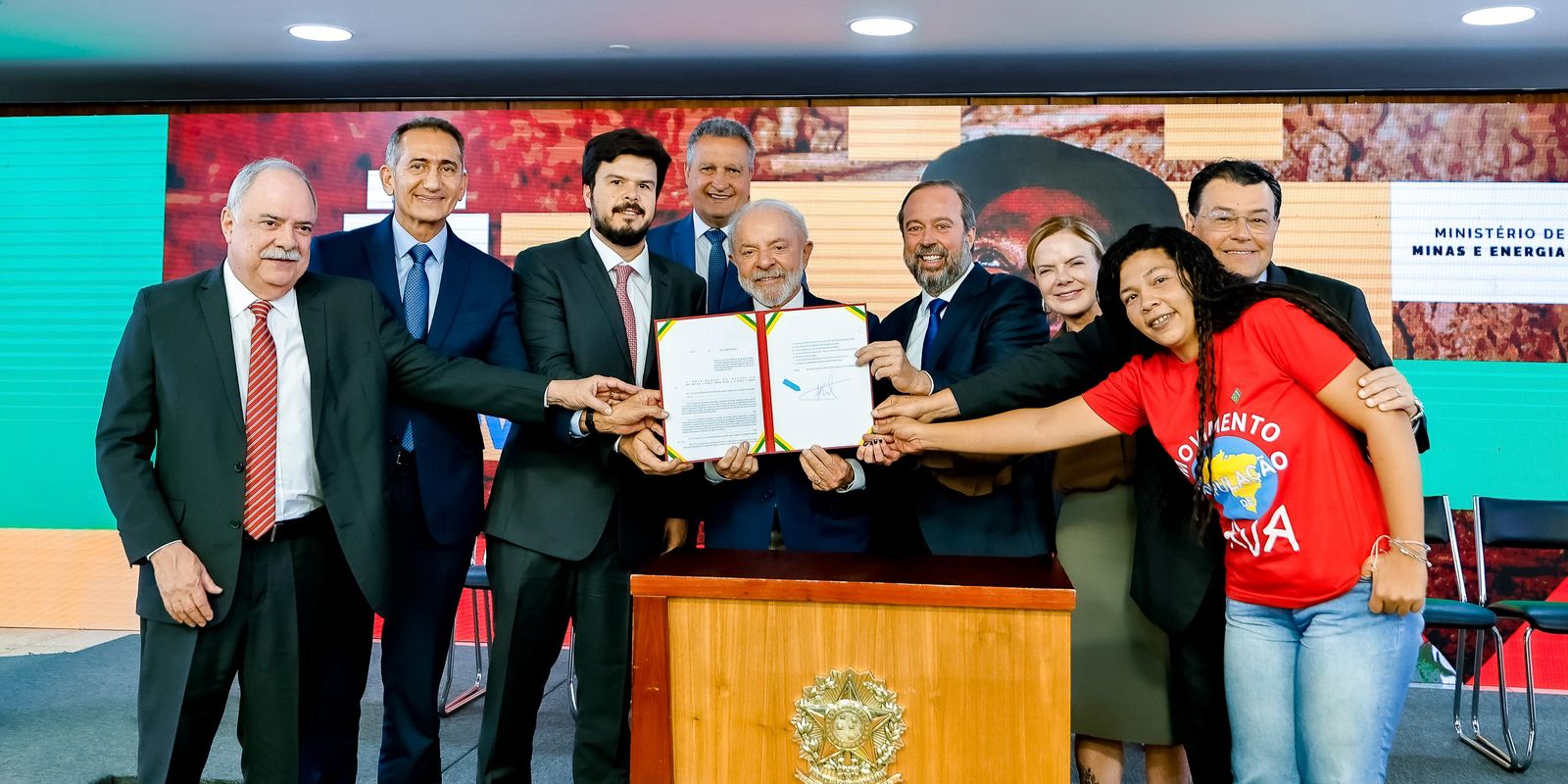
The free electricity bill for low-income families who consume up to 80 kilowatt-hours (kWh) became definitive law this Wednesday (8), after presidential sanction of Provisional Measure 1,300/25, which established the Luz do Povo program. The event at Palácio do Planalto was attended by President Luiz Inácio Lula da Silva.
Instituted by the government in May, the MP was processed for four months in the National Congress, until its final approval last month.
The free payment should benefit 4.5 million families registered in the Single Registry of Social Programs (CadÚnico) with monthly family income per person less than or equal to half the minimum wage. According to the text, families that receive the Continuous Payment Benefit (BPC), as well as indigenous people and low-income quilombolas, also receive the social tariff. In total, 60 million people will be directly served free of charge.
“Social protection is necessary until Brazil can increase the revenue base with tariff justice, increasing everyone’s income so that we can reach the country we all dream of”, stated the Minister of Mines and Energy, Alexandre Silveira.
The new social energy tariff has been in effect since July, as the MP takes immediate effect, but needed Parliament’s approval to become law. From January 2026, for families that register consumption of up to 120 kWh, discounts should reach 12% on the electricity bill, reaching around 55 million beneficiaries.
According to the text, now converted into Law 15,235/2025, the exemption will be supported by the Energy Development Account (CDE), a fund financed by consumers to support public policies in the energy sector.
On the other hand, families may be charged other costs not associated with the energy consumed, such as the contribution for public lighting and the Tax on the Circulation of Goods and Services (ICMS), in accordance with the law of each state or municipality.
Among the items that were left out of the text of the original MP, by decision of Parliament, are tariffs differentiated by time of day and changes in pricing criteria for short-term energy operations.
Hydroelectric debts
Proposed by the MP’s rapporteur in the Chamber, deputy Fernando Coelho Filho (União-PE), a discount was included for debts owed by hydroelectric generators to the Union. The reduced installments due imply a tax waiver to the government of around R$4 billion, according to the rapporteur.
Also according to the new measure, the higher energy costs of nuclear plants will be shared among all consumers through additional tariffs, except for low-income consumers. Until then, this cost was concentrated in specific contracts. The change will take effect from January 1, 2026.
In relation to the irrigation and aquaculture sector, the text ends with the fixed time from 9:30 pm to 6 am for energy discounts granted to these activities and also with a continuous period, with the timetable being defined with the distributor according to government parameters.
Points removed
Several points set out in the Executive’s original MP were withdrawn during the processing of the matter by the National Congress. Some removed devices were transferred, by agreement between leaders, to MP 1,304/25, still under discussion.
Among them, the choice of energy supplier by residential and commercial consumers, the role of the Electricity Trading Chamber (CCEE) in the gas market and the end of incentives for energy from alternative sources. Minister Alexandre Silveira said he hopes there will be progress in Congress.
“I have absolute conviction that interests will converge and will deliver to the Brazilian people the freedom for consumers to choose energy supply companies, breaking the monopoly of our distributors. This is cheaper energy for the middle class. Those who today buy energy on the free market are 20% cheaper than the middle class and the poorest who consume on the regulated market”, highlighted the minister.