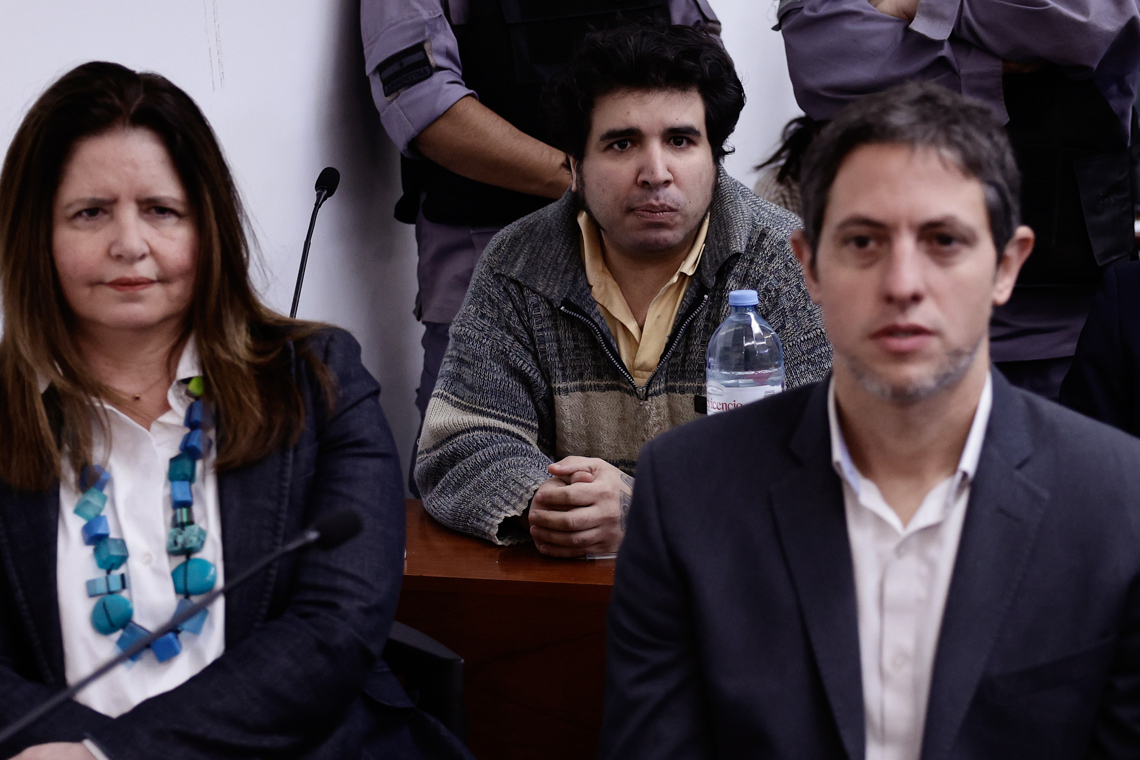
Three years after the trial, the Federal Oral Court No. 6 handed down a sentence this Wednesday against the two main people responsible for the attack that occurred on September 1, 2022 against the former president and Peronist leader Cristina Fernández de Kirchner.
Fernando Sabag Montiel, the man who fired the gun less than half a meter from the head of the then vice president, was sentenced to 10 years in prison for attempted aggravated homicide with the use of a firearm.
His ex-girlfriend and accomplice, Brenda Uliarte, received an eight-year sentence after being declared a necessary participant in the criminal plan. The sentence will be completed with the reasons that will be announced on December 9.
A third defendant, Nicolás Carrizo, leader of the group of street vendors known as Los Copitos, was acquitted for lack of evidence after both the complaint and prosecutor Gabriel Baigún withdrew the accusation against him.
During the trial, Sabag admitted having tried to kill Cristina Fernández, without showing remorse. Uliarte, on the other hand, refused to testify in the final stage of the process.
The attack that shocked Argentina
The night of September 1, 2022 was etched in collective memory. Cristina Fernández was returning to her home in the Buenos Aires neighborhood of Recoleta, surrounded by supporters who greeted her after attending a court hearing.
In the crowd, Sabag Montiel approached with a 32 caliber pistol, pointed it at his face and fired twice. No bullet came out: the gun jammed.
The attacker was immediately arrested. The event unleashed a wave of mobilizations and repudiation as the attack was considered a direct threat to political coexistence and the Argentine democratic system.
“The episode refreshed the dark memory of political violence,” said analyst Facundo Cruz, alluding to the times of the military dictatorship and the persecution of public figures.
Justice and controversies: the political plot
Although the sentence closes a judicial stage, investigations continue. Cristina Fernández, through her lawyers José Manuel Ubeira and Marcos Aldazábal, appealed the file of the case that was investigating PRO deputy Gerardo Milman, accused of alleged links to the attack.
The complaint arose after the testimony of advisor Jorge Abello, who declared that he had heard Milman say, two days before the attack: “When they kill her, I am on my way to the coast.”
When charged, the legislator completely deleted his mobile phone and his secretary deleted documents, as revealed in the trial.
Judge María Eugenia Capuchetti archived the file after finding no direct evidence, but did not dismiss Milman, leaving the door open to new measures. The appeal presented by Fernández’s defense seeks for higher authorities to review that decision.
A failure that does not dissipate threats
The attack occurred in a context of high political tension, when at that time Cristina Fernández was facing a trial for corruption in the awarding of road works, for which she was sentenced in December 2022 to six years in prison and perpetual disqualification from holding public office.
Since 2025, he has been under house arrest in Buenos Aires, although he continues to be one of the most influential voices of the Peronist movement.
For many of their followers, the sentence against Sabag and Uliarte represents an act of justice, but also a reminder that hate speech has real consequences.
Sabag himself said during the hearing: “All this was set up, but they didn’t pay me to do it,” a phrase that once again fueled theories about political conspiracies.
The shadow that persists
Three years after the attack, the court ruling leaves a double message: the conviction of those responsible shows the institutional strength, but the context of threats, attacks on networks and partisan tensions reflects that the figure of Cristina Fernández continues to be the target of extreme passions.
The case “refreshed the dark memory that violence can be used to resolve political differences,” analyst and consultant Facundo Cruz told AFP.
“It became palpable that in the 21st century something could happen that was believed to be banished from Argentine practices,” he added, alluding to the murder of political activists during the civil-military dictatorship (1976-1983), a period in which some 30 THOUSAND people were disappeared by the regime’s security forces.