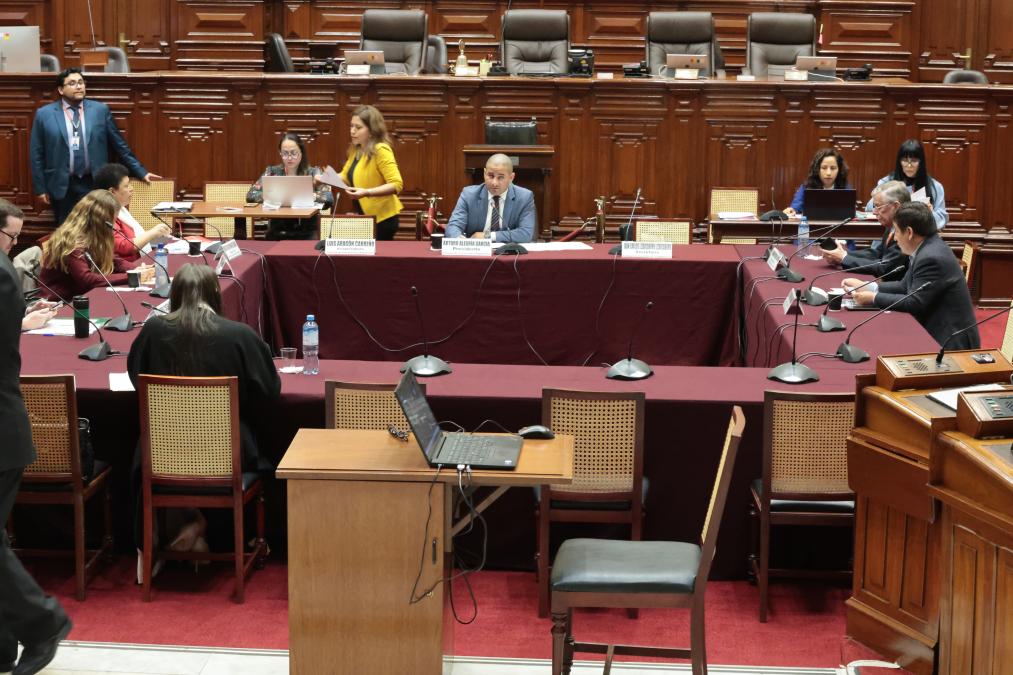
Some are made of lime and others are made of sand. The Constitution Commission of the Congress of the Republic approved by a large majority – 16 votes in favor – the modification of the Organic Law of Elections in order to allow the dissemination of surveys on voting intention or mock voting until 3 days before the election or popular consultation, that is, until the Wednesday before election day. The working group, however, did not equally support the initiative to eliminate the call dry law. The controversy regarding this point led to both issues being put to a separate vote.
According to the approved text, which is still pending a vote in the Plenary, “pollutors with current registration before the National Elections Jury (JNE)” will be able to “disseminate surveys on voting intention or simulation of voting regarding an election or popular consultation, through mass media, up to three days prior to the day of the electoral act or popular consultation.”
No manipulation
Congressman Ed Málaga, author of the project, defended during the debate the need to have reliable surveys and maintained that their dissemination up to 24 hours before the election, as was his original proposal, will avoid misinformation about voting intentions.
“Basic freedom of information takes on special importance in an electoral context because it prevents manipulations, especially in the last week, which is a critical moment in which we must be informed. Although the opinion proposes dissemination up to 72 hours in advance, the original proposal was 24 hours for citizens to be informed with surveys with a minimum technical standard on the real situation; in any case, we hope that the issue reaches the Plenary and the debate is expanded,” he stated.
Martha Moyano, from Fuerza Popular, also warned about the risk that secrecy regarding the surveys leads to manipulation of the figures, while Alejandro Cavero stressed that pollsters carry out these studies up to one day before the election, their results transcend and can ultimately be distorted. The issue did not generate objections as did the initiative to annul the dry law, which ultimately did not prosper.
In this regard, Málaga recalled that the current regulations do not prevent the consumption of alcoholic beverages but rather their sale, so – he said – it has no effect on reality. “It is a restriction that is not applied, is not complied with and has no major impact,” he warned, after insisting that, on the contrary, it has negative effects, as it causes losses at a commercial level.
In contrast, Alejandro Muñante alleged that “the dry law guarantees public order and that the vote is cast consciously and soberly by the voter.” Fernando Rospigliosi, however, replied that there is no evidence that the population drinks excessively on the date prior to election day. “It’s not that there are going to be drunken groups that are going to attack the polling stations, that is out of reality,” he said.
Finally, however, no consensus was reached, even with the addition that it would only be applied in the regional elections of October 2026. That division was reflected in the vote: 12 legislators voted against and 9 in favor; In addition, there were 2 abstentions, with which the proposal was sent to the file.
I KNEW THAT
The impediment to publishing polls will not apply to exit polls, published or disseminated after voting hours have ended.
In the event of non-compliance with this measure, the National Elections Jury (JNE) may apply a sanction consisting of a fine between ten and one hundred Tax Tax Units (UIT).
Receive your Perú21 by email or WhatsApp. Subscribe to our enriched digital newspaper. Take advantage of the discounts here.