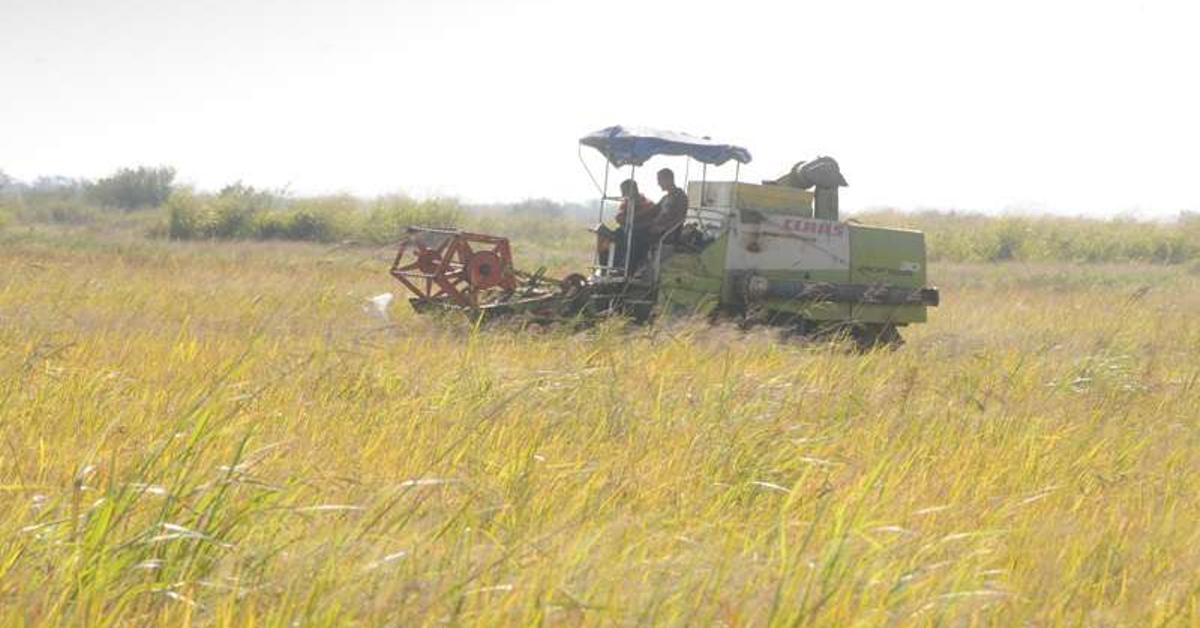
Madrid/The participation of the private sector in rice production has grown so much that it has already exceeded the contribution of the State. From official information, economist Pedro Monreal deduces that individual deliveries rose from 40.8% to 50%, while the state share fell from 55.7% to less than 50%.
“The non-state sector contributes 50% of the rice program, which contributes to reducing rice imports,” admitted in passing the leaders of the sector, who participated this Tuesday in the Round Table television program to give explanations of agricultural production.
The general outlook is expected to be very dismal, even with this vital contribution from the private sector. According to the authorities, the campaign will not be good once again, not even with help from abroad. In 2024, Cuba produced 80,000 tons, just over 10% needed for domestic consumption.
The drought that the Island has suffered throughout the year does not help at all, although managers hope that the most recent rains, which have improved the filling of some dams, will allow for some optimism. Currently, the reservoirs are at 45% on average, “which does not favor rice activity,” however, the forecast for the cold season is to increase planting by about 20,000 hectares.
Currently, the reservoirs are at 45% on average “which does not favor rice farming activity”
“We are working on the productive chain between two large companies and forms of non-state management, which guarantee the necessary inputs for the campaign, while the rice companies provide the irrigation, drainage systems and industrial infrastructure,” they explained yesterday, recalling that there is foreign investment with “significant impact” in two provinces.
They referred, predictably, to the projects of Pinar del Río (in Los Palacios and Consolación del Sur) and Artemisa, where the Vietnamese company Agri VMA has usufruct land whose yields are exposing Cuban farmers: 7 tons per hectare compared to the country’s average of 1.5 tons – although the amount was raised to 3.5, thanks to the use of biofertilizers as a solution amid the shortage of chemicals–.
But it will take more than that to improve production. The Agriculture directors explained that a lease of tractors is being carried out – probably those that contribute Belarus in exchange for rum and coffeeamong other things – and “progress is being made in opening six comprehensive logistics centers for the sale of inputs to producers”, the first of which, they specified, will open in Pinar del Río, offering seeds and technological packages.
It was not detailed in what currency these purchases could be made, since it was just over two weeks ago in the same province. a store was opened with “more than 100 inputs and products necessary to guarantee tobacco production and improve the living conditions of producers,” read the promotion that Tabacuba made in this regard, but the sale is in freely convertible currency (MLC).
As the authorities warn, “all the components of the technological package are not yet available, so agricultural yields will continue to be low.” In Granma alone, they warned, 12,000 hectares will be planted in the cold season, with the goal of reaching 30,000 in the spring season, “a figure not reached since 2018,” they noted.
To alleviate this bad omen – that the new donation of rice unquantified South Korea will also not solve–, it has been planned to produce more foods that require less water for cultivation, such as cassava or bananas. Another protagonist of the cold campaign will be corn, both for direct consumption and for feed. As the sector’s executives acknowledged yesterday, the national production of animal food is “practically zero.”
Cuba spends more than 1.2 billion dollars annually on the import of five products, one of them precisely corn
Cuba spends more than 1.2 billion dollars annually on the import of five products, one of them precisely corn. For this reason, the use of transgenic seeds has been promoted for several years, without it having penetrated too much this innovation capable of leaving better harvests for producers, as the official newspaper lamented Granma last September.
It is planned to plant 1,000 hectares of cassava and the same number of plantains, while the old poles specialized in this product are recovered. “We have been working since this year to rescue those historic areas, which at the time were a national reference for their productive results,” said Julio Gómez Moldón, vice president of the Agricultural Business Group, including Camagüey, Matanzas and Ciego de Ávila.
Of the latter, the work of two of its best-known companies, Ceballos and La Cuba, was once again highlighted, which this year has managed to cultivate 4,000 hectares of bananas, the largest number in its history. In total, this product is one of the few that meets the projections and as of August more than 16,000 hectares have been planted throughout the Island.
The managers mentioned more experiences that are going with “dynamism”, from the Yabú Valley, in Villa Clara, to the Horquita company, in Cienfuegos, although we will have to wait to see the fruits that the planted hectares bear and if there is a way to bring them to the Cubans’ table.