“Cuban doctors do not provide care without the disbursement of the funds allocated for the service,” one of the police officers hospitalized in Cuba told the independent Haitian media ‘AyiboPost’.
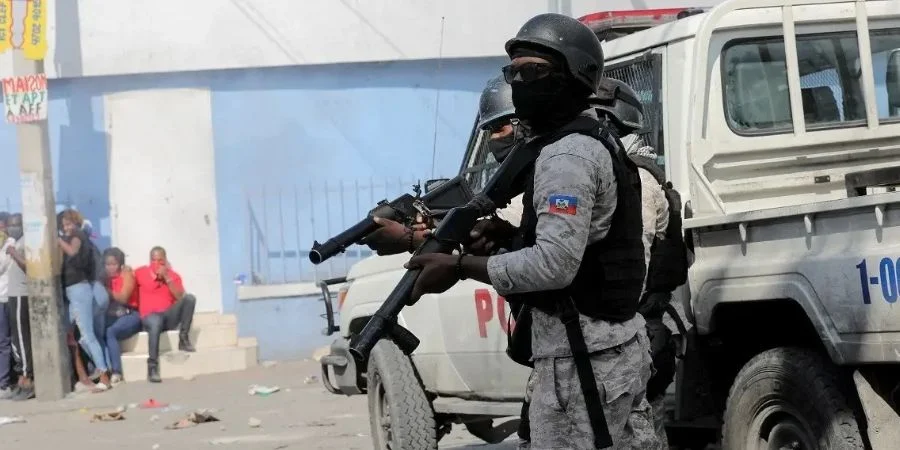
MIAMI, United States. – Up to twenty agents of the Haitian National Police (PNH) injured in operations against gangs are hospitalized in Cuba without enough money for medicine or maintenance and with medical procedures hindered by the lack of state payments, according to a report by the independent media. AyiboPost.
Several police officers interviewed accuse the Haitian State of leaving them helpless on the Island and the institutions responsible for not covering the agreed costs. One of the agents, identified by the media as “The Survivor,” said that he had to pay for two surgeries in Cuba with his savings after being injured by projectiles in October 2024, and stated: “I don’t regret the day I joined the Police, but they treat us like spare parts.”
AyiboPost specifies that the insurance designated for PNH agents refused to pay for the treatment and that Haiti’s Office of Work Accident, Sickness and Maternity Insurance (OFATMA) also did not provide assistance.
The National Union of Haitian Police (SYNAPOHA, by its French acronym) denounced a lack of transparency and impacts on the right to health. His spokesman, Mathieuny Sidel, told AyiboPost: “Cuban doctors do not provide care without the disbursement of the funds allocated for the service.”
Sidel asked OFATMA to assume its responsibilities, while the agents continue dispersed in different hospitals in Cuba, without psychological follow-up despite the post-traumatic context, according to the report.
consulted by AyiboPostthe director of OFATMA, Vikerson Garnier, explained that the organization signed a contract with the private company Good Money to manage the care of Haitian police officers in Cuba. He detailed it like this: a technical commission from OFATMA evaluates each case; then a contract is signed—up to a maximum of five million gourdes* by police—and Good Money sends the file to the Cuban medical authorities, who refer it to a hospital; This returns a care plan that Good Money forwards to OFATMA.
“Once the care is provided, Good Money sends the invoice to OFATMA, which then settles the amount corresponding to the expenses incurred by the insured,” the source added.
AyiboPost He adds that Good Money, established in 2023, has no known physical address in Haiti or website, and that it charges a commission of 3 to 4% of the total of each invoice, as confirmed by its head of operations, Pedro Guerrero.
The precariousness in Cuba aggravates the situation, according to the testimonies collected by AyiboPost. A police officer hospitalized since November 2023 said that he must pay for the drugs out of pocket and that he faces enormous obstacles for OFATMA to cover the costs. Another agent, injured in 2024 during an operation in Gressier, denounced premature medical discharges if treatment plans expire. A third had to pawn something to be able to eat and buy a painkiller since June: “The authorities don’t know how we live,” he told AyiboPost from his bed.
A fourth, transferred to Cuba in October 2024 after impacts to the right thigh, claimed to have lost sensitivity due to injury to the sciatic nerve; After several operations, his case would have been left out of the program and today he is in Haiti without therapy. “The treatment plan is custom-built, but if it is estimated that the cost will be too high, the case may be withdrawn from the program,” he lamented. And he added: “For this reason, the majority of hospitalized police officers do not fully recover. The agency [Good Money] person in charge does not provide a complete treatment program; The rest is on us.”
AyiboPost maintains that the shortage of medicines in Cuba —recognized by the person in charge of Good Money himself and by a specialized doctor consulted by the media—complicates care: antibiotics, painkillers and drugs for chronic diseases are usually imported and sold in foreign currency, which is difficult to obtain. To fill the gap, Good Money turns to Jamaica or Panama, but the persistence of the problem raises questions about the choice of Cuba as a health destination for Haitian police officers, the report indicates.
The investigation also documents a fatal case on the Island: Inspector Jean Bernard died on June 28 in a Cuban hospital. According to a police witness cited by AyiboPostBernard had advanced cancer and was transferred to Cuba without the necessary medical considerations; He died alone in his room, asking to be returned to Haiti for his last days.
Meanwhile, OFATMA continues to evacuate the most serious cases to Cuba: the most recent transfer, it points out AyiboPostoccurred on June 14 of this year, with fifteen patients, including PNH agents, due to the lack of adequate centers in Haiti.
* Haitian currency. Each gourde was equivalent to 76 cents on the dollar this Wednesday, October 8, 2025.