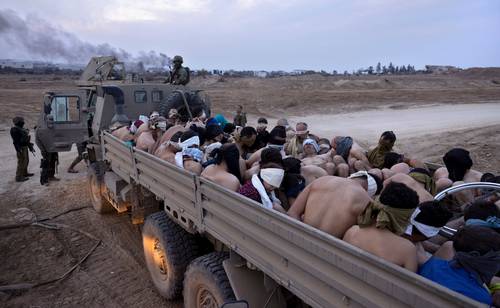
▲ Many of those who have not been located are because they were detained by Israel, which does not provide information.Photo Ap
Ap
La Jornada Newspaper
Wednesday, October 8, 2025, p. 5
Deir Al-Balah. When Israeli bombs began to fall, Mohammad al-Najjar, his wife and six children fled their home in southern Gaza in the middle of the night, scattering in terror with hundreds of other neighbors.
When the dust settled and Al Najjar huddled with his family in a shelter miles away, his son Ahmad, 23, was missing. At dawn, the family searched nearby hospitals and asked neighbors if they had seen him.
There was no trace. Almost two years later, they are still looking for him.
“It’s like the earth has swallowed him,” Mohammad al-Najjar said. He spoke from the family’s tent in Muwasi, along the southern coast of Gaza, their ninth displaced persons camp since that fateful night in December 2023.
Thousands in Gaza search for relatives who have disappeared in one of the most destructive wars in recent decades. Some are buried under destroyed buildings. Others, like Al-Najjar’s son, simply disappeared during Israeli military operations.
In a war where the true death toll is unknown, “what the exact number (of missing persons) is, no one knows,” said Kathryne Bomberger, director general of the International Commission on Missing Persons.
The Al-Najjar family has searched through the rubble of their bombed home. They went to morgues and spoke to the International Committee of the Red Cross.
“Is he a prisoner (in Israel)? Is he dead?” asked the 46-year-old father. “We are lost. We are tormented by everything.”
The Israeli Prison Services and the military said they could not release identifying details about specific prisoners and declined to comment on Al-Najjar’s condition.
Under rubble
Some 6,000 people have been reported by their families as still buried under the rubble, according to the Gaza Ministry of Health. The real number is probably thousands more because in some cases entire families were killed in a single bombing and no one was left to report the missing, said Zaher al-Wahidi, the official in charge of the data.
On the other hand, the ministry received reports from families of about 3,600 more missing people, Al-Wahidi said, who are missing. So far it has only investigated more than 200 cases. Of them, seven were found detained by Israel. The others were not among those known to be dead or buried under rubble.
The ministry is part of the Hamas-led United Nations (UN) government and its figures are considered reliable by many independent experts.
The International Committee of the Red Cross (ICRC) has its own list of missing persons: at least 7,000 cases still unsolved, not including those believed to be under rubble, said chief spokesman Christian Cardon.
There have been many ways to disappear during the chaos of offensives, attacks on buildings and mass displacement of nearly 2.3 million people from the Gaza Strip. Hundreds have been detained at Israeli checkpoints or captured in raids without notifying their families. Commissioned experts appointed by a UN body and rights groups have accused Israel of genocide, charges it strongly denies.
During Israeli ground assaults, bodies have been left abandoned in the streets. Palestinians have been shot when they came too close to Israeli military zones and their bodies are found weeks or months later, decomposed.
The Israeli army has taken an unknown number of bodies, arguing that it is seeking Israeli or Palestinian hostages it identifies as militants. He has returned several hundred unidentified bodies to Gaza, where they were buried in anonymous mass graves.
Investigating the missing requires advanced DNA technology, samples from families and unidentified bodies, as well as aerial images to locate burial sites and mass graves, Bomberger said. “It is an enormous task,” he stressed.
But Israel has restricted the entry of DNA testing supplies into Gaza, according to Bomberger and the Health Ministry. Israeli military authorities did not immediately comment when asked if they were banned.
Bomberger stated that it is the responsibility of the State to find missing persons, in this case Israel, as the occupying power. “So it would depend on the political will of the Israeli authorities to want to do something about it.”
Fadwa al-Ghalban has not heard from her 27-year-old son, Mosaab, since July, when she went to look for food at her family home, believing that Israeli troops had already abandoned the area near the southern city of Maan.
His close cousins saw Mosaab lying on the ground. They shouted his name, but he didn’t respond, and with Israeli troops nearby it was too dangerous to approach him, and they left. They assumed he was dead.
Returning later, family members found no body, only her sneakers.
No charges or trials
Human rights groups say Israel is “disappearing” hundreds of Palestinians from Gaza, detaining them without charge or trial, often incommunicado.
Israel does not make the number of detainees public except through freedom of information law requests. Under a revision of Israeli wartime law, Gaza detainees can be held without judicial review for 75 days and denied lawyers for even longer. Appearances before a judge are usually conducted secretly via video.
The Israeli human rights group Hamoked obtained records showing that, as of September, 2,662 Palestinians from Gaza were detained in Israeli prisons, plus a few hundred more in army facilities where rights groups, the UN and prisoners have reported routine abuse and torture.
All Al-Ghalban has of his son is his last change of clothes. He refuses to wash it.
“I keep smelling it. I want a scent of him,” she said, her voice breaking into tears. “I keep imagining him coming, walking towards me in the store. I say he’s not dead.”