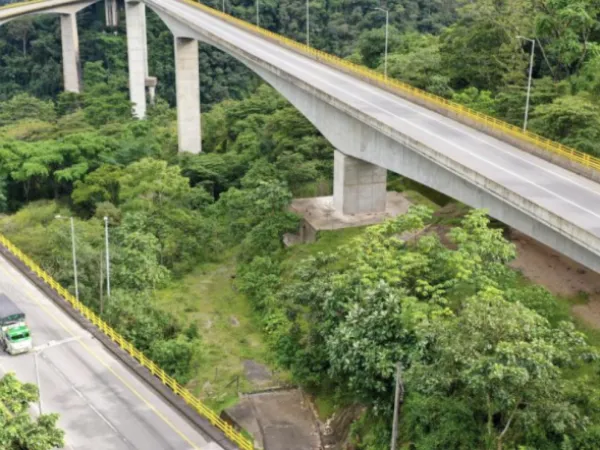
The National Government He announced that he works to enable the Bogotá -Villavicencio road within a maximum period of month and a half, after the emergency occurred at kilometer 18, One of the most critical points of the corridor. The work is advanced by the Ministry of Transportation, the National Infrastructure Agency (ANI) and the National Roads Institute (Invías), with the purpose of restoring the mobility between the center of the country and the eastern plains.
You can see: ANI adjusts schedules and measures on the Bogotá-Villavicencio road since October 4
According to the official statement, the ANI and Invías teams are carrying out stabilization and removal of material in the affected area, seeking to restore at least one transit lane in Bogotá – Villavicencio. These tasks are developed under strict security conditions for workers and users who travel through the sector.
The Minister of Transportation, Mafe Rojas, said that the government’s commitment is to maintain constant work pace to meet the objective of enabling the road before two months. “We are on the ground every week, verifying advances and accompanying the communities. Our goal is clear: enable the road before two months and keep the plain region connected with the center of the country,” affirmed.
According to the Ministry, interventions at kilometer 18 respond to a comprehensive mitigation strategy, which combines immediate attention with structural works. These actions seek to prevent similar situations from affecting connectivity between Bogotá and Villavicencio, Considered one of the most important routes for cargo, food and passenger transport.
Also read: Llano road closure raised cattle and lacteos prices during September
Way to the Llano
Coviandina
The Government stressed that the work articulated between the ANI and the Invías has allowed to advance in a coordinated manner in the removal of landslides and the installation of drainage systems, while technical solutions that guarantee the definitive stability of the land are evaluated. In parallel, permanent monitoring of slope behavior and climatic conditions to anticipate possible risks are executed.
The Ministry of Transportation reported that the reopening will be done gradually and with the accompaniment of the Traffic Police, to ensure that the vehicular flow is carried out under the required safety standards. Once the first lane is enabled, the stabilization of the rest of the road will continue and with complementary works aimed at improving the general mobility of the corridor.
Community roads in affected municipalities
While the work on the main road, the Invías will implement community roads in the municipalities most impacted by the emergency: Chipaque, UNE and Cáqueza, in the department of Cundinamarca. These works are intended to guarantee local mobility and allow communities to maintain access to basic services, food transport and everyday displacements.
The interventions are framed in a quick response strategy, aimed at offering temporary solutions to rural inhabitants, while the total rehabilitation of the main corridor is completed. The community road program contemplates the active participation of local communities, which will allow to generate employment and strengthen the sense of co -responsibility with the works.
The Invías validated a total of 76 applications presented by organizations and paths of the area, of which 28 were prioritized for execution during the year 2026. These initiatives will have an estimated investment of 18.2 billion pesos, resources that will be used for the construction, improvement and maintenance of the tertiary roads that communicate the populated centers with the main road.
Can read: Government adjusts passage schedules in variant to improve mobility on the road to the plain

The new schedules for the passage through the variant of K18+000 are already in force in both directions of the Bogotá -Villavicencio road.
Courtesy Coviandina
The Minister of Transportation explained that the objective is to accelerate these projects with the participation of citizenship. “We are going to put these paths with direct participation of the communities and the veteramors of the road to the plain. They are our allies to guarantee transparency and that each weight reaches where it is most needed,” Indian.
The Ministry said that these works will reduce the impact that the road emergency has had on the local economy, especially in the transport of agricultural products to Bogotá. Community roads will work as alternate routes that will facilitate the circulation of small vehicles and pedestrian traffic, while the total connection with Villavicencio is restored.
The Government stressed that the strengthening of tertiary roads is a short and medium term measure that complements the actions on the main corridor. In addition to guaranteeing mobility, Community works seek to promote rural development and improve communication between the most remote paths.
Paula Galeano Balaguera
Portfolio journalist