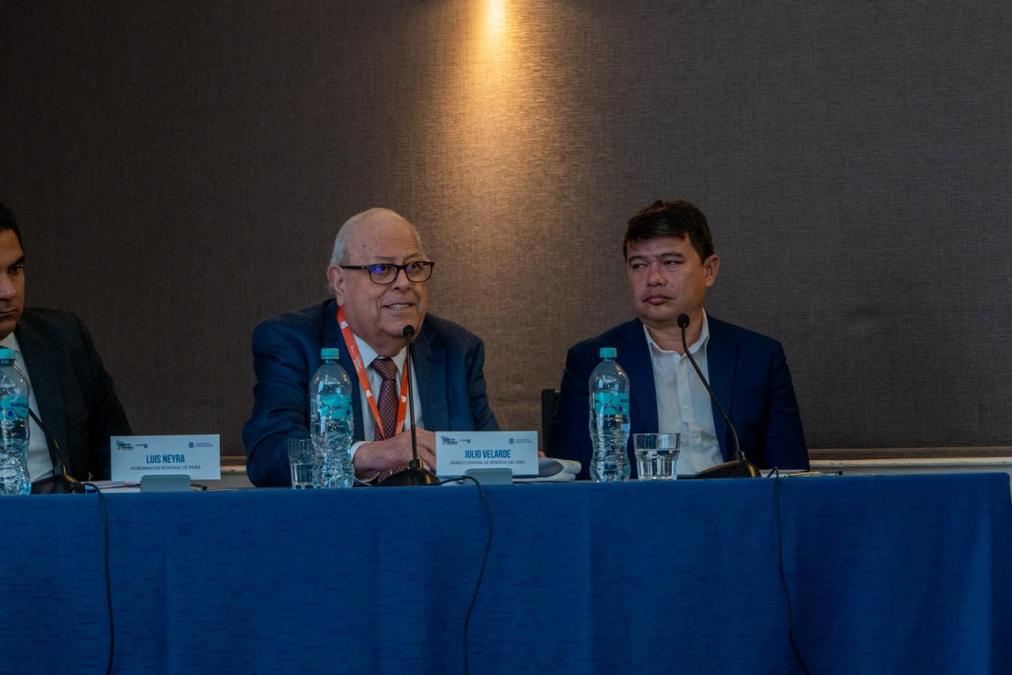
The president of Central Reserve Bank (BCR), Julio Velardewarned about the risks facing the country’s fiscal sustainability due to the approval of new projects with public spending initiative. Although Peru’s fiscal deficit remains controlled, Velarde insisted on the need to preserve the balance of public accounts to avoid situations similar to those of other economies in the region.
“The fiscal deficit is waiting for it to be 2.4%, as it was in August. It is a lower deficit than last year, not compared to other countries. But with these exceptional export prices, with also exceptional income, it would be normal to have a lower deficit and even a surplus,” said the head of the BCR during his dissertation in a new edition of the economic encounter organized by the BCR, in Piura.
Recently, this newspaper reported that there are more than S/12,000 million cost for legislative initiatives that have not taken into account public spending.
Velarde recalled that, historically, the fiscal policy in Peru sought to save in the periods of high international prices, the so -called “fat cows”, to have greater resources when prices fall and public spending requires an additional impulse. “The rule that occurred in Peru was that, in times of fat cows, one saves, so that spending can increase strongly when international prices fall,” he said.
The economist warned that the problem is not at the current level of the deficit, but in his trend. “There are a lot of projects already approved and that are being promulgated to increase spending, which can make our fiscal situation, which has been good for 35 years, begin to erode much more and have the problems we saw in other countries,” he said.
The cost of the deficit
To illustrate the risks of a fiscal deterioration, Velarde compared Peru’s situation with that of other countries in the region: “Brazil has a deficit of 8.5% of GDP. Colombia has a 6.5% deficit and many estimate that it will reach 7%. In Brazil, the interest rate of its sovereign bonds is 14%, twice that we. Colombia pays almost 80% more than us, for a faster situation.
He also stressed that Peru maintains one of the lowest debt levels in South America: “We are still below 24% of GDP, while Brazil is almost 92% and Colombia in almost 60%.”
Velarde insisted that maintaining a solid fiscal position allows the country to have margins to face economic shocks. “If the Colombian government has to stimulate, it has no margin because it not only has a very high deficit, but also an excess debt,” he warned when referring to the restrictions faced by some neighboring economies.
With a deficit that expects to remain at 2.4% of GDP, Velarde remarked that Peru retains advantages over other countries in the region, but that these could be lost if the growth of public spending is not contained.
Economic encounter
The economic encounter is a space for debate promoted and organized by the BCR that seeks the approach of the different political, economic, academic and union actors of the regions of the interior of the country to address issues of interest.
Regional and local authorities, representatives of private companies, public institutions and universities, are gathered in Piura (until tomorrow) to analyze the challenges and potential of Piura in a new edition of the economic meeting.
Receive your Peru21 by email or by WhatsApp. Subscribe to our enriched digital newspaper. Take advantage of discounts.
Recommended video