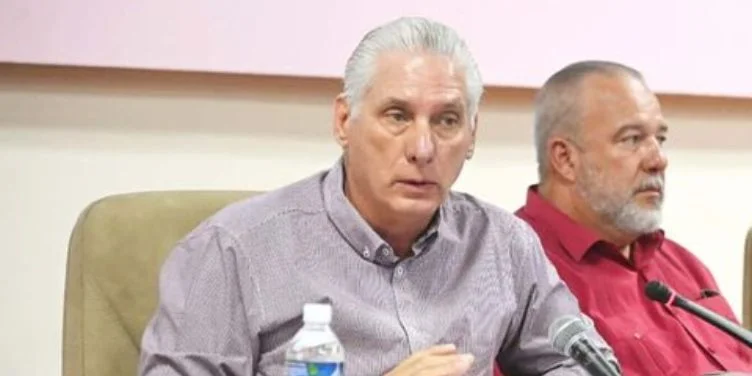
The ruler said that whoever exceeds the established consumption “although he can pay the expense, will have to stop.”
Miami, United States. -Cuban ruler Miguel Díaz-Canel warned that the units of the non-state sector that exceed their electrical consumption plan will be closed, even when they can pay for spending. “You have to visit the centers of the non -state sector, and control whether they are fulfilling their electrical consumption plan,” Indian during A work meeting held in Havana Last Saturday. “You can’t allow waste, although they can pay electricity. The place that fails your plan closes,” he added.
On Saturday, October 4, Díaz-Canel called to attend “with the greatest speed, intensity and order possible” three priority issues in the capital: the distribution of electricity, water supply and solid waste collection. According to the official report, the ruler stressed the need to strictly respect consumption schedules and the “savings value”, and reasoned that, in a context of uniform restrictions, who exceeds the established consumption “even if he can pay the expense, he will have to stop.”
The announcement occurs in a scenario of high fragility for micro, small and medium enterprises fabric (MSMEs). According to the report Private sector in Cuba: Exhaust valve or development engine? From Cuba Study Group, the State treats independent business as a “necessary evil” and imposes a “glass roof” that limits its expansion.
“Cuba is going through a deep economic crisis,” said the author of the study, economist Ricardo Torres Pérez, an attached professor at the Center for Latin American and Latin Studies of American University in Washington. In his opinion, “right now there is a lot of uncertainty in the private sector, because the economy is drowned. It depends on regulations of a government that is not committed to the free company.” He added: “There is always a new regulation that can be done to bother the private company in one way or another,” something possible “at any time, as they have demonstrated in these recent months,” because the State reaches “how far it wants to get there.”
The analysis of Cuba Study Group emphasizes that in two years more than 10,000 MSMEs have been registered, responsible for around 30% of employment, but with growth capacity braking by the regulatory framework.
The regulatory and macroeconomic tensions were already reflected in the official data of the late 2024. In March of this year it transpired that, for the first time since its legalization in 2021, the number of private MSMEs had fallen into a quarter, with a contraction of 2.35%. That same month, the Ministry of Economy and Planning had stopped publishing the weekly parties of new authorizations, and in December 2024 a resolution in the Official Gazette It prohibited private MSMEs from exercising wholesale trade, forcing them to operate in a state mediated by the State and ex officio canceling licenses previously granted for that activity.
Cuban economist Pedro Monreal warned in x that the first quarterly reduction of private MSMEs “could be reflecting both current stagflation and longer -term structural problems.” Although with limited information, he pointed out that the decrease “seems to point towards an effort of the supply deficit”, with falls in all provinces and high concentration in Havana (43% of the national total of MSMEs as of December 2024).
Likewise, Monreal detected contractions greater than 6% in Cienfuegos, Villa Clara and Camagüey, and attributed the coup in the industry (36.5% of the reduction) to “multiple causes” such as the energy crisis, investment difficulties and deficit of agricultural supplies. In tourism and gastronomy (28.4% of the total), it linked the decline to the “derailment of international tourism.”
On trade – 9.5% of the decrease – warned that “it could indicate a major problem”, despite their lower weight, because private MSMEs had gone from representing 4.1% of total retail sales in 2022 to 25% in 2023.
Monreal added additional obstacles: “The general prohibition (with exceptions) of wholesale trade, the energy crisis, reduction of consumers’ purchasing power, and a growing dollar state monopoly competition.” In its synthesis, the “puncture” expresses “structural problems (crisis of the growth model and inappropriate regulatory and institutional framework) and a recessive macroeconomic environment of stagflation (economic contraction and two -digit inflation)”, so “we will have to continue observing.”
Now, Díaz-Canel’s instruction to close non-state entities that exceed their electrical plan-even if they have resources to pay-add a new risk front for MSMEs, already affected by contractions, greater fiscal loads and operational limitations.
The official call to control consumption anticipates stricter controls on a sector that, despite its growing weight in employment and sales, remains conditioned by discretionary decisions of the State ..