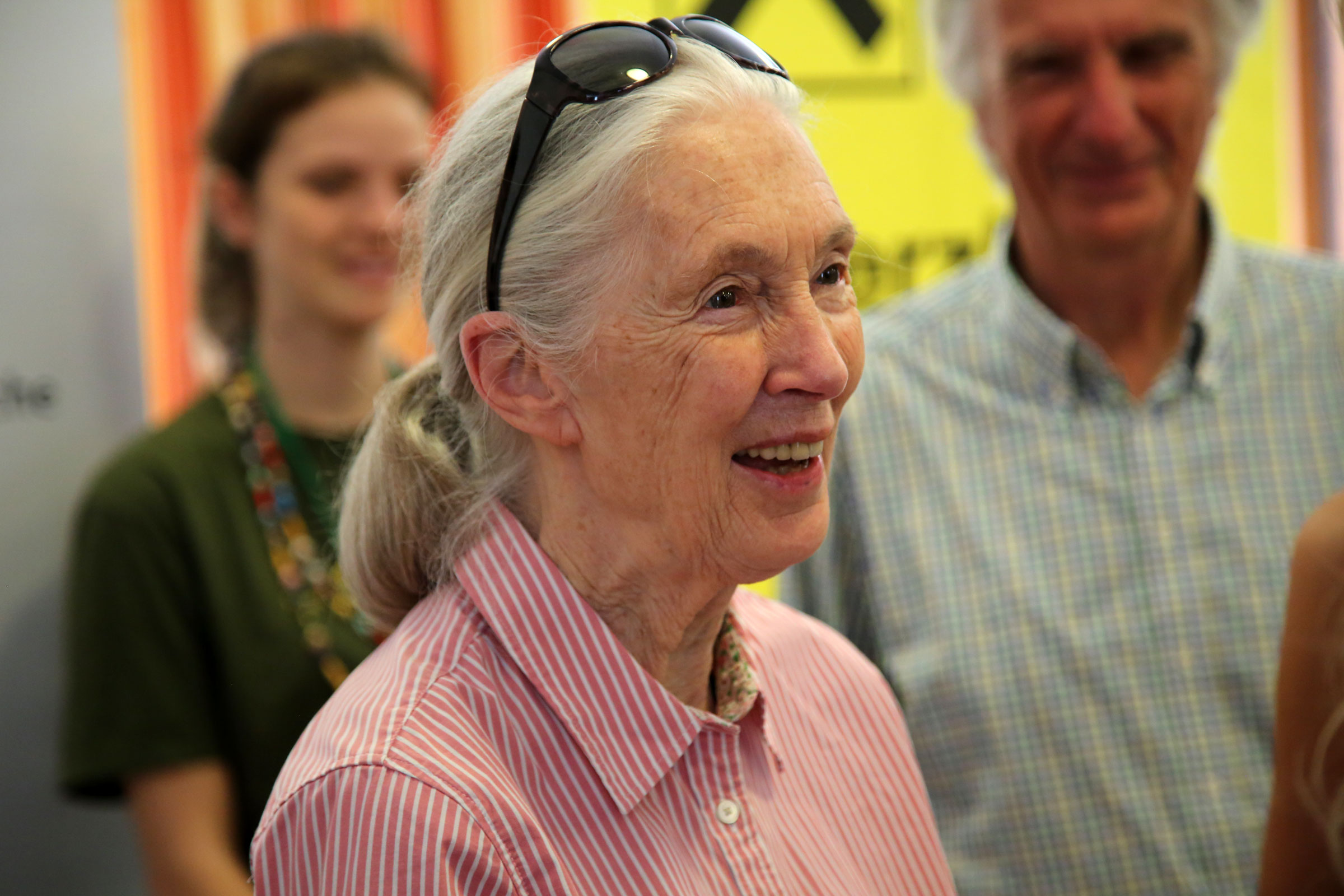
National Park of Gombe streamTanzania, end of November of 1960. Jane Goodalla 26 -year -old London, animal lover, has been living in a hut surrounded by the dense jungle vegetation, accompanied only by her mother and a cook. During the months passed, he has documented how chimpanzees move, what they feed and how they manufacture the litter nests where they spend the night. But these apes are only fleeting and elusive shadows that move between dense vegetation, avoiding contact with it.
Financing ends and fears defrauding Louis Sb Leakeythe great paleoanthropologist whom he had met three years before and who trusted it to entrust him a pioneering field size, despite lacking academic training.
It is precisely in this moment of doubts when, by surprise, a male chimpanzee whom he will baptize as David Graybeard (“Gray beard”) is approached to her, without showing an aggressive attitude, sitting next to a mound that houses a nest of termites. Take a twig, manipulate and break it until the appropriate dimensions, introducing it repeatedly into the nest to take out the termites, who are preparing to defend it, and eat them with deletion. When being informed by Goodall about the finding, Leakey responded enthusiastically with a telegram that has gone to the annals of human evolution:
“Now we must redefine the concept of tool, redefine the concept of human or also accept chimpanzees as human beings.”
Paradigm change
An overwhelming majority of people go through this world without leaving a lasting mark. Very few make significant contributions to the general collection of knowledge of humanity, and even less contribute a vision that translates into a paradigm shift. Jane Goodall, who died for natural causes on October 1 at 91 years of age, was undoubtedly one of these unique people.
Its legacy is immense, not only in the scientific fields of ethology (the analysis of animal behavior) and primatology (the study of primates, the order of mammals to which we belong human beings and our closest living relatives, chimpanzees), but also in social awareness about the need to preserve biodiversity and natural spaces that house it.
There are multiple reasons to value the exceptional legacy of Jane Goodall, because before Gombe moved we knew very little about the behavior of the chimpanzees in their natural environment. Without being conditioned by biases inherent to regulated academic training, Goodall adopted a heterodox methodology.
Among other things, he refused to follow the usual practice of numbering the objects of study, justified by the supposed loss of objectivity that the emotional attachment to the individual studied implies. Instead, he proceeded to give names to the chimpanzees, choosing the nicknames based on the traits observed of their character or the physical similar ones that he thought he saw with known people.
Thanks to this emotional proximity, and its immense patience, he documented disturbingly human aspects in his behavior, such as the fact that each of the individuals had a unique personality, being able to develop rational thoughts, experience emotions – such as joy and sadness – or develop complex alliances – and mutable in time – with other congeners. Something that at that time was nothing conventional.
In his field studies, whose first results masterfully reported in his book On the path of manpublished in 1971, Goodall documented that, although the chimpanzees had been considered strictly vegetarian, consumed meat whenever possible, hunting colobos monkeys regularly. In fact, it has been estimated that even A third of the population of these monkeys in the park is devoured every year by the chimpanzees.
In the hunting games, whose success depends largely on the number of copies that collaborate to isolate the monkey in the glass of a tree, blocking the possible outputs, the distribution of the meat once the piece is collected, the piece acquires special relevance. The males preferably share it with those others who depend on ensuring their position in the hierarchy, but They also attend the requests of sexually receptive females (That is, they pay in exchange for having sex).
Chimpanzees also engage in wars
Another disturbing finding was that the dominant females of the group occasionally kill others younger to maintain their position in the hierarchy, practicing infanticide and even, sometimes, cannibalism. But perhaps the greatest commotion caused by their studies was that chimpanzees are engaged in lasting territorial conflicts with neighboring groups, whose members systematically and deliberately kill what can be called with property as authentic wars between clans. This was reported in his 1989 book, entitled Through a window: thirty years studying chimpanzees.
Cultural transmission of mothers to their young
In short, Jane Goodall’s pioneer studies have changed our perception of human evolution and the place we occupy in nature. His observations inspired the works of new generations of primatologists, who grew with the stimulus of their writings. For example, those related to the non -trivial aspect of whether we can consider that chimpanzees have their own culture, which was always considered as something exclusively human.
Thus, in two subsequent jobs, in which Goodall also participated, the distribution of more than six tens of Behavior features in eight populations of Chimpanzees different from central Africa, detecting in two thirds of them cultural variants depending on the appearance or not of such features in these populations. These types of differences that precisely allow us to talk about human cultures. However, it should be noted that the populations studied belong to the three subspecies of Chimpanzee, Troglodytes Troglodytes bread, P. t. Schweinfurthii and P. t. Verus, the last of which evolutionarily diverged from the other two almost 1.6 million years ago According to genetic data.
On the other hand, in the chimpanzees there is female exogamy (that is, it is the females that are dispersed, changing family group upon reaching the reproductive age). This means that the dissemination of cultural variables depends on female sex, as well as the fact that cultural transmission by learning is preferably given from mothers to their young. This seems to be supported by the fact that it is the number of females chimpanzees which correlates with the variety of cultural habits in the groupNot that of males.
In short, it is difficult to calibrate the scientific and cultural legacy of Jane Goodall without having the appropriate temporal perspective. This legacy has materialized, for the moment, in the Jane Goodall Institutewith thirty offices around the world, whose objective is to protect the habitats of wild animals, conduct research and promote environmental education. But also in the World Young Program “Roots & Shoots”(Roots and outbreaks), which sponsors about 10 thousand local impact projects in more than sixty countries, promoting initiatives for recycling, reforestation and defense of animal welfare.
Although what is achieved in their long life, generations to come, inspired by their memory, still have enough to do.
Paul Palmqvist BarrenaProfessor of Paleontology, University of Malaga
This article was published in The conversation. Read the original.