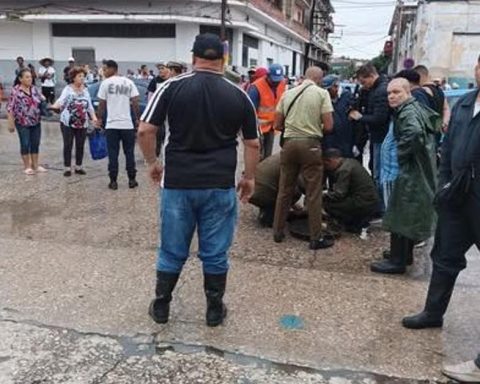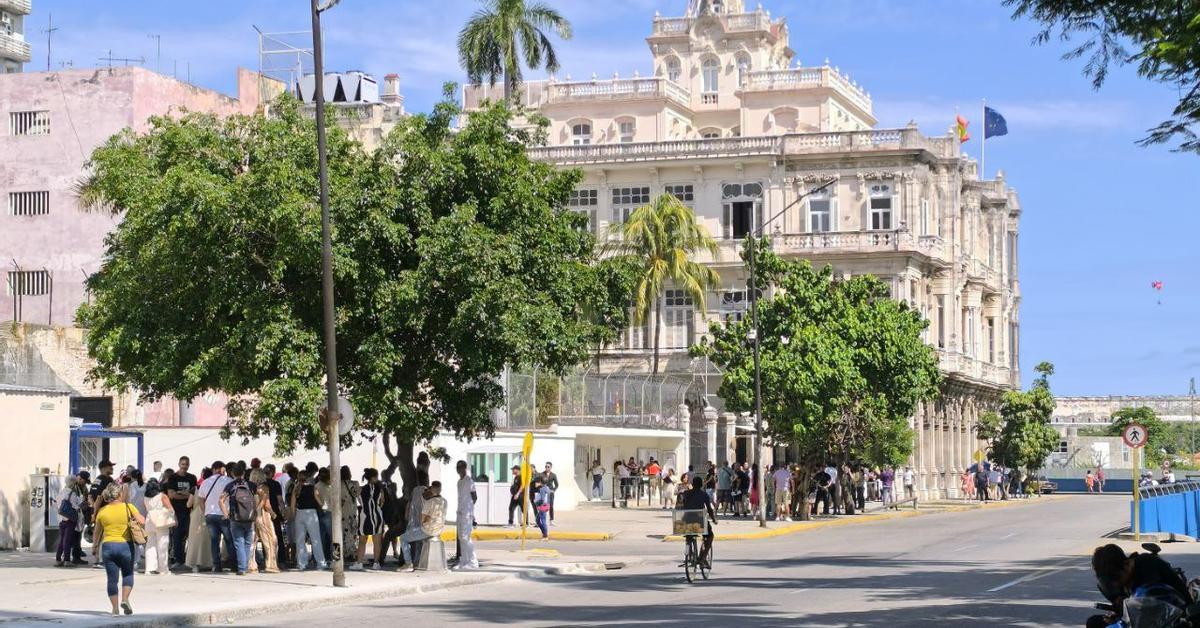
Havana/In front of the Consulate of Spain in Havana this Thursday, it was piled up, like any day of the week, a mass of Cubans eager to complete their procedures. Most of them, seeking to obtain Spanish nationality through the Democratic Memory Lawwhose deadline for submitting applications expires on October 23.
“This is turned on and the tail advances very little. I have the five hundred and peak and only three oa every time enter,” complained one of the future Spaniards. People, who occupy the portals, the sidewalk and part of the neighboring block, try to take refuge from the sun under the trees and sit in the avenue that borders the diplomatic headquarters. On the horizon, a paratrooper who carries a Cuban flag on his team is maneuvering his descent to the ground. “Look at that, a flying patriot, and one here wanting to fly, but for another part,” Ironiza.
He Foreign Ministry From Spain he published last Tuesday a note recalling that on October 22 is the limit to accept requests for Spanish nationality through the Democratic Memory Law. After that date, says the statement, only those who have requested an appointment at the Consulate of Havana before the deadline can be obtained.
“This is caught and the tail advances very little. I have the five hundred and peak and only three or four to every time enter”
“As of October 23, the computer computer system will not register more appointment requests for the option for Spanish nationality,” said exteriors, which detailed the cases in which Cubans do have the right to continue with the procedure. “Those people who have requested an appointment by email before the implementation of the computer platform and those who have done it through the computer platform and have received a supporting request for an electronic signature will be guaranteed the possibility of obtaining an appointment to be able to present the documentation physically.”
Also those who have received the Consulate credentials, by mail or through the platform, may obtain an appointment, provided they request it before the expiration period of the law.
If, on the contrary, their credentials have been rejected, “they cannot be treated as of October 23.” In that case, as if the appointment application has been rejected or a response email has not been received from the embassy, the interested party must register on the computer platform and rebuild the process before the deadline veins and will receive a notification of the headquarters informing of the credentials or date of citation.
In the case of those who do not go on the date indicated to the Consulate to deliver the documentation, the Ministry warned that, after the term of the law, new appointments will be assigned.
Exteriors also recalled that both processes can be expanded “due to the number of applications received, which will be processed according to the date of submission.” The same happens, he adds, in the resolution deadlines of the nationality files, which could take more than expected.
However, he insisted, “it is essential that they do not lose access to the email indicated in your application and verify that the consulate’s email do not enter their unwanted mail tray.”
According to the Gallego newspaper, the region, only from Havana, had received, until that same date, 108,000 applications
Until July 31, the specialized media reported Spain exteriorthey had registered A total of 876,321 applications of nationality by the LMD, of which 414,652 had already been approved and 237,145, registered. Another 423,048 files were in process. Cubans are the second in the list of applicants, behind Argentines and ahead of Brazilians.
According to the Gallego newspaper The region, Havana only 108,000 applications had been received until that same date.
Also last July, exteriors reported that its new computer platform had come into operation to manage nationality procedures. The announcement of the new system had been made in May and is part of a whole process of digitalization of consular procedures in all the Spanish headquarters in the world.
“From now on all appointments must be requested by this new system, and the previous credential application is permanently closed. We inform you that all the credentials generated by the previous system will be eliminated as of October 22, 2025,” the statement then added.
However, the computerization of the system failed to get rid of the dozens of people who are dedicated to obtaining quotations – at the beginning – in exchange for money. For hundreds of Cubans who obtained or seek to opt for Spanish nationality, the precarious Internet access, the irregularity in the availability of appointments and the collapse in which the system is added when the dates are enabled make them impossible to do the process on their own.
As a result, they end up going to some “manager” that is responsible for, from presenting the credentials – a process that the applicant himself must do, as the consulate demands – even collecting with a client author’s authorities apostille or certified documents.
Last May Facua-Consumenitors in Action, one of the best known consumer associations in Spain, He complained Before the Spanish Ministry of Foreign Affairs after several users claimed the “slow and farragoso” of the prior appointment process to obtain an entrance visa in Spain, both for Cubans who wish to travel to the country and for Spanish citizens who reside on the island.
“Cubans, relatives of Spaniards or anyone who wants to access the services of the consulate of Spain in Havana is with constant delays when it comes to getting a previous appointment that is required to carry out the necessary bureaucracy,” said the association, who denounced that the illegal payment for a free appointment reached up to 500 euros.
In the three years that the Democratic Memory Law has been in force, many other irregularities have been denounced. Among the best known cases is Network that made false certificates to prove the Spanish ancestry for up to 2,000 or 3,000 euros.
The volume of fraudulent documents was so high in Cuba that the consulate began to demand from the historical archive of Ourense a double verification: the wedge of the institution and the signing of the vicar, when in the rest of the world it is enough with the first. The information was revealed in a local television program in the province in which a young diocesan archivist had anecdotes derived from the high workload that has meant for these places the demand for documents, from Latin America especially.