Since 2009, Colombia obtained the support from the International Monetary Fund (IMF) with the entry into force of the Flexible Credit Line (LCF) granted by the international body through which a vote of confidence was given to the country.
(You may be interested: Fiscal Framework Weakened after years of deviations and rules suspension, says the IMF).
However, in recent days the IMF reviewed a report in which it evidence The government anticipated and decided to lose the flexible credit line.
For experts in the field such as the former Minister of Finance and now rector of the EIA University, José Manuel Restrepo, the decision taken by the Government is very bad because it puts the country at risk of the facts that may occur unexpectedly.
(We recommend: Why the ghost of the electric blackout in the country grows by leaps and bounds).
“A valuable instrument as a precautionary line to face difficult moments of unexpected shocks in the economy or current account difficulties, paying scales, exchange rate among other issues. Then, the government ends up making a decision that puts the country at risk,” Restrepo said.
In addition, he mentioned that when a nation has this line of credit it is a sign of good economy management and is a macroprudence guarantee seal.
What are the consequences of not having it?
According to the expert, there are many consequences of this decision of the national government, since initially puts the country with the risk ratingrs that measure the signals to invest in an economy.
“I think the markets have been anticipated and the risk ratingrs have also done so. As a result of which, they have been making decisions of the reduction of risk rating of Colombian sovereign debt and has increased the country’s risk premium”he mentioned.
He stressed that currently the cost of debt that Colombia has is almost 40% more than what the country had about three years ago on public debt and this contributes to a higher level of fiscal deficit.
(We invite you to consult: Colombia canceled the flexible credit line with the IMF).
“The reality is that the fiscal has already demonstrated for a long time that there is a severe problem and to a large extent, this was already planned, let’s call it the market, but it is still worrying because what we are is sending a very bad signal to the future to those qualifiers, to those investors on a macroeconomic management that at this time and to put a parallel with a family it does not have over approved turn”Restrepo added.
He pointed out that in the economy this is seen as when a person in his credits has an overdraft for eventuality, if something happens that money available, but if he does not have this, he could not overcome a crisis.
“Colombians when we go to a financial entity we seek mentioned the rector of the EIA University.
And he added: “The good I don’t think anything is, really. And the bad is everything, the bad thing is that we lost credibility in macroeconomic management”.
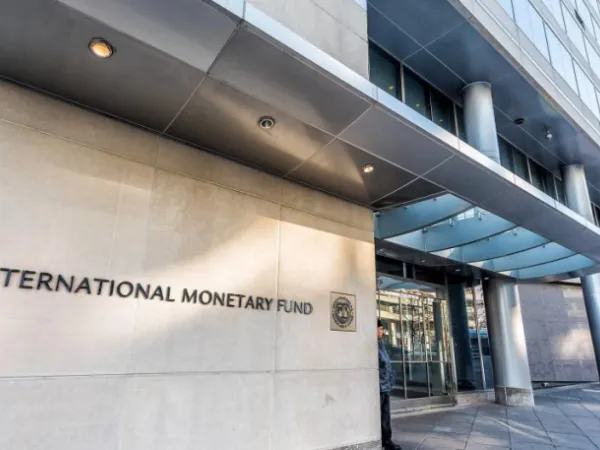
IMF – International Monetary Fund
EFE- JIM LO SCALZO
What else do experts say?
For the director of Fedesarrollo, Luis Fernando Mejía, having lost this flexible credit line is to determine that the country no longer meets a solid macroeconomy.
“The recent FMI statement confirmed that Colombia lost access to the Flexible Credit Line (LCF), at the conclusion that the country no longer fully complies with the solidity criteria of the economic policy frame the fragility of public finances and the urgent need to launch a serious and credible plan of fiscal adjustment ”, Mejía said.
In turn, Germán Cristancho, Economic Research Manager and Strategy in Davivienda Corridors said that this represents lower access to financing alternatives.
“The cancellation of the FMI Flexible Credit Line agreement (LCF) is not good news for Colombia. Access was already suspended by the deterioration of the country’s public finance situation, but this announcement represents a bad step in the country’s access to low -cost financing alternatives and that very few countries have. Beyond the use of resources, having access to the LCF is a sample of the support of the macroeconomic management of a country”Cristancho mentioned.
And for the president of Anif, José Ignacio López this decision generates greater risk of country and will devalue the Colombian weight that for this start of the month began its price on the $ 3910.
“The FMI flexible credit line (LCF), created in March 2009, is a support for countries with solid foundations against external shocks. Colombia has had access since then, signing ten agreements and using it only once, in 2020. The LCF is more efficient than accumulating reservations and sending a positive signal to the markets. Losing it would increase the country risk, financing costs and press the weight. The government must present a credible fiscal plan.López said.
It is worth noting that in August 2024 andl International Monetary Fund approved a new two -year agreement for Colombia for an amount of around US $ 8.1 billionfor crisis prevention. However, these resources will no longer be available.
Leidy Julieth Ruiz Clavijo
Portfolio