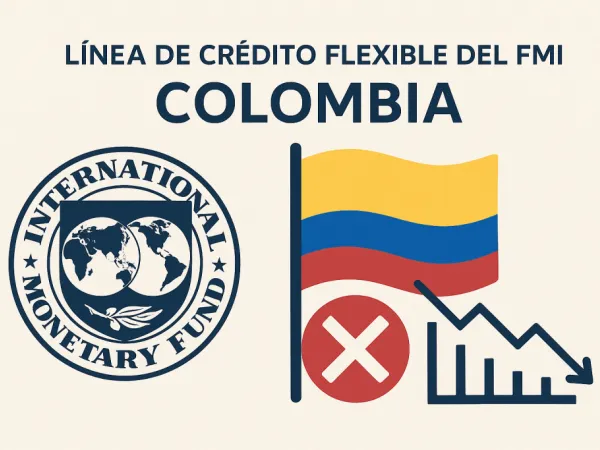
Colombia will no longer use the Flexible Credit Line (LCF) of the International Monetary Fund (IMF)which has maintained since April 2024, according to the Bank of the Republic, after revealing the monetary policy interest rate for the month of October.
This responds to the suspension of said ’emergency card’ by this multilateral body to the country from April 26, after its last evaluation of article IV. In this way, Colombia can no longer have this credit line, approved at the time For an amount of 6,133.5 million Special Rights of Giro (DEG), which amounted at that time to about 8,100 million dollars to two years.
(You can read: Colombia canceled the flexible credit line with the IMF).
According to the issuer, the decision is made in a context in which Colombia maintains adequate levels of external liquidity and solid international reserves, which currently amount to US $ 65,500 million. This result obeys, on the one hand, to the currency accumulation program executed in 2024 for a value of US $ 1.5 billion, and on the other, to the returns obtained in the management of investment portfolios, which have added about US $ 4.5 billion between 2024 and the run of 2025.
However, from the issuer they assured that “The cancellation of the current agreement has no effect on the Payment schedule of the disbursement of the LCF that was carried out in December 2020. The payment of the only pending fee will be made in December 2025, as planned. The country continues in a constructive dialogue with the IMF for all aspects it deems necessary”
The Bank of the Republic was calm with this turn in its fiscal policy.
Chatgpt image
An outcome warned
On April 26, the IMF made the decision to suspend the flexible credit line that he maintained with Colombia from 2024 until the current consultation of article IV and an intermediate review of the credit did not end.
(Besides: Fiscal Framework Weakened after years of deviations and rules suspension, says the IMF).
“Since April 26, 2025, the continuous qualification of Colombians for the Flexible Credit Line (FCL) of the IMFM depends on the completion of the current consultation of article IV and a subsequent intermediate review of FCL. The FCL agreement was approved on April 26, 2024, for a period of two years, with an intermediate review to evaluate the continuous rating”, Said the entity at that time.
In fact, This year an IMF team made its annual visit to Colombia to meet with public and private entities, within the framework of said consultation.

IMP
EFE
As a result, There were hard comments by the delegation regarding the fiscal situation, the increase in the deficit of the national government and public debt in 2024; Factors that weighed in the decision to reassess the credit line and that were accentuated in the annual report of the multilateral entity, issued on Tuesday.
“New delays in fiscal consolidation could raise concerns about the disagreement of fiscal policy, in addition to further undermining investor’s confidence and perhaps causing a sudden interruption of capital entries. The increase in political uncertainties and the resurgence of violent crimes and insecurity could hinder the economic activity and development of the private sector“The IMF mentioned in its annual report.
(You can read: This will be the country of Latin America more indebted to the US for 2050, according to AI).
It is worth mentioning that each of the reasons stated by the multilateral entity coincides with the anticipations made by the market on the country’s access to this flexible credit line, so, according to Luis Fernando Mejía, director of Fedesarrollothe decision “It has no immediate practical effects“
In fact, The proper international liquidity of the country would cushion the effects of the uselessness of the flexible credit line by the country.
“This decision is made at a time when the country’s international liquidity levels are adequate, with a level of international reserves that currently reaches 65,500 million dollars. This level has been achieved thanks to the reservation accumulation program carried out in 2024 for 1.5 billion dollars and the profitability of the portfolios, which reached 4.5 billion dollars for 2024 and the run of 2025“The Bank of the Republic mentioned on Tuesday.

The fiscal deficit is the great challenge to overcome from the national government.
Chatgpt image
However, Scotiabank He said at the time that it was expected that the national government did not carry out any plan for the management of the public treasury to be more efficient, taking into account the situation of the difficult fiscal situation of the country.
“The IMF conditioning is a signal of less confidence in Colombia and probably press the government to have a more specific plan for its public finances. Unfortunately, we do not foresee that any plan occurs before the publication of the medium -term tax framework“The financial entity said.
And now what?
Now, the sure thing is subtracted from Colombia is to pay the responsibility of payment acquired with the IMF until December of this year.All aspects you consider necessary“, According to Banrep.
However, the question is sown with the way in which the country would respond to the notes made by the fund regarding the fiscal situation, the search for other favorable lines of credit and the strengthening of the country’s credibility before the multilateral banking.
(We recommend: Foreign investment in the country would be the most sensitive to descertification from the US.).

Colombia
Source: Canva
José Ignacio López, president of the Anif Economic Studies Centerhe said at the time that in the event that Colombia lost the LCF, it “The country risk, financing costs and pressing the downward weight would increase and press“, among other effects.
Already after the non -renewal of the LFC, Luis Fernando Mejía, of Fedesarrollo was confirmed, emphasized what the director of Anif said, also mentioning that the most important thing that the country should do from now on is precisely, “”launch a serious and credible fiscal adjustment plan“
What did the IMF flexible line make special?
Colombia could have this flexible line, since it met at the time with the requirements of Have a sustainable external position, capital account with predominance of private flows, good history of access to international capital markets under normal conditions, level of adequate reservation, public finances under control, low and stable inflation (under a solid framework of monetary and exchange policy), healthy financial system, effective supervision of the financial system, and transparency and integrity in information in information.
Mejía said that this line of credit has particularities that make it special for those countries that have it, highlighting it as a “crisis prevention and management instrument“, used by countries similar to Colombia, such as Peru, Mexico or Chile.
“The flexible credit line is an instrument of crisis prevention and management that has historically been granted to countries with solid macroeconomic management, such as Chile, Colombia, Mexico and Peru. It is a kind of pre -approved credit that can be used in times of external shocks (as in 2020)“He explained.
(Also read: The impacts of the fiscal hole in the country).

The two -year agreement between the IMF and Colombia occurs within the framework of the flexible credit line (LCF).
Istock
Andrés Pardo Amézquita, former Minister of Finance and former economic advisor in chief of the PresidencyI explain in an article for portfolio on what differentiates this flexible line from others offered by the International Monetary Fund.
“Traditional IMF lines are available for any member country, but usually only request those whose economic situation is fragile and with a high probability of having a crisis in their balance of payments. This is why traditional agreements can have a negative connotation and come accompanied by a reputational loss for the requesting country“The former Vice Minister mentioned.
And he added: “Once the LCF has been approved, the resources can be requested totally or partially and at the time that the country considers it necessary, instead of being conditioned to commitments in the field of drastic economic policies and adjustments imposed by the IMF or agreed with said body. The latter does happen in traditional credit agreements such as those that Colombia had at the end of the 1990s and the beginning of the 2000s. In this way, having an agreement under the LCF and a loan derived from this ease, is a sign that Colombia has followed a responsible road in the field of economic policy in recent years and allows the country to maintain its autonomy in the management of its monetary instruments and exchange instruments“He said.
Juan Martín Murillo Herrera
Portfolio journalist