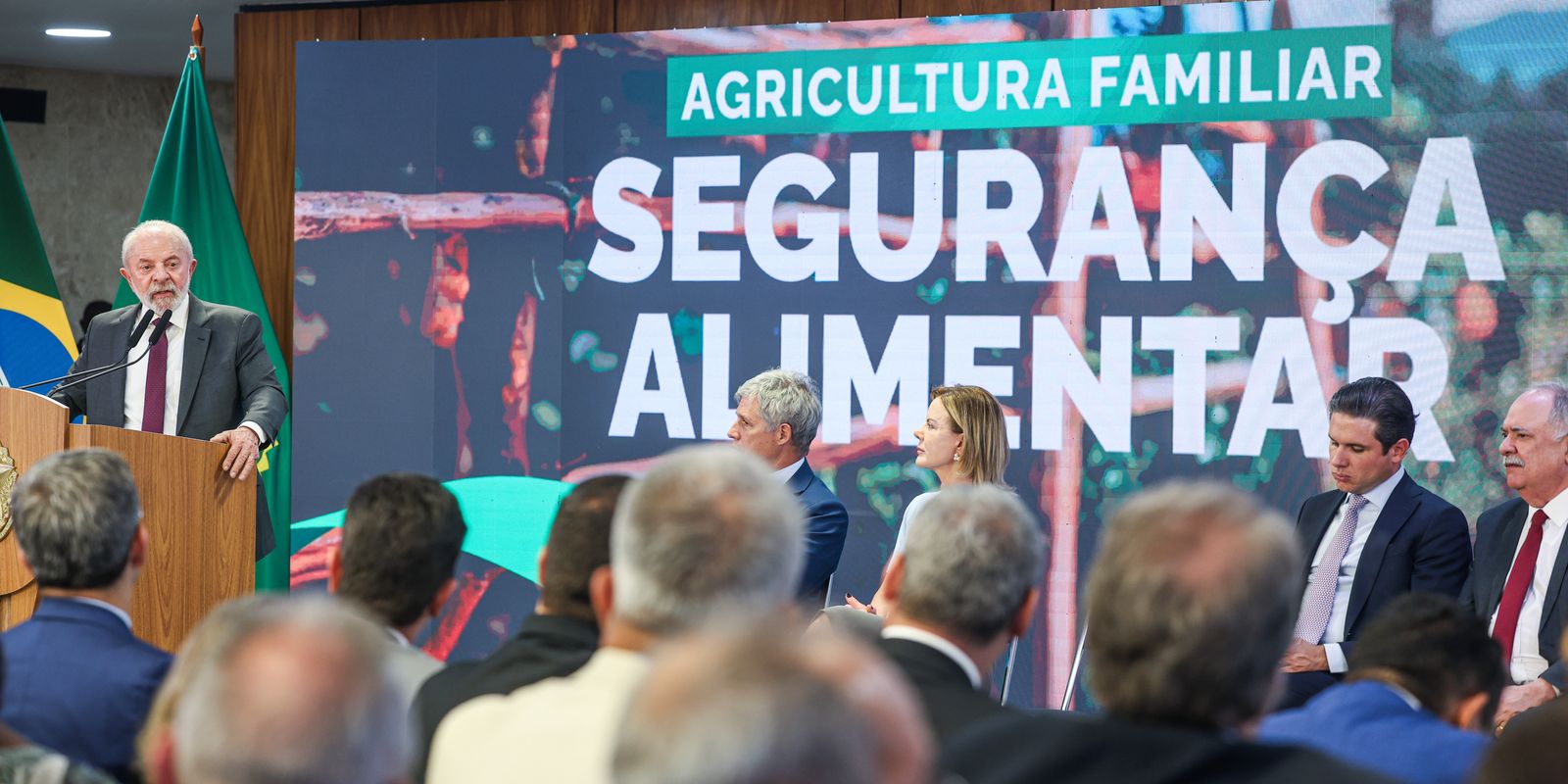
Brazil now has five new federal laws to stimulate family farming and foster the production and distribution of foods for more vulnerable populations and regions of the country. The texts, approved by the National Congress in recent weeks, were sanctioned by President Luiz Inacio Lula da Silva, at a ceremony at the Planalto Palace, on Tuesday afternoon (30).
One of the projects transforms the National Program for Strengthening Family Farming (Pronaf), created in 1995, and the Family Farming Plan, in force since 2003. Since then, the two programs have been regulated by presidential decrees. When transformed into law, they will be consolidated as permanent actions.
Pronaf aims to provide financial and technical support to small Brazilian rural producers, especially those who live in rural areas and have a low family income. The Safra Plan is a federal government program with the purpose of providing resources for the financing of agricultural activity in Brazil. It has a specific modality for family farming, which had been discontinued in 2019, but resumed in 2023. For the 2025/2026 cropthe plan foresees a total of R $ 89 billion in rural credit for these producers.
“Sometimes we have Rusga, we have divergence. But, in essence, the National Congress voted everything that we needed to be voted. So, congratulations, Hugo [Motta, presidente da Câmara dos Deputados]to the National Congress, to the House, “Lula said in his speech after sanctioning the five new laws.
The president made a point of highlighting Parliament’s commitment to the guidelines.
“Democracy is a little, we do not have to be of the same party, we do not have to be of the same religion, we do not have to cheer for the same team. We only have to have the common sense to know what the good things are to meet the interest of most people in Brazil,” he added.
In the same line, the mayor, Hugo Motta (Republicans-PB), emphasized the importance of approved bills, which give boost for the country to face the challenge of combating hunger.
“There is no shortage of food to produce food. Today, we are a barn of the world, yet we need to continually improve our public policies to ensure that food reaches the entire population. Fighting hunger is not a right and left agenda, but from all the Brazilian people,” he said.
School food
ANDNTRE Projects now transformed into law, which increases from 30% to 45% the minimum percentage of family farming products for the National School Feeding Program (PNAE).
According to the Minister of Agrarian Development and Family Farming, Paulo Teixeira, the change represents a 50% increase in the participation of family farming in PNAE, with almost R $ 1 billion in institutional purchases.
“Expands the market, increases the income of family farmers, stimulates production and collective organization, via cooperatives and associations. It benefits students with less processed and regional menus,” said Paulo Teixeira.
Another law sanctioned by Lula establishes the National Policy to Combat Loss and Food Waste (PNCPDA) and creates the Food Donor Seal to encourage the participation of commercial establishments in combating food waste. Two other sanctioned bills create new parameters to prioritize the distribution of food from the Food Acquisition Program (PAA) to municipalities with a low indicator of human development and for those in emergency or public calamity state. PAA is a public food purchasing program for family farming.
Check out the laws sanctioned by the federal government:
- Law 15.223/2025 – Establishes the National Program for the Strengthening of Family Farming and the Family Farming Plan. The law guarantees legal support to programs that offer financial and technical support to small farmers, especially those of low -income, and interest on subsidized interest to the same sector.
- Law 15.224/2025 – Provides for the donation of food by supermarkets. The law establishes the National Policy to Combat Loss and Food Waste (PNCPDA) and creates the Food Donor Seal to encourage the participation of commercial establishments in combating waste.
- Law 15.225/2025 – Includes the Human Development Index (HDI) among the criteria of the National Food and Nutrition Security Policy. The law provides for food and nutritional security indicators, to allow more vulnerable municipalities to have priority to receive public food security resources.
- Law 15.226/2025 – Regulates the validity period of food provided to the National School Feeding Program (PNAE). The law aims to curb the delivery of food for consumption in the school environment, whose expiration date is the imminence of its expiration. Additionally, it increases from 30% to 45% the total financial resources passed on by the National Education Development Fund (FNDE), within the PNAE, for the acquisition of food genera directly from family farming.
- Law 15.227/2025 – Prioritizes the distribution of the Food Acquisition Program (PAA) to municipalities in an emergency situation. The law prioritizes the purchase and distribution of food in municipalities in emergency and or state of calamity, the proposal aims to strengthen food security and support family farming in times of crisis.