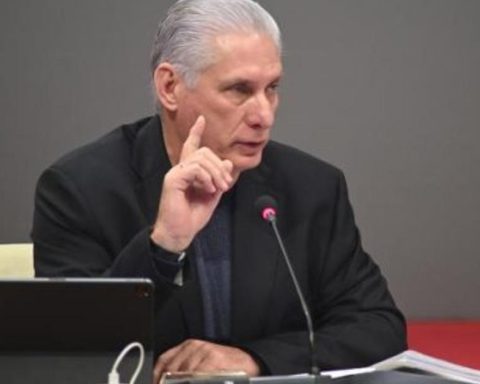
Madrid/The Cuban Government’s strategy to recover the National Electrical System (SEN) is completely wrong, explains the researcher at Texas University Jorge Piñón in an interview Posted on Monday By Bloomberg Line. The expert is clear that, in the short term, it is impossible that there is a solution and bets on a radical change that goes through the use of liquefied natural gas and biomass, the latter in a very relevant way, because it would mean, in parallel, in parallel, the sugar industry.
“If you tell me tomorrow: ‘Hey, here are a $ 20 ticket, where do you put it?’ In his opinion, the island has enormous potential in sugar as a generator of energy, a model that Brazil follows. However, the state of the mills and an increasingly diminishing harvest, play against them. “I would forget to drill to find oil and bet on the Cuban field, to fix sugar plants and increase cane production.”
Faced with the usual ads of the Cuban authorities about, especially with small facilities, which generate just 21 MW each, the specialist rejects this native energy source, due to the high sulfur content that has contributed to a deterioration of thermoelectric plants already in Franco Declive by overuse. Pìñón describes the national crude as “harmful, very harmful”, for thermoelectric plants. “It is a vicious circle: they repair the plants, but they break again for the crude with which they feed them.”
“It is a vicious circle: they repair the plants, but they break again for the crude with which they feed them”
Piñón admits that US sanctions weigh when “recapitizing” the Cuban system, but denies that it is the main cause of SEN deterioration. “There are several projects that Cuba could not finish, such as a wind farm in La Herradura, Las Tunas, a 100% project funded by China. Another example is Ciro Redondo, a biomass plant that cost 186 million dollars, also paid by China, to generate 62 MW, which is inactive due to the lack of sugar cane biomass,” he recalls.
Other foreign actors cited by the specialist are the companies Total (France) and Siemens (Germany), which were in 2018 on the island raising the construction of an electric plant with natural gas, without achieving it. “I was going to take three to five years and there was no money to build it, or financing,” he says, remembering that neither Cubans with their invoices, nor the bank in bankruptcy can pay, nor are there international organizations that can or want to lend money to the island. “As you can see, the only thing is that Russians or Chinese give you new electricity generation plants. I see no short -term solution,” he admits.
Piñón also refers to China’s contribution with solar energy, which, in his opinion, cannot be the only solution, especially with small facilities, which generate just 21 MW each. “I support renewable energies, such as solar, wind and biomass that contemplates that plan, but you cannot put all the eggs in a single basket,” he emphasizes. The lack of batteries, which leaves the energy generated without storing, is a ballast at the moment, adds, and gives as an example a park that has just been built in Texas – where it resides – a French company that provides 720 megawatts (MW) with 225 storage.
The expert is also very skeptical with the support of China or Russia and believes that, beyond political support, in practice it is not the island who interests Beijing and Moscow. “Cuba is like the pawn in a chess, a small piece. For Russia and China, a Venezuela and a Guyana are more important. They want to demonstrate their political support to Cuba, but not a financial support that guarantees a long -term income,” he argues.
“Cuba is like the pawn in a chess, a small piece. For Russia and China, a Venezuela and a Guyana are more important. They want to demonstrate their political support to Cuba, but not a financial support that guarantees a long -term income”
Among the errors of the Cuban strategy, Piñón affects again and again that national oil is a hindrance. The distributed generation – which qualifies as “coal copy of the thermoelectricas” – demands very expensive maintenance, which Cuba cannot afford, as happened with the Turkish floating plants. “The island leased the entire team, but it also had to supply the fuel, and since it had no cash available to pay the lease, there are nothing more than the eight they had originally. The others have left for Ecuador, Guyana and the Dominican Republic.”
In the midst of this bleak panorama, and the certainty that in order to solve the problem of the MoriBundas thermoelectric plants, huge years and amounts of money that do not exist – ”are required to generate 60% energy with plants that use 100% natural gas, would require between 8,000 and 10,000 million dollars and three to five years of work,” he calculates – the expert is forceful.
“We applaud the objective of reaching 37% of renewable energy, and the rest? It should be liquefied natural gas, following the steps of the Dominican Republic, Puerto Rico, Panama. Liquefied natural gas can be brought from Trinidad and Tobago, from a future Venezuela, of Angola, of a county markets, to supply thermoelectric plants instead of doing so with high sulfur content,”