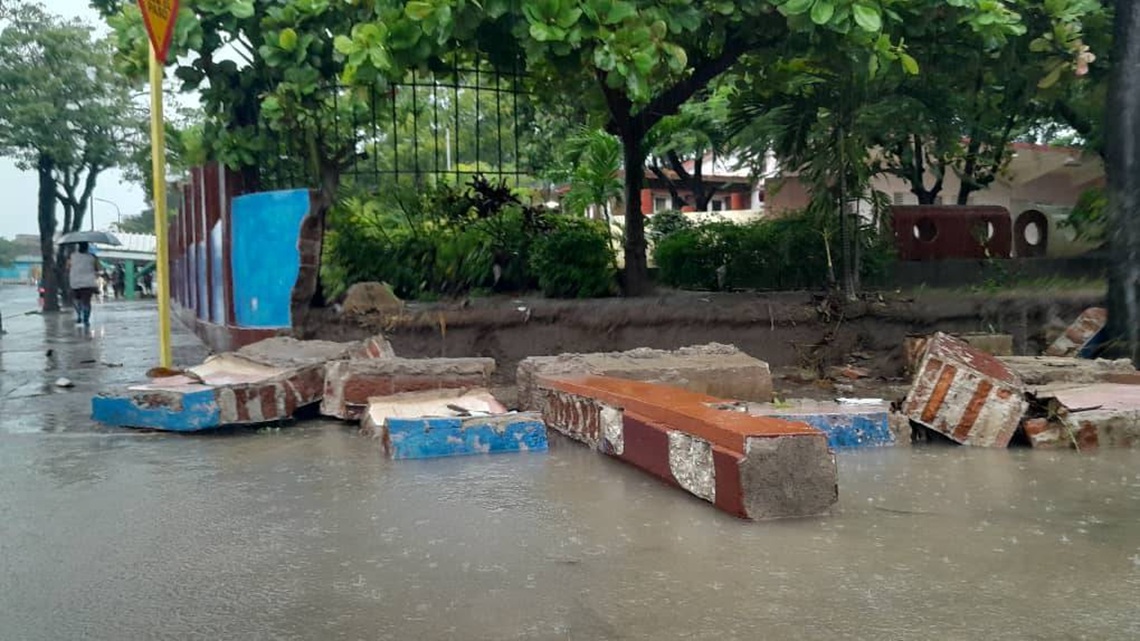
Although the total damage is still quantified, the heavy rains that it brought on the east of the country tropical depression nine – now converted into a tropical imelda storm – have left a trail of landslides in homes and walls, as well as collapses of almost full bridges and reservoirs.
In Santiago de Cuba there have been at least 11 partial collapses of homes and retaining walls, although there are no fatal or injured victims, local television points out in Facebook.
According to the Institute of Meteorology, the accumulated rain exceeded 200 mm in less than 24 hours in several locations of the Cuban East. In the last 24 hours about 340 millimeters of rain in the bell, 330 in sawmill, 316 millimeters in Canasí, 252.7 in the Great Stone are reported. In the city about 250 millimeters accumulated, as well as 219.9 in Chaloons.
Quoted by TV Santiago, Aris Arias Battle, Head of Operations and Relief of the Red Cross in the province, he explained that most incidents have occurred in areas affected by the overflow of rivers, particularly the Siga River, which has left several communities in the area of Baconao.
A publication by the reporter Cuscó Tarradel indicates that hundreds of structures fall apart in dissimilar points, while “thousands of families suffer irreparable losses” and “dozens are inside their homes bathed in water.”
For the journalist, the rains have been “a very hard blow for vulnerable families”, as elderly and homeless children, or atmosphery families, must be evacuated and immediately fed “taking advantage of any recalmon.”
Favored reservoirs
As for the reservoirs, the rains made possible the recovery of Charco Mono, which since April was without operation “for being totally exhausted”.
In less than 24 hours it reached 55 percent filling, the medium points out.
In Holguin, the rains yesterday were greater than 90 millimeters, with rainfall that could still be strong and locally intense.
According to Angulo Radioamong the largest volumes stand out, in the municipality of Moa, with 94.2 mm; Pumpkin of Sagua and Naranjo Agrio, in Sagua de Tánamo, with 90.5 mm and 89.0 mm; In addition to the Pinares de Mayarí and Guaro stations, in the town of Mayarí, with 62.5 and 54.8 mm each, according to information from the Provincial Meteorological Center.
Closure of school activities
In Santiago de Cuba, all teaching activities were suspended as of this Monday in all organizational units and study modalities, “until weather conditions allow it.”
In a statement, the Directorate of the University of the East, in tune with the communiqués of the Civil Defense and the Meteorological Service, takes the measure with the objective of protecting the physical integrity and security of the teaching staff and students, as well as facilitating the work of civil protection.
In that sense, students call for students and student residences, avoiding unnecessary displacements, as well as keeping attentive to official communications through institutional channels.
Imelda tropical storm is born
After winning in intensity and organization, tropical depression nine ended up becoming the tropical storm Imelda, the ninth of the current cyclonic season.
In the most recent part, the Institute of Meteorology indicates that this system maintains strong areas of showers, rains and thunderstorms in localities of the Cuban East, mainly on the provinces of Granma, Santiago de Cuba and Guantanamo.
´
Its central region was located at 2:00 in the afternoon, about 155 kilometers to the west-northwest of the central portion of the Bahamas. The maximum sustained winds increased to 65 kilometers per hour, with upper gusts. Currently, it moves to the north next 11 kilometers per hour, adds the INSET.
From now on, Imelda will remain with similar trajectory, increasing its translation speed, as it continues to win in organization and intensity, becoming a hurricane during the next few days.