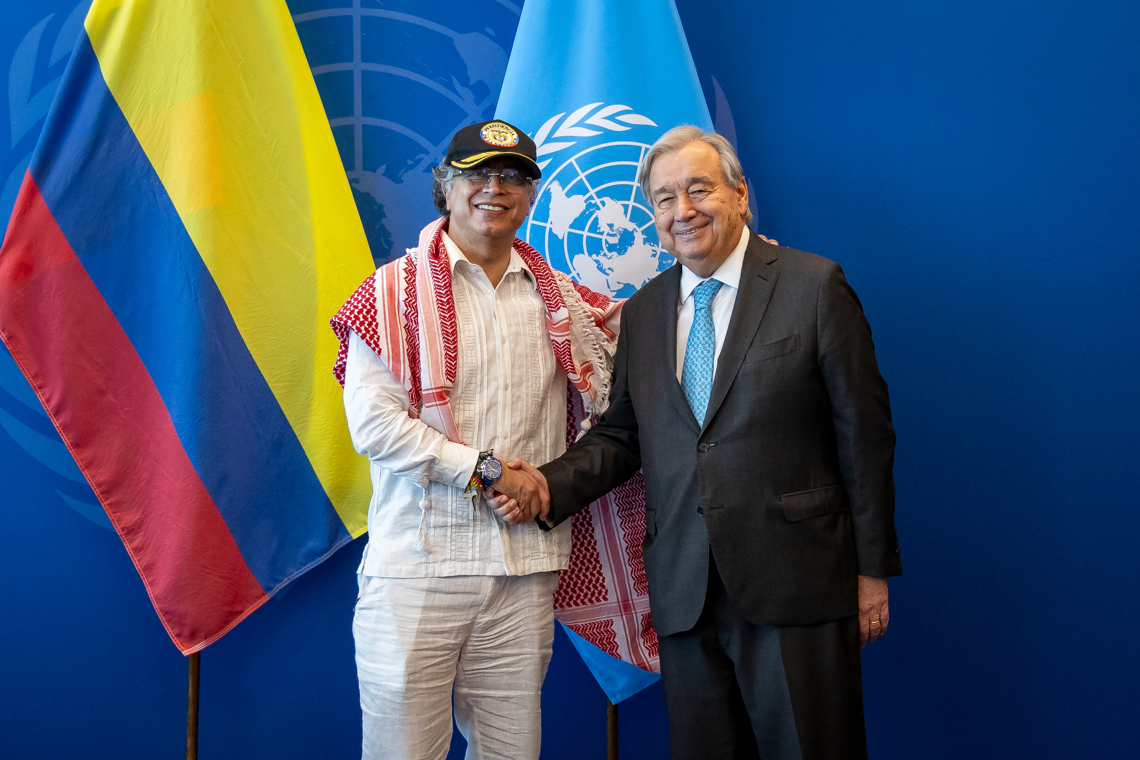
The president of Colombia, Gustavo Petro, denounced that USA breaches international law and affirmeither that cannot remain a good host for the United Nations headquarters in New York.
The statement of the South American president It arrives after the revocation of its American visa, announced shortly after Petro participated in a demonstration in favor of Palestine in the streets of New York, urging US soldiers to disobey orders so as not to attack Gaza.
The President He said that the withdrawal of his visa is a retaliation for his complaint of the “genocide” committed by Israel in Gaza and his support for Palestine.
“I arrive in Bogotá. I no longer have a visa to travel to the United States. I don’t care. I don’t need a visa […] Because I am not only a Colombian citizen but a European citizen, and I really consider myself a free person in the world, ”wrote the president in his social network X.
Petro insisted that “the United Nations headquarters cannot continue in New York”, questioning the impartiality and legitimacy of the host country of the most important global organization.
Visa revocation
The United States Department of State justified the revocation of the visa for the “reckless and incendiary actions” of the Colombian president during a protest in New York, where Petro called American soldiers to disobey the orders of President Donald Trump and avoid attacking Gaza.
The United States government considered it an incitement to violence. This decision occurs in the middle of an escalation of diplomatic tensions between Washington and Bogotá since Trump’s arrival at the White House for the second time.
The Colombian president had publicly criticized the American policy towards Israel, qualifying military actions in Gaza as a genocide and calling for the formation of a “world salvation army” that defended Palestine with a power superior to that of the United States and Israel together.
In the demonstration, accompanied by the musician British Roger Waters and the Colombian ambassador to Washington, Petro emphasized that the diplomatic route had collapsed after the US veto in the UN Security Council.
https://www.youtube.com/watch?v=6xwxcmtsu7o
Context of the crisis in relations between Colombia and the United States
This is not the first time that the relationship between the two countries is tense. In January, Petro prevented American military flights with deportees to land in Colombia, which led Trump to impose sanctions and cancel visas to Colombian officials.
Subsequently, in July, both countries temporarily withdrew their ambassadors after Petro accused the United States of planning a coup against him, an accusation that Washington described as “unfounded and censurable.”
In addition, a few weeks ago the United States “booked” the Colombian struggle against drug trafficking, claiming breaches in their commitments, while Petro assured that Colombia’s armed forces have confiscated record amounts of cocaine.
A radical and controversial proposal in the UN
During the UN General Assembly, Petro proposed an unconventional initiative: the creation of a multinational army more powerful than the American to defend the Palestinian people and stop what he described as Israeli genocide.
He said he was willing to participate personally in the fight if necessary, stating that “if we really started, Trump’s voice and Netanyahu’s voice will be silenced by their own peoples.”
Colombia broke diplomatic relations with Israel in 2024 and suspended strategic exports such as coal, in direct response to the Israeli offensive in Gaza.
Bogotá’s position, with Petro’s leadership, has aligned with the denunciation of the damage to the Palestinian civilian population and with increasing international support to the Palestinian cause, which include formal awards from several countries to an independent Palestinian state.
Meanwhile, the International Criminal Court has issued an arrest warrant against Israeli Prime Minister Benjamin Netanyahu for crimes against humanity.
United Nations evaluates genocide complaints presented by South Africa and backed by Colombia, adding another dimension to the fractured relationship between Bogotá and Washington.