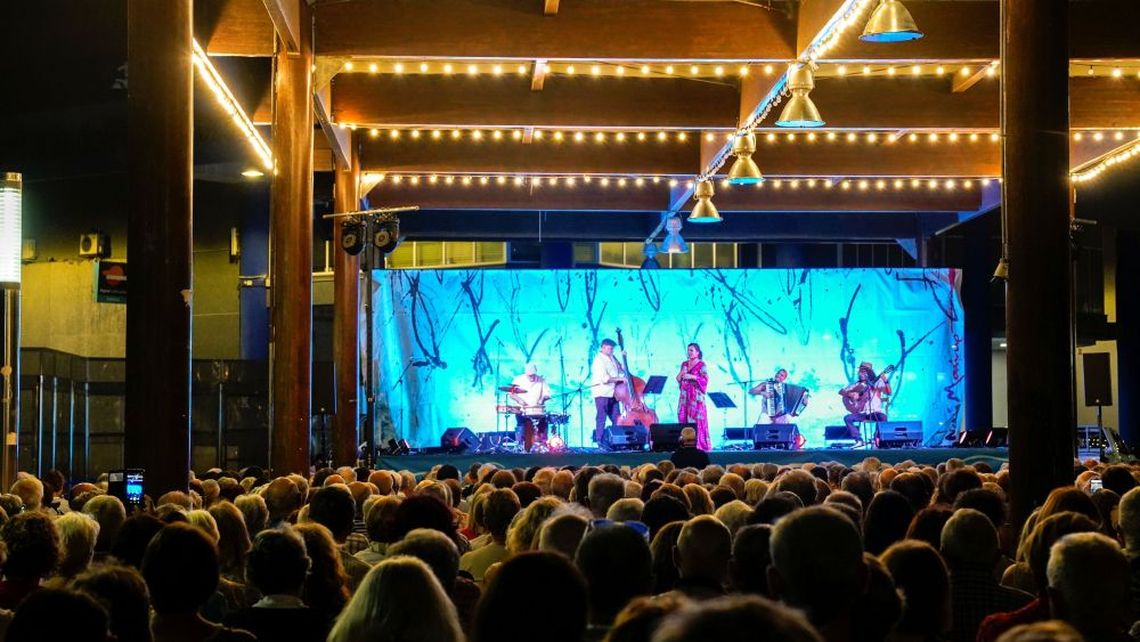
This Sunday, September 28, the I Day of Habanera 2025 starts in the Catalan city of Tarragona, a festival that seeks to consolidate and disseminate Havana as shared cultural heritage between Catalonia and the Caribbean, He referred a radio encyclopedia note.
Organized by the Catalan-Ibro-American Cultural Association (ACC-I), with the collaboration of the Vila-Seca City Council and the Department of Culture of the Generalitat of Catalonia, the event will take place in the gardens of the Castillo de Vila-Seca, whose documented origin dates back to the twelfth century, between 1162 and 1168, when it was the defense tower of the local fief and served to protect the population, goods and food from looting attacks.
Musical program
The inaugural day will feature the participation of Cuban pianist Cecilio Mueles Ferrer, who will interpret emblematic works such as “Felicita” by Ulpiano Estrada and pieces by Manuel Saumell, one of the first Cuban classic composers that integrated elements of Havanera.
In addition, the public will listen to “Habanera de Tres Divertimos” by Xavier Montsalvatge, by Jordi López Roig in piano, and “La Habanera” by Ernesto Lecuona, another undisputed teacher of this music.
The musical program is completed with performances of the Caelastis quartet, the pianist Marc Torres, singer Alba Fortuny and groups such as Havana Vieja Habaneras and Jacaranda Habaneras. The day will also begin the theoretical part of the festival, with presentations that will address the history, influence and future of Havanera.
Presentations and debate on the cultural influence of Havanera
The theoretical event will be moderated by Maica Vidal Rull, president of the ACC-I, and will have relevant investigations. Among them, the outstanding presentation of Dr. Cecilio Mueles Ferrer about “The Catalan presence in Havana in Cuba”, which will analyze the historical and cultural link between Catalonia and the Caribbean island through this genre.
Musicologist Gerard Moreno Sabaté will address “La Habanera at the School of Music as a multidisciplinary pedagogical tool”, showing how this gender It can be a valuable educational resource.
For its part, Pere Domènech Santos, patron of the Foundation of Habaneras Ernest Moratón and member of the ACC-I, will exhibit the “Havana in Catalonia and in the Spanish State. Proposals for its consolidation”, while Enric Frigola Viñas, president of the Ernest Morató Foundation, will present a study accompanied by his experience on the objectives of the Foundation thirty years after his creation.
https://www.youtube.com/watch?v=uvavu-2k61o
A musical genre with deep and universal roots
Havanera is a genre of song and dance that emerged in Cuba during the nineteenth century, characterized by its slow and cadencious rhythm that fuses African, Spanish and Caribbean elements.
Initially popular in Havana, Havanera spread rapidly to Europe, especially to Catalonia, where she joined the local musical tradition and remained for generations.
With its origin in European contradanza and African music, Havana tells a history of cultural and diaspora miscegenation, marked by its distinctive rhythm In a simple binary compass of 2/4, that is, two times per beat, and nostalgic melodies that evoke the sea and life in the Caribbean.
Composers like Manuel Saumell, Ignacio Cervantes, Ulpiano Estrada and Ernesto Lecuona were vital in the formation and popularization of the Cuban genre, which is still alive at festivals and groups from various countries.
Another fundamental reference was Eduardo Sánchez de Fuentes (1874-1944), a prolific composer that Habanera brought to a high artistic level, combining the romantic musical language with a marked crying.
His best known work is the Havana “You”, along with pieces like “I know about a kiss” and “La Volanta”.
Havanera was also a genre that significantly influenced European music and generated numerous adaptations and arrangements by composers such as Georges Bizet in its famous “Carmen” opera, Emmanuel Chabrier, Claude Debussy and Maurice Ravel, who joined Gender In various musical contexts.
https://www.youtube.com/watch?v=L7hucdug7oi
Tarragona, cultural epicenter of Havanera in Catalonia
The Port City of Tarragona is recognized as the capital of Havana in Catalunya Sud, a consolidated title thanks to initiatives such as “Habaneras in the port”, which in 2025 celebrated its 33rd edition with a program that combines classic groups and renovators of the genre.
With a high artistic level and an important female participation, the cycle attracts a diverse public, both local and other regions, making gender an important living cultural heritage.