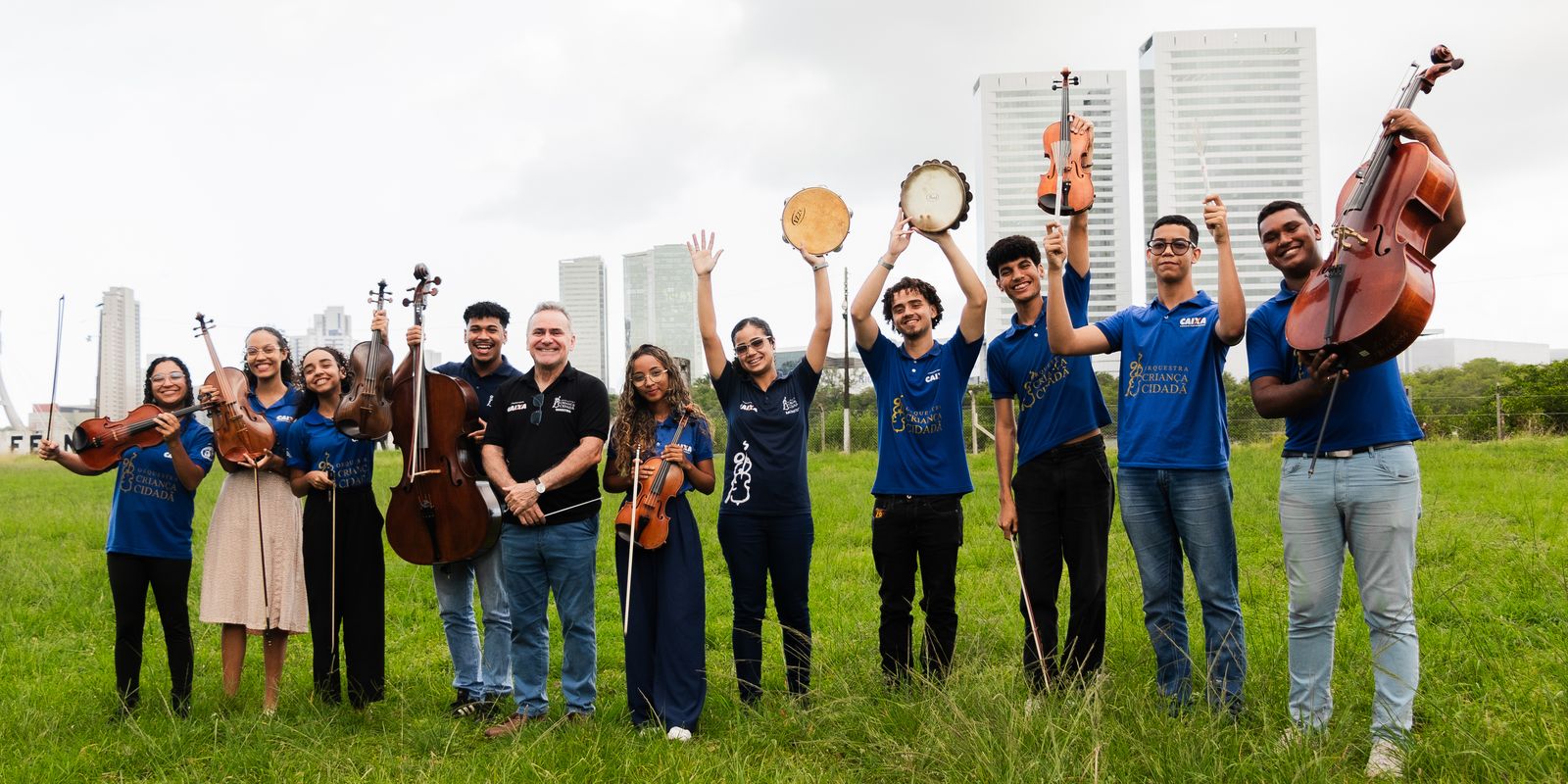
The broom, like the body of cello. The pencil, like the arc that slides on the strings. In the imagination of Pernambuco Callyandra Santos, the music in the head obstructed even the sounds of gunfire in the streets of the neighborhood of Coque, one of the most violent – and stigmatized – regions of Recife (PE). At the time, at the age of 9, she had joined the Citizen Child Orchestra, a non -profit project that more than a thousand children and adolescents like her have passed. New chords entered the community window which, in 2006, had the smallest HDI in the Pernambuco capital. 
Today, at 17, Callyandra was one of 11 selected from the Youth Orchestra from Recife to play abroad on a tour of Asia and Europe. They will be accompanied by musicians from war countries, such as Palestinians and Israelis, Ukrainians and Russians, as well as Koreans from the South and the North.
The tour of what is being called “Concert for Peace” provides presentations in Seoul (South Korea, Tuesday, 30th), Hiroshima and Osaka (Japan, October 4th and 5th), in Rome (Italy, on the 7th) and the Vatican to the Pope (on the 8th).
“Nothing was in vain”
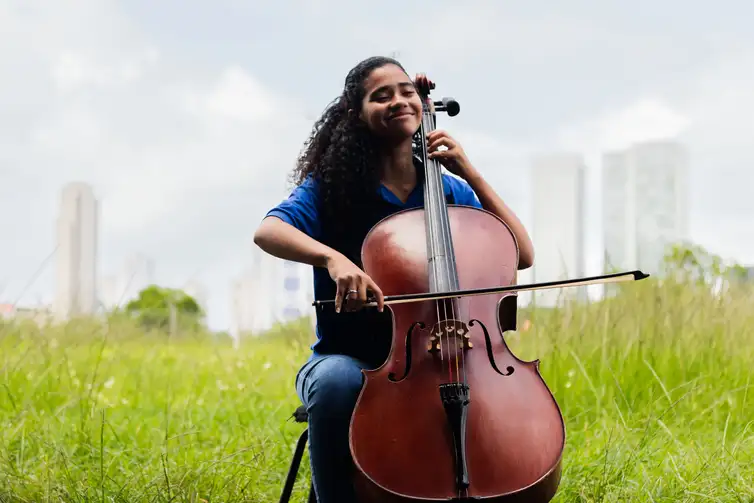
Recife (PE) – Callyandra Coutinho, member of the Citizen Child Orchestra. Photo: Augusto Cataldi/Ascom OCC
In Callyandra’s story, like her colleagues, nothing was simple. The mother, Sara Coutinho, 47, works every dawn in a soda factory at more than an hour at home. She is entitled to just one break a week and can only hear her daughter rehearse at lunchtime – while the girl trains with the cello, her mother can rest with this new sound. “It’s a unique opportunity in life. I’m very proud,” says the mother.
Sara is a solo mother and learned from the orchestra by her nephew, David Andrade, who started in the project at 7 years old. He graduated in music at the Federal University of Pernambuco (UFPE) and today, at 26, is a teacher. David will also tour. His neighbors have already gotten used to the soundtrack at the door.
“In music, my cousin David was the one who inspired me the most. He also became my teacher,” says Callyandra.
By witnessing the boy’s trajectory, the girl also intends to follow the lines of her sheet music: to go to college next year.
In life, the mother’s daily struggle and the memory of her grandmother, who died during Covid’s pandemic in 2020, inspire the girl and cause her to breathe deep when playing.
“I want to show them that nothing was in vain,” says Callyandra.
Eye -filled bach
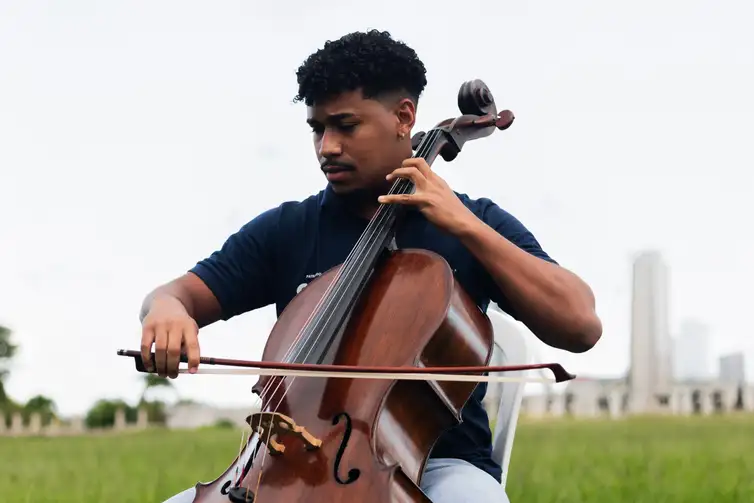
Recife (PE) – David Andrade, member of the Citizen Child Orchestra. Photo: Augusto Cataldi/Ascom OCC
Among so many songs that have already undergone their young strings, Johann Sebastian Bach’s “Suite for Cello Nº 1”, makes the bun girl fill her eyes with tears, while making the bow moving between the present, the past and whatever for the future.
David, Callyandra’s cousin and inspiration, recalls that he learned the cello from the supported instrument, even without being able to step on the floor so small that it was compared to the equipment.
“At 13 years old, I saw that it would be my profession because it changed my history and my family.”
It was at the orchestra headquarters that he made the three meals of the day, in an Army Barracks (7th Supply Deposit), an institution with which the music project has a partnership. As a teenager, the boy touched Pope Francis.
At only 19 years old, he became a teacher at the orchestra nucleus in a rural area of the city of Igarassu (PE). There he teaches music for teenagers who, during the day, work in the fields with their parents.
“I identify with them. I see myself in them.” In addition to Igarassu and Recife, young people in vulnerability in the city of Ipojuca, on the south coast, they also have a chance to learn. In all, there are 400 students in the three units of the project. For him, as important as musical notes is solidarity that comes in sounds and gestures, among masters, young people and musicians. One drives the other not to give up.
Peace
While playing the Czech Cello Concert Antonin Dvorak (1841 – 1904) at the door of the coke, David regrets that he lost friends to the neighborhood violence, previously taken by factions.
“We had in the orchestra children of parents of different factions. Music helped establish peace many times,” says the musician.
He understands that the orchestra teaches more than music. “The orchestra literally has a social aspect in the very important bun that does not fit in numbers. Teaches citizenship.”
The orchestra project was created 19 years ago by the Judge João Targino, of the Pernambuco Court of Justice (TJPE). After joining the Child Citizen Program, which worked for homeless people, the magistrate chose to create a choir. From voices to instruments, it was a new boldness.
“We chose the Coque community because it had the worst rates of human development and the highest rate of violence,” he recalls.
Maestro José Renato Accioly, 59, says that bringing together young cultures is challenging, but shows how music has universal language. He explains that the repertoire will contemplate songs from the different nationalities. And of course, it includes Frevo and Medley of Brazilian songs.
“They are very high level musicians. Regardless of whether they will want to follow in music, they will never forget this opportunity they had to be in this orchestra.”
German accent
One of the experienced musicians who will play on the tour is the 32 -year -old double bassist Antonino Tertuliano. He was also born in the coke and joined the orchestra when he was only 14 years old. Today, he lives in Germany and is a member of Niederbayerische Philharmonie Orchester (the Baviera Philharmonic Orchestra). He is a project enthusiast and is part of the organization of international events. “The meaning that the citizen child has for me is huge. I have immense gratitude,” he said in an interview with Brazil agency.
Whenever you are in Brazil, you visit the old masters and the new students. “I present to young people my current reality and I say that it is possible to conquer the world.”
Thrilled, he recalled that when he joined the project, he had no knowledge of music. Student from a local public school, he enchanted after he took a musical aptitude test.
“The project remalled the neighborhood and the community. This social project presented not only a profession but another prospect of the future.”
“It was difficult to raise a child in the coke”
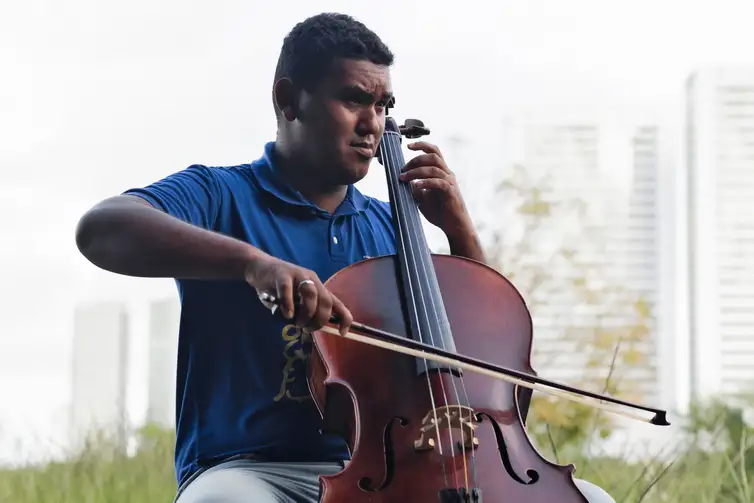
Recife (PE) – Cleybson Silva, member of the Citizen Child Orchestra. Photo: Augusto Cataldi/Ascom OCC
One of the young people who arrived for the project and then became a cellist was Cleybson da Silva, 21. He arrived at the project at age 13 and, in 2020, lost his mother to Covid. “Music has totally changed the course of my life,” says Clebson, who today is a degree in music at UFPE. The father, Clayton Oliveira, 44, works with installation of security cameras.
“In the past, it was very difficult to raise a child in the coke. It was very dangerous. We always heard shooting,” Clayton recalls.
The noises changed. For him the transformation of the place has direct relationship with the orchestra. The father is proud because the youngest son, Bernardo, 7, has also started in the orchestra.
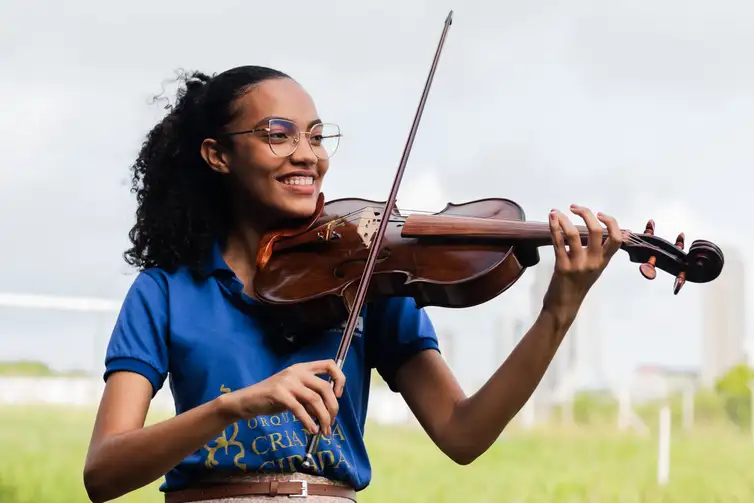
Recife (PE) – Ana Clara Gomes, member of the Citizen Child Orchestra. Photo: Augusto Cataldi/Ascom OCC
Already Ana Clara Gomes, 17, fell in love with the guitar when she was in the evangelical church she attends. It was love to the first sound. So much so that the musical notes since childhood began to draw even on the wall. The scenario of your life has the landscape of the suburb, the roofs with flaws and wires tangled on the light poles.
When he learned that he would have the first opportunity to travel outside Brazil, he had five days to rehearse music by composer Camargo Guarnieri (1907 – 1993). “I was studying nonstop.” The first musician of the family was raised by his mother, who is a nursing technician, and saw in the song a chance of happiness after his father died eight years ago.
A year ago Ana was able to buy, in installments, the instrument itself. And to think that at first, what made the role of the guitar was the soap box powder to feel the weight of the new instrument.
Soap powder
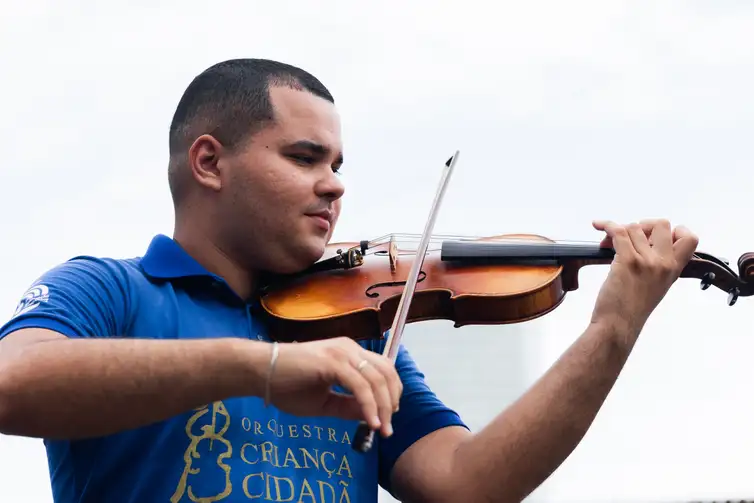
Recife (PE) – Pedro Martins, member of the Citizen Child Orchestra. Photo: Augusto Cataldi/Ascom OCC
Violinist Pedro Martins, 21, also used the soap box powder, as if it were the instrument, and the pencil, as if it were the bow. “If you don’t hold the right violin, the music comes out differently.” He had a taste for music listening to his father, who is a application driver, playing guitar in the room.
To imagine the song, I took CD home to play the old stereo. When it started, there was no computer at home, no cell phone.
“I turned the small room at my stage. My parents had to hear me,” recalls Pedro.
The father, George Silva, 41, proudly, recalls that he changed the work schedules to applaud the Filon, who is attending music at UFPE. “He didn’t get involved with the wrong thing. He didn’t move on the church guitar. Who would say now will travel the world around. I never passed a plane or college.”
The father regrets that he lost a brother, brother -in -law, and friends to “wrong things,” particularly drug involvement. The son plays the violin and he sees the neighborhood of before becomes farther and further. The bun, the difficulties of every day, the hope that knocked on the door of the neighbors.
The world became another and didn’t even need a plane. It started with a box of soap powder.
“Every time I play, I think of my parents and how much they insisted. Today our family feels in the clouds,” said the violinist before boarding.