The betrayal of Padura is not only to some characters who have dug deep among Cuban readers.
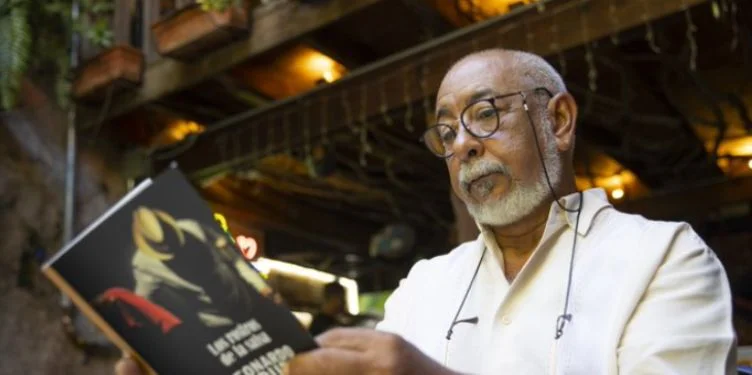
Havana, Cuba. – Leonardo Padura will not die in Paris, on Thursday with a downpour, like his admired Peruvian poet César Vallejo, but in Mantilla, a peripheral neighborhood south of Havana. However, his desire will only be fulfilled if he does not take the grim before a flight to Barcelona or Madrid, in the midst of the presentation of his novel Death in the sandthe latest novelty of the author of Tetralogy The four stations, my life’s novel, the man who loved dogs and Hereticsamong other titles.
To die in Mantilla, the creator of the sui generis Cuban detective Mario Conde, protagonist of the novels of the mentioned tetralogy and Yesterday’s mistamong others, he would do it among the ruins of his native neighborhood, in a tangled house, with surveillance cameras, alarms and illuminated by an electric plant of 4,000 dollars, to prevent some of his childhood friends from falling into the temptation of the robbery with violence.
The problem is that the friends of childhood or the pre of the viper who in the novels serve as a fraternal to condemnation for or after each detective adventiveness to solve a case of murder, corruption, drug trafficking or other crimes throughout Havana, have multiplied by tens of thousands throughout the country, such as a criminal plague that does not repair family steal.
Besieged by general shortage, blackouts and other individual or collective calamities, characters such as Candito, Jehovah’s witness; Yoyi El Palomo, jewelry trafficker; Carlos El Flaco, from a wheelchair for life because of a bullet received in the War of Angola; Tinguaro, the taxi driver and seller of Montecristo and Cohiba tobacco, today can be found in any corner or prison of Cuba.
They and the rest of the friends of childhood or the pre of the viper like Andrés el Rabbit “The Chemist”They kill an entire family in the blind of Ávila or the Lisa, contemplate their titles of professionals hanging on the wall that are of no use, do the unspeakable to eat in Cuba or send remittances from exile to their relatives.
Hence the contradictions of condemaduras jump from fiction literature to real life full of conjectures of Cubans. Padura’s public statements in nothing resemble what their characters express.
When Padura puts Mario Conde in the mouth, feeling as “someone even unknown, located too much time among the supposedly strong and powerful, when his nature tended to militancy at the club of the dissatisfied,” I see an self -portrait of the writer. However, in His statements to journalist Jorge Morla, from the Spanish newspaper The countryhe regrets that in Cuba “men and women are discovered poorer than ever”, and then he adds: “We have no choice but to incorporate all that misery into life, and in many cases, shut up.” More than disagreement, this cowardly call denotes submission so that Cubans give up not only to manifest and protest, but also to express their opinion.
The betrayal of Padura is not only to some characters who have picked up deep among Cuban readers, trapped between sympathy and suspicion towards an author who puts in the mouths of his alter ego: “Too many people without dreams or hopes. Too much fire under a covered pot that sooner or sooner would burst by accumulated atmospheres.”
I cannot deny that I admire, read and reread all Padura’s work, but, in a inversely proportional way, I despise him by ambivalent and cowardly.
You can die in Mantilla, an any day of blackout and lack of water and food for childhood exams and its neighbors, but I am sure that few of them will attend their wake and burial.