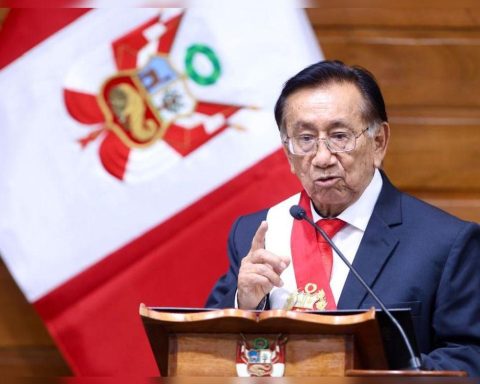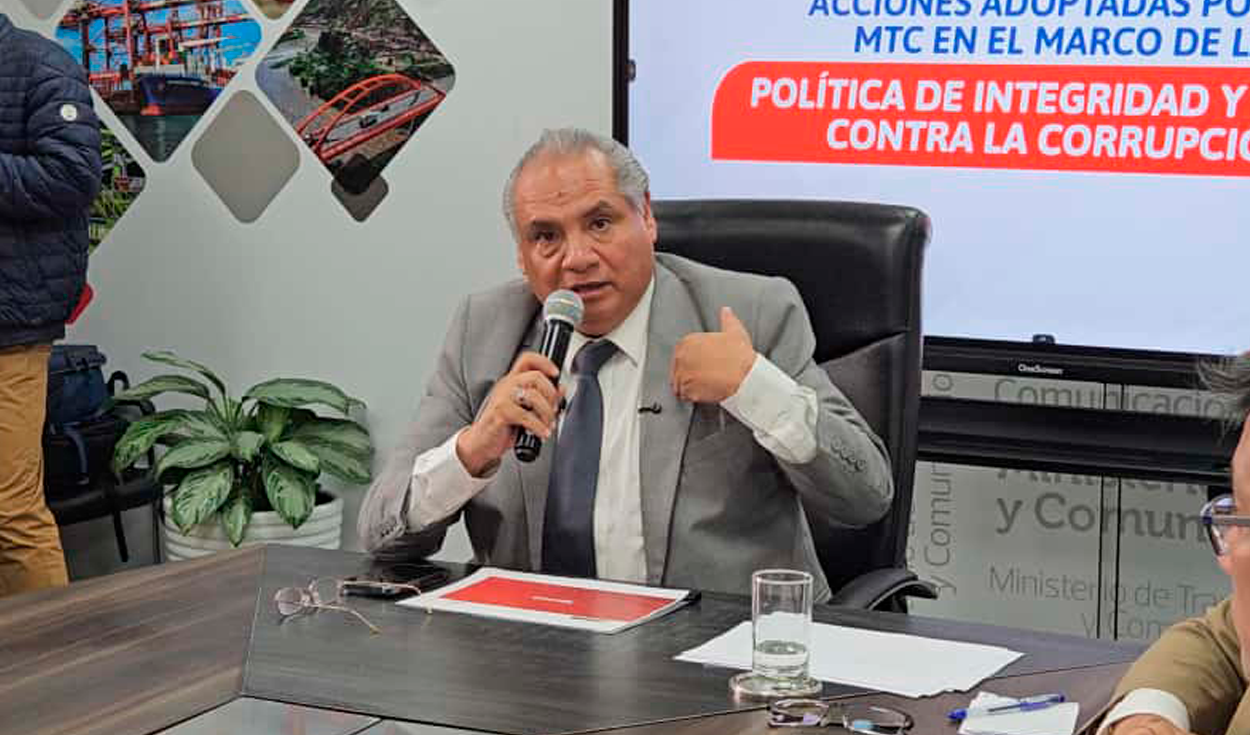
During a conference, the minister César Sandoval He gave scope about The administrative restructuring of national and decentralized Províasofficialized on August 16 through Ministerial Resolution No. 564-2025-MTC/01. The decision was adopted after identifying “administrative and management deficiencies, critical weaknesses in administrative systems that generate risks in the use of resources, as well as limitations in the provision of services and execution of specific orders”, according to the norm published in the Peruvian.
Sandoval said that in “less than five months we have done what others could not, or did not want to do in years.” He said that since August 12, the Evaluation Directive was approved, which forces the members of the Selection Committees to be appointed by specialty criteria and without conflicts of interest. He also said that “we have asked the Comptroller to exercise concurrent control in all investment projects” and that “we are already filtering suitable profiles.”
You can see: Police Chief accuses Juan José Santiváñez to pass it to retirement for looking for “the monster”
Critical cases
In his exhibition, Sandoval gave concrete examples that graph the magnitude of irregularities. The most popular case is that of the Boca del Río road, in Tacna, where the selection committee would have leaked privileged information about the offers of nine bidders. “The president of the Committee entered 43 times to visualize the offers before the evaluation,” said the minister. Given this, on August 8, the fact was denounced to the Anti -Corruption Prosecutor and, weeks later, on September 3, the nullity of the process valued at S/ 650 million was declared.
In Checca -Mazocruz, Puno, the previous management of Provías Nacional signed a contract in April without demanding the guarantee of faithful compliance, although advances had already been granted for more than S/ 32 million. “Instead of defending the State, it was signed despite irregularity,” Sandoval reproached, ensuring that his office has been correcting that situation.
Something similar happened in Pasco – Ingo María (Section I), where the good Pro was given to a consortium prevented from hiring with the State. Provías Nacional declared nullity in August, but now faces a precautionary measure that orders to continue with the signing of the contract, which maintains the work in a legal limbo.
Another case under the magnifying glass is that of the Picota bridge, in San Martín, where false documentation was presented in the supervision process. Although a precautionary measure sought to stop the decision, on August 5, Decentalized Provías declared the nullity and criminally denounced the consortium involved.
Finally, in the Molinopampa -Huari road corridor, in Áncash, failures were detected in the award process and the nullity was also arranged to avoid greater damages.
“These facts confirm that restructuring is not a whim, but a necessity. We could not continue with the same officials and practices that put the State at risk,” said Sandoval. However, he avoided specifying which companies or consortiums are directly involved, just pointing out that “everything is being evaluated” within the framework of restructuring. Will they continue to operate?
Pullas between ministers
In the final stretch, Sandoval launched the phrase that marked the conference: “In less than five months we have done what others could not, or did not want to do in years.” The statement sounded like a dart to its predecessor, Raúl Pérez Reyes, current Minister of Economy and member of the same Council of Ministers.
Asked by the Republic, Sandoval retreated: “I have not committed Minister Pérez Reyes. He delegated functions and trusted his officials. On the contrary, he supports me in what I am doing.” However, several of the cases indicated occurred during the management of Pérez Reyes (September 2023 – May 2025). “If Minister Pérez Reyes must answer for something, he will have to do it,” he admitted in another passage.
The change route
The ministerial resolution created a temporary sector commission responsible for evaluating critical processes. The key term is October 10, when an integral report with results and correction measures must be submitted.
Meanwhile, on September 25, 16 public entities were convened – among them Comptroller and Regulatory Organizations – to provide recommendations on contracting, investments and personnel selection. “It is no longer among groups or among office. Now all institutions participate, listen to officials and evaluate each one. That means transparency,” said the minister.
At the close, he avoided giving more details about ongoing projects. He only left one postcard: “While we talked here, there is a meeting with 16 institutions, including the Comptroller, evaluating how restructuring is walking.”