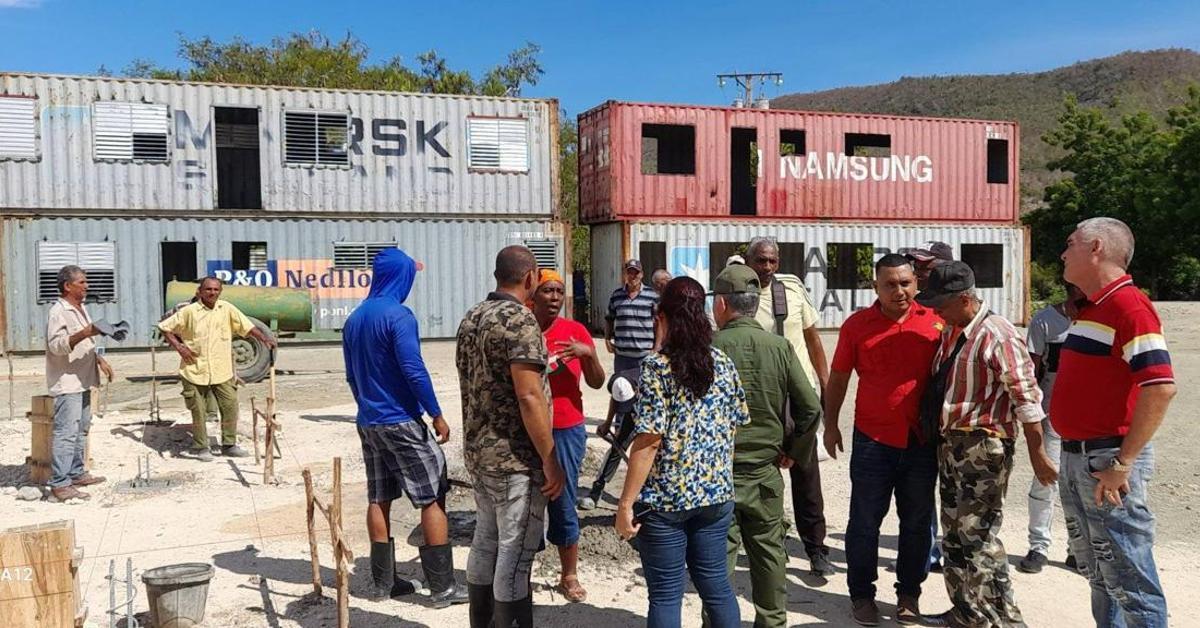
Havana/In a country without cement, blocks and cabillas, the State has taken hold of containers and has made them homes. If before the boxes were only conditioned as annexes of companies and temporary premises, now the country has a whole plan for them to inhabit dozens of families throughout the island. The main problem, and what worries the future tenants more, is the incompatibility between tropical heat and a house completely made of metal.
In Sancti spíritus, areas in eight municipalities have already been located where 133 containers will be installed “that reach the end of their useful life after merchandise transport operations”, in this case, to transport the solar panels that arrive on the island. The project, which has been launched in other provinces such as the Tunas or Guantanamo, intends to be “an alternative to the deficit of essential materials to build, as cement, steel and aggregates ”.
The authorities have insisted that recycling containers to turn them into homes is a resource used throughout the world. However, they overlook that these are generally dedicated to well -conditioned tourist facilities, with air conditioning at all times and all kinds of comfort. They are rarely dedicated to the construction of permanent housing for the population to which air conditioners are not even installed.
Even so, the official press emphasizes that the containers are installed “anti -line coatings on interior walls and additional roofs” that make them suitable for serving as a house. Reinforced concrete piles are also included to avoid corrosion and moisture and, as a plus, the authorities mention an “adequate aesthetic finish”.
“This is something very incipient, but, given the shortage of resources, the housing construction plan rests on that modality”
“This is something very incipient, but, given the shortage of resources, the housing construction plan rests in that modality, hence the majority has as main destinations those affected by weather events, mainly in Yaguajay, as well as mothers with more than three minor children, among others,” he explained to Escambray Néstor Borroto González, director of the housing in the province.
In the face of the reluctance of the population, which sees in the containers a half solution to the housing crisis of which in a short time the disadvantages will begin to be noticed, both the state press and the authorities ensure that everything is benefits. “These houses will have different dimensions, depending on the size of the structure, and will include kitchen, bathroom, dining room, doubles, doubles and simple windows from raw materials and local products that will be compensated with some of the national balance.”
The measure is already implemented nationally by the company of architecture and engineering projects of Mariel, and in each province are the local authorities in charge of “the foundations and urbanizations”.
Last Monday, the ruling in Guantanamo gave part of the installation of 14 containers in Buena Vista, a town in the municipality of Yateras. The improvised houses will be destined for those affected by Hurricane Oscar, who expect the help promised by the State for a year.
Last Monday, the ruling party in Guantanamo gave part of the installation of 14 containers in Buena Vista, a town in the municipality of Yateras
Before, at the beginning of August, it also spread THE CASE OF THE TUNAS. Then, Héctor Rodríguez Espinosa, provincial housing director, announced optimism that the first containers would be installed in the municipalities of Manatí, Puerto Padre and Majibacoa. Among the advantages that the resistance, durability and low environmental impact are awarded.
“At the moment the province has 46, 18 of them were assigned to the electricity company for the construction of nine homes for their workers and 28 to deliver through the popular councils with the delegates, the community groups and the government in each territory,” said the manager.
According to the National Office of Statistics and Information, although in 2024 the Investment in housing It was 54,553 million pesos (14% more than a year earlier), the finished premises were only 7,427 (53% less than 2023). As if that were not enough, 62% of those homes were built by their own effort.