In 1798, in the midst of a possible war with France, the United States Congress adopted the laws of foreigners and sedition, promoted by the federalist party, which as its name indicates, defended the idea of a strong central government.
There were four laws that, among other things, raised the residence requirements of 5 to 14 years; they authorized the president to put in jail and deport foreigners; and to suppress newspapers that “printed, issued or publish any false, scandalous and malicious writing or contrary to the government.”
These laws were a direct attack on the first amendment to the Constitution, part of the Charter of Rights that had entered into force on December 15, 1791 in the young Republic. In that first amendment it is established that:
“Congress will not make any law for which a religion as an officer of the State or is prohibited to practice it freely, or that the freedom of word or printing, or the right of the people to meet peacefully and to ask the government to repair the grievances.”
The judicial processes implemented under the laws of sedition and the repression of dissent unleashed a wave of rejection against the federalists of John Adams and Alexander Hamilton, contributing to their defeat in the elections of 1800. That year Thomas Jefferson was elected president of the United States.
The author of the declaration of independence had written in 1786: “Our freedom depends on the freedom of the press, and this cannot be limited without getting lost. And in 1787:“ Being the opinion of the people the basis of our governments, the first objective should be to preserve that right; And if I had to decide whether we want a government without newspapers or newspapers without government, I would not hesitate for a moment to prefer the latter. ”
The laws expired between 1801 and 1802. Historians consider them a nightmare, one of the thickest examples about the fragility of democracy, even in exceptional situations, but at the same time of the strength of the US experiment when correcting the aberrations of the road.
Enemy of the people
One of the lougiest features of Donald Trump’s populist rhetoric is in his relationship with the press and the media. Not only for being carriers of calls Fake News, but also for labeling them as “the enemy of the people”, phrase symptomatically used by dictators and autocrats to delegitimize opposition parties and the discrepants.
Various authors They remind us that during the French Revolution, the expression “Ennemi du Peuple” (enemy of the people) was used to refer to those who disagreed with the order of things in the reign of terror, period in which thousands of people, revolutionary or not, were executed in the guillotine. It was later used by the Nazis under the baton of Goebbels, who referred to the Jews as “jurisdiction enemies of the German people.”
And also by Stalin. An analyst says that the label “could include anyone, from the clergy who did not want to adopt atheism imposed by the State to writers and the political opposition. And could mean immediate imprisonment or transfer to a field of work.”
Counterweights and balances
In April 2023 the Heritage Foundation, a Think Tank With a long and consistent conservative executing, it produced – together with other groups of the Ultra – the so -called 2025 project, a document, in fact, to serve as a platform for the new Republican mandarins in case of winning the 2024 elections.
The ideologues gathered in this forum were among the most persistent promoters of the idea of the so -called “hyperventilated executive”, who wants to put aside the functioning of the counterweights and balance sheets of the US experiment by granting exceptional powers to the president, clearly a distortion of federalism.
Although the 2025 project does not constitute the only source of the conceptual energy that was being given to the possible new republican administration, however proposals contains that they came true once arrived to power, in some cases to the letter: launch a mass deportation program; purge public officials and replace them with loyal supporters; reduce the role of the Federal Emergency Management Agency (FEMA); eliminate federal initiatives of diversity, equity and inclusion; and prohibit the presence of transgender people in the army, among others.
https://www.youtube.com/watch?v=lngsyz4-xf4
It is also one of the bases of certain positions before the media. One of them, perennial discomfort before the work of the press and journalists as Watchdogsthat is, monitor government policies and activities and ask for accounts. In its chapter 8, “media agencies”, it is basically postulated that public news sources are submitted to government control, which loses their independent condition, even if they are financed by the Government.
They are also pronounced for paramentating public broadcasting, in this case, to the Public Broadcasting System (PBS) and the National Public Radio (NPR) throughout the country. Many have reached marginalized communities. Achieving this has been one of the dreams of this sector of the political class, as or more aggressive than those generated by the political constructs of the Reagan administration in the 80s.
“Journalists and media organizations must prepare for the possibility of working in a considerably more adverse environment, in which their rights and reputation are constantly attacked,” warned a critical text early. And he continued: “The media, despite all their defects, have remained a bulwark against the abuses of power and an engine for accountability.”
For conclude: “With the 2025 project, a president with antimedia trends could fuse the conservative political agenda with the strengthening of the Executive Power, which would generate a threat to press freedom and the first amendment.”
https://www.youtube.com/watch?v=bttmus4en98
The author of that chapter 8 is nothing less than Brendan Car, the current director of the Federal Communications Commission (FCC), the government entity that regulates Internet access, communication networks, television and radio.
What speech we like and which no
That most adverse environment prefigured by the aforementioned critic was crowned just a week ago with the announcement of the “indefinite suspension” of the Jimmy Kimmel program. Carr warned that the FCC could take measures against ABC and its parent company, Disney, for the comments that the presenter made in his night program about the purpose of the Conservative activist murder Charlie Kirk.
“This is a very, very serious problem at this time for Disney. We can solve it for good or bad. These companies can find ways to change their behavior and take measures, frankly, against Kimmel or the FCC will have additional work ahead,” said the official suggested after the ABC subsidiaries could face fines or the revocation of their licenses if they continued to transmit that program.
The fact caused a political earthquake in a medium with too many traumatic brands. The first amendment, nothing else, was what was in the center. Even Senator Ted Cruz described the statements of the “dangerous” official.
“I think it is incredibly dangerous for the Government to put yourself in the position of saying that we are going to decide what speech we like and which one does not, and that we are going to threaten to get out of the air if we do not like what you say,” he said.
Charlie Kirk conservative activist dies, a Trump ally, after receiving a shot at Utah Valley
“I hate what Jimmy Kimmel said,” said, But he compared Carr’s comments with the behaviors of the gangsters. “It seems taken from a gangster who enters a bar and says: ‘What a good bar you have here, it would be a shame that something happened to him,” he said. He added, however: “I like Brendan Carr. He is a good person, he is the president of the FCC. I work closely with him, but what he said is extremely dangerous. He may feel good right now to threaten Jimmy Kimmel, yes, but when he is used to silence all the conservatives of the United States, we will regret it.”
A problem for freedom of expression
On the other side of the spectrum there was a true avalanche. Numerous presenters of political humor programs – Stephen Colbert, Seth Meyers and Jimmy Fallon – expressed their solidarity with Kimmel and denounced that it was an attack on freedom of expression and the first amendment.
Celebrities, actors and figures from the cultural world did the same. The ACLU published a letter with the signatures of more than 400 personalities – among them Tom Hanks and Meryl Streep – protesting against Kimmel’s suspension, considering it a problem for freedom of expression in the United States.
ABC suspends Jimmy Kimmel’s program for his comments on the death of Charlie Kirk
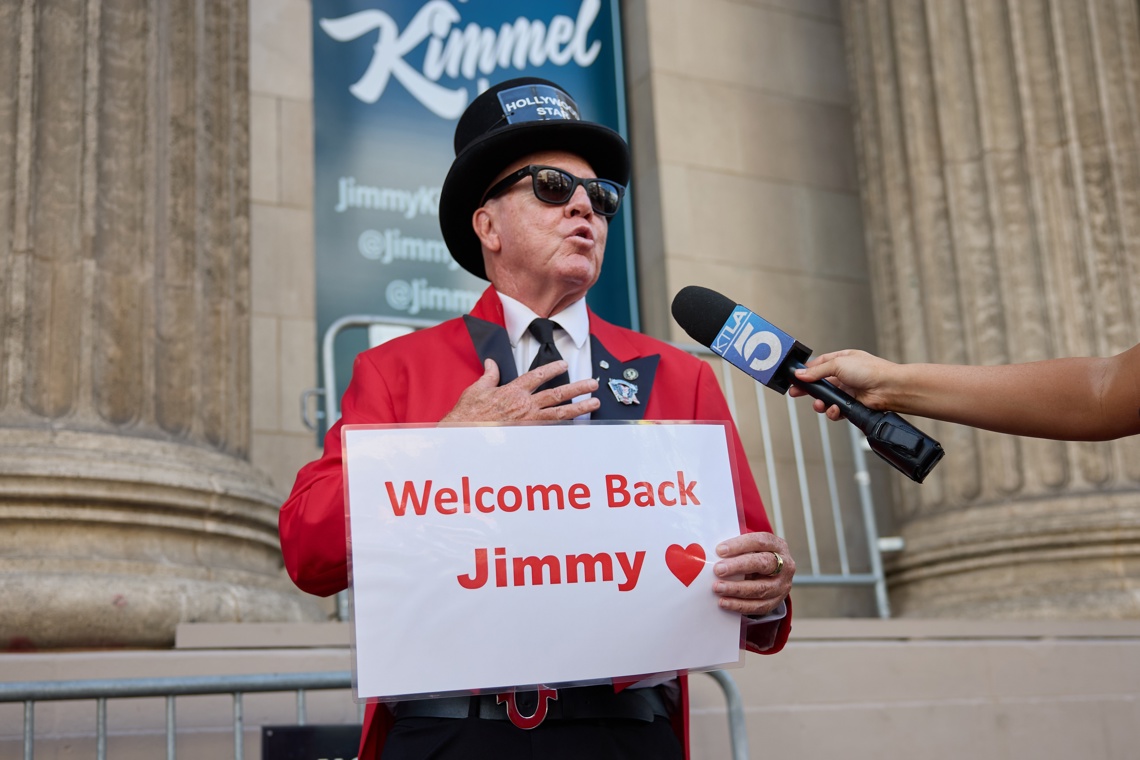
And among the numerous open sky protests, the one in front of the Walt Disney studios in Burbank, California. “This is a crucial moment for our democracy, and we must all defend the principles of freedom of expression,” said Seth Meyers, the NBC comedian. “There is a reason why freedom of expression is on the first amendment. It is above all the others.”
Last but not least, there were calls on the web to cancel subscriptions to the services of streaming Disney At the end of June the company reported having 183 million subscribers to Disney+ and Hulu worldwide.
Kimmel: Trump “did everything possible to cancel”
All this, and more, went up like the foam. On Monday, September 22, in the middle of filtered news about ongoing negotiations, I expected the expected: the announcement of the restitution of the Kimmel program. “Last Wednesday we decided to suspend the production of the series to avoid further aggravating the situation at such a delicate time for our country,” said the company in a statement.
“We made this decision because we consider that some comments were inopportune and, therefore, insensitive. We have spent the last days talking with Jimmy and decided to subtract the series on Tuesday.”
Jimmy Kimmel program will be broadcast on Tuesday in the US after a week of suspension
“Disney ABC was carried away by progressive mob and decided to bring Jimmy Kimmel back,” published the Maga Voice account on the social media platform X. “Power for the people!” Wrote the filmmaker Steven Deknight On the same platform.
For its part, in the first broadcast of your show, Kimmel said: “You understand that it was never my intention to downplay a young man’s murder. I don’t think he has anything funny.” And that your program “is not important.”
“The important thing,” he emphasized, “we can live in a country that allows us to have a program like this.” And about Trump: “He did everything possible to cancel. On the other hand, he forced millions of people to see the program.”
Indeed, he tripled his audience: 6.3 million viewers saw him live. Towards the 1 am his initial monologue had 11.8 million views on YouTube and 5.2 million on Instagram.