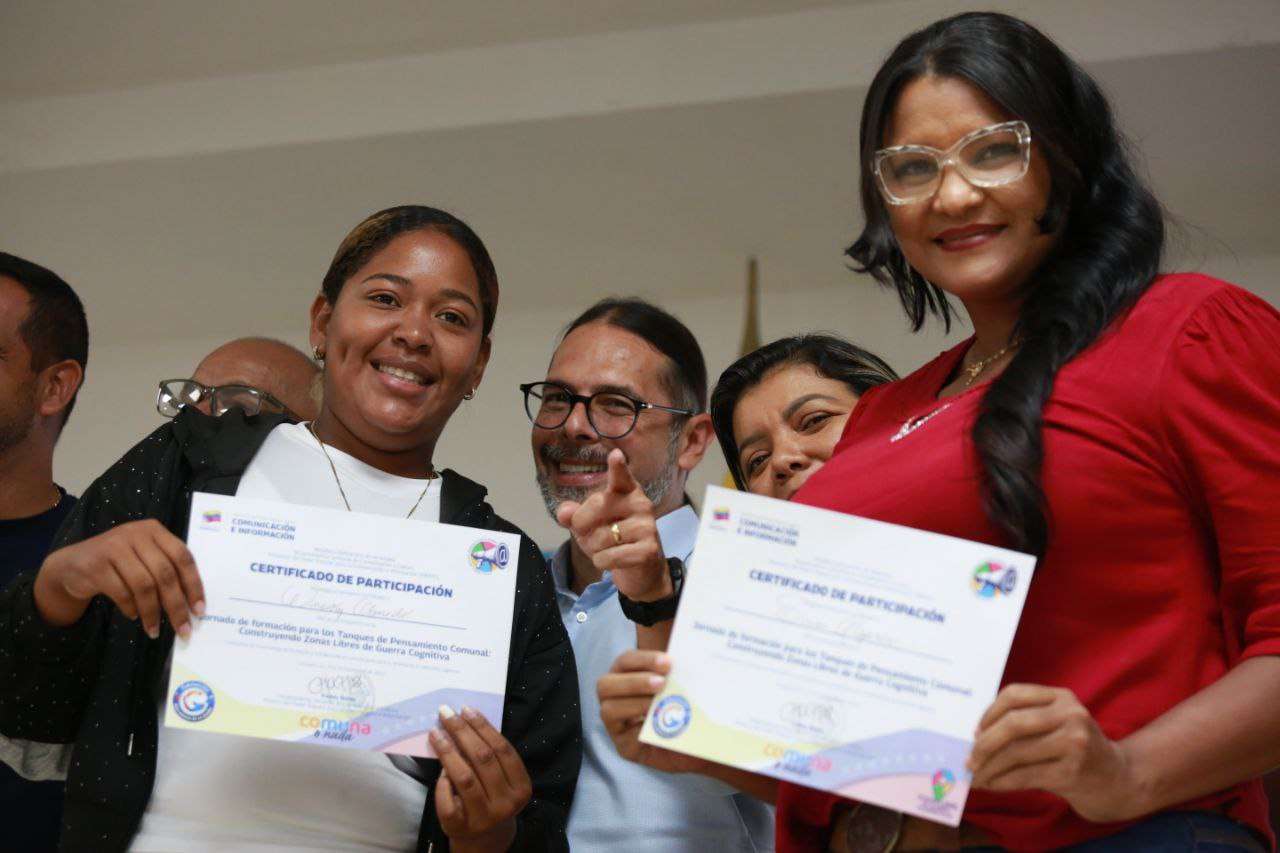
From the La Guaira state, a training day for communal thought tanks was developed, with the aim of consolidating a cognitive -free zone.
This initiative seeks to strengthen the communication consciousness of the Venezuelan people in the face of the challenges of misinformation, digital isolation and media manipulation.
The meeting, led by the Minister of Popular Power for Communication and Information, Freddy Ñáñez, reaffirms the role of the communicating people as a builder of emancipatory narratives and defender of national identity.
Ñáñez said that the role of a “communal thought tank is to be a Communication bastion of the revolution ”, so he called to tell the revolutionary history and keep it alive in any scenario.

What is cognitive war?
Cognitive war is a form of informative confrontation that operates on the perception, culture and sense of belonging of the peoples. In the Venezuelan case, it has remained active for more than 25 years, with multiple nuances and strategies aimed at depoliticizing everyday life, fragmenting social cohesion and weakening national identity.
According to Minister Freddy Ñáñez, this war seeks to “start from our symbolic territory and take us to digital loneliness, in an individualistic loop that keeps us isolated and dominated.”
Strategic role of communal thought tanks
Community thought tanks are constituted as spaces for reflection, training and communication action from the popular bases. Its task is to guarantee the validity of historical consciousness, the defense of revolutionary achievements and the construction of own narratives against hegemonic speeches.
In conflict or threat scenarios, these spaces become bastions of popular communication, capable of activating truthful information networks, symbolic mobilization and cultural resistance.
Cohesion, territory and sense of belonging
During the day in La Guaira, it was reaffirmed that the strength of the homeland lies in community cohesion, the love for the territory and the relations that support collective life. “As long as we are united, with dignity and memory, our homeland will be impregnable,” said Ñáñez.
The formation included analysis of the impact of social networks, the role of the word on the construction of popular power and the need to keep the flame of the will to fight alive.
Venezuela as a communicational reference
The Venezuelan experience in popular communication has been internationally recognized as a model of resistance and creativity. The Bolivarian Revolution has promoted the leadership of the communicator people, valuing the word as a tool for transformation and defense.
“We are building a homeland for our children, for future generations. Revolutionary history must be counted and stayed alive in any scenario,” concluded the minister.