The War of Independence in Santa Cruz It was a process that extended for 15 yearstime in which the people fought firmly for their freedom. It began on September 24, 1810 with the proclamation of the Patriot Government Board and culminated with the final independence, on February 14, 1825, according to the stories of the exhibition literary whispers of the House of Culture.
In the city of the rings, which we travel daily, there are emblematic places that were scenarios of those struggles and decisive moments in the search for emancipation. Many of them remain almost unnoticed, although they are an important part of the history of Cruceña.
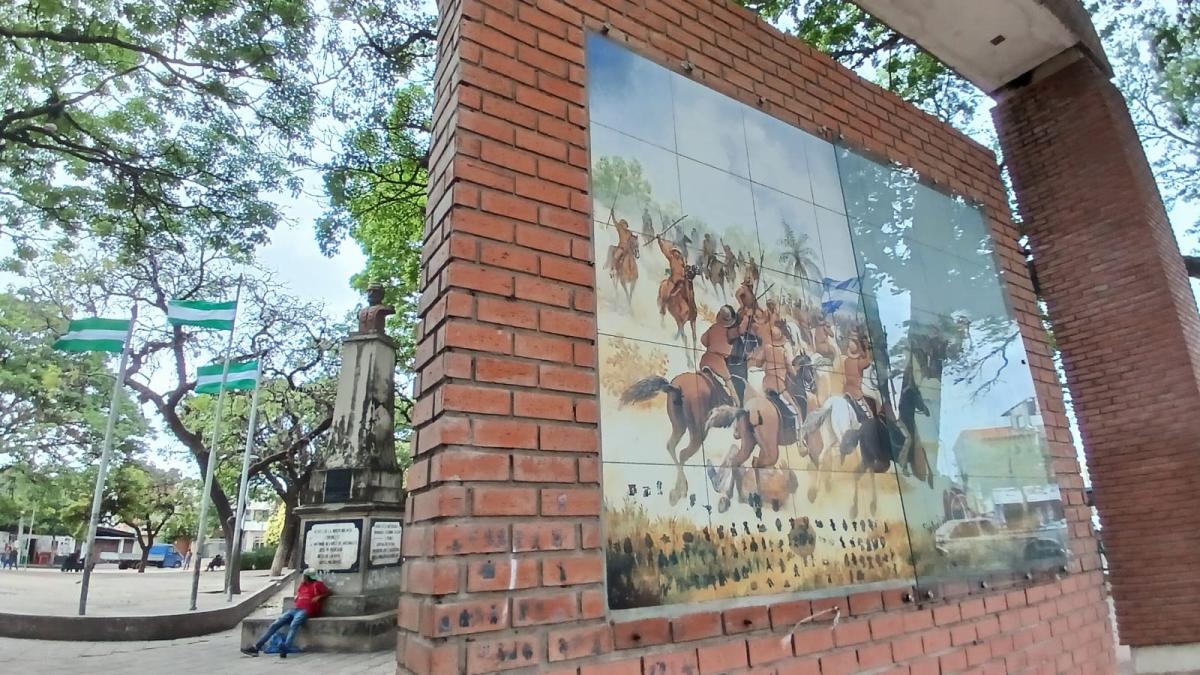
The main square, heart of the city, was the scene of the first libertarian cry on September 24, 1810. That day, while the people celebrated the feast of Our Lady of the Mercedes, In the historic municipal council, located in the southwest corner of the then Plaza de la Concordia (today September 24), an open council was convened against the Spanish domain. The town rose with courage, dismissed the delegate Pedro José Toledo Pimentel and established a Governing Board led by Dr. Antonio Vicente Seoane. That act marked the beginning of the independence deed and inspired the entire region to follow the path of freedom.
The independence movement broke out on the afternoon of September 24. “The adhesion of Colonel Antonio Suárez, at the time, second to military command, results in the patriotic action of the garrison, the dismissal of the intendant governor Toledo, the call to an open council and the designation of the Governing Board,” describes in the history of Santa Cruz, Isaac Sandóval Rodríguez.
At that time, Santa Cruz de la Sierra was a modest city, with septum and adobe houses, motorcycle ceilings and just some public buildings around the main square. On the southern sidewalk the government house, the jail and the cathedral were lifted; While on the west sidewalk were the Seminar College and the Chapel of El Sagrario.
Santa Cruz de la Sierra and its surroundings then housed about 11,000 inhabitantsdedicated mainly to the cultivation of rice, corn and sugarcane, in addition to cattle raising.
El Pari Battle
On November 21, 1816 one of the toughest moments was lived of the struggle of independence in the place where the Plazuela Fatima is located today, located in the second ring and Grigotá Avenue.
Francisco Xavier Aguilera, a military born in Santa Cruz de la Sierra, commanded 1,600 soldiers and attacked the city. The battle was fought in the fields of El Pari and a bloody confrontation was unleashed that lasted for hours.
Patriots of Cotoca, Paurito and JitaPaqui came in defense of freedom. However, the efforts were unsuccessful, since the realistic army was more powerful.
Warnes died in this battle in Aguilera. José Manuel Mercado, under the patriot cavalry, He was forced to retire to the Pampas from El Trompillo with his men. Similarly, José Manuel Baca (Cañoto) fled to Salta.
A text by Eduardo Cortés collects a testimony of the horror that the crossings lived during that battle. “When Commander Aguilera gave permission to many women, after four days to bury his dead, an 8 -year -old boy, who accompanied his mother, told him in old mud cathedral.. The battle ended at the beginning of the 21st (November), but the dead were abandoned four days‘”, Says Cortés.
La Pólvora neighborhood
In the neighborhood the gunpowder were collected explosives for combat
Located between Vallegrande and Colón streets was the La Pólvora neighborhood, where the explosives for the army cross was collected and the uniform and the clothing of the combatants were also made. In the area there are only some houses of yesteryear.
In the El Tao neighborhood the uprising of slaves was prepared. In this place is the pirate plane
Another sector that keeps important moments in history is the Pirate plane, where the El Tao neighborhood remainedplace that witnessed the organization for the uprising of slaves in August 1809. However, it was frustrated by an informant, suffocating the rebellion before it could materialize.
This uprising, motivated by rumors of freedom after the facts of Sucre and La Paz, marked an antecedent to the subsequent independence of the Spanish domain region.