The Congress of the Republic starts Monday, September 22 a key week for the future of the country’s finances, in which after the failure of the joint economic commissions on September 11, when the session was suspended due to lack of quorum, The General Budget of the Nation (PGN) by 2026 reaches the debates without the global amount being voted.
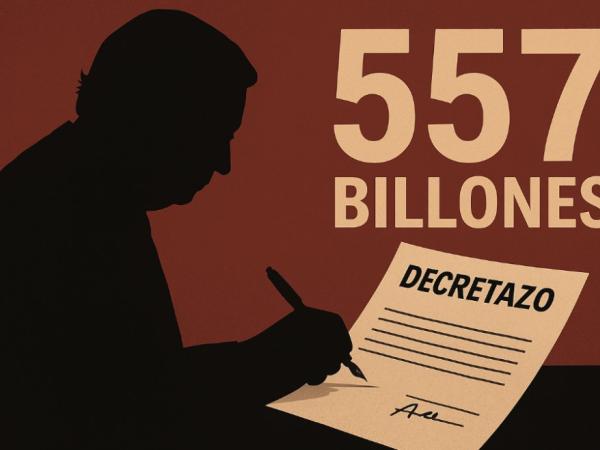
With the ghost of the decretazo around again through the halls of the National Capitol, this vacuum implies that the project must be discussed with the initial figure presented by the Government for $ 557 billion, of which $ 26.3 billion depend on a financing law, which in practice is better understood as a tax reform.
More information: CARF warns that the fiscal deficit continues to deteriorate
While on the agenda everything indicates that there will be debate, Portfolio knew that inside From the Executive there is an intention to allow the process to fail to repeat the 2024 scenario, when for the first time in recent history the budget ended up approved by presidential decrees.
With this, President Gustavo Petro would have the power to set the figure to his convenience, clearing the way to his fiscal plan without major concessions; While this possibility has lit the alarms inside and outside the Congress, where some already speak of a “fiscal dictatorship.”
This will be a key week for the 2026 budget accounts.
Chatgpt image
A ghost that is repeated
To better understand what happens with the budget, the first thing to say is that the Constitution establishes strict deadlines so that the budget is approved in the Legislative, such as, for example, 15 September, which was the deadline to define the global amount in joint commissions.
As it was not achieved, the initiative advanced with the original figure of the Executive, which generates an imbalance in the debate and now, between September 15 and 25, those same commissions must approve in the first debate the presentation of the project; So that since October 1, the Senate and Chamber plenaries must discuss it article by article.
Also read: More than 40 Colombians a day have declared bankruptcy this year
The problem is that the clock runs against and with the suspended sessions and disagreements to the red red, every day loses brings the country to the stage of a new decretazo; While the Constitution allows, if on October 20 at midnight there is no approval of the Congress, the budget is firm as the government settled.
“We cannot give up a function that the Constitution gives us the congressmen who are part of the economic commissions so that by a decrees we repeat the history,” the representative warned to the Wilmer Castellanos Chamber, who requested dialogue and consultation so as not to leave control of the expense in the exclusive hands of the government.

This will be a key week for the 2026 budget accounts.
Chatgpt image
The fight for the amount and the covert tax
The background shock revolves around the size of the budget and the source of financing, since the 2026 project amounts to $ 557 billion pesos, an amount that congressmen such as Senator Angélica Lozano describe as “inflated”. According to her, the Government intends to tie the debate a tax reform disguised of financing law, which seeks to raise $ 26 additional billion, the highest in history.
“In these 10 days we have to approve article by article and there are some where the Government and the President are given to make movements at will in some areas, which are black holes, huge gaps that are fed with several billion pesos and that is not known for what they are or have any control,” said Lozano, who anticipated a ferrous opposition to the items that can compromise the pocket of Colombians.
Other news: Pension reform: The time to present the Chamber Acts is over
The Government, meanwhile, has shown provision to a partial cut. It should be remembered that the Minister of Finance, Germán Ávila, proposed to reduce these accounts by $ 10 billion, leaving them at $ 547 billion.
Likewise, before the failure of the joint economic commissions, the possibility of adjusting the financing law in equal proportion, from $ 26.3 to $ 16.3 billion; Although both the unions, as the analysts have said on several occasions that a cut of the expense of more than $ 40 billion is needed.

This will be a key week for the 2026 budget accounts.
Chatgpt image
It must also be said that after the failure of September 11, for now everything seems to move in a scenario in which while the opposition and a sector of the parties seek to reduce the amount, the government seems more comfortable with inertia, since the failure in the commissions allows it to keep its initial proposal intact.
This pulse revives the ghost of the “fiscal dictatorship”, a model in which, for lack of consensus or political will, the budget It ends unilaterally by the President, without effective counterweights of Congress.
In all this, Senator Lozano has been one of the most critical voices in the face of the way in which the Government proposes to distribute the resources and for it, in addition to the implicit tax, the project contains opaque items without clear explanation of its destiny, compared to those who warn that they are black holes, fed with several billion, which is not known for what they are or have any control ”.
See here: The dollar in Colombia closed the week consolidating below 3,900 pesos
Therefore, your call is that, from here to September 25, each article is reviewed With magnifying glass and signed any attempt to deliver discretionary powers to the Executive.
Debate or decree?
The dilemma is evident in the face of either the economic commissions this week to advance in an adjusted and agreed project, or the country is heading to repeat the outcome of 2024, when for the first time in recent history the budget was issued by decree.

This will be a key week for the 2026 budget accounts.
Chatgpt image
The political risk is enormous, since on the one hand, distrust is deepened in Congress, which already loads with the sign of inability to discuss one of its most important laws. On the other, the narrative of an executive who concentrates fiscal power is strengthened amid doubts about the transparency of spending and sufficiency of their sources of financing.
Thus, what is at stake is not only the figure of $ 557 billion, not even the $ 26 billion of the tax, but the legitimacy of the budgetary process, based on the fact that a tax democracy is built in the debate, not in the decrees. And in that field, this week will be decisive to define whether Colombia reaffirms the balance of powers or advances towards a dangerous normalization of the fiscal dictatorship.
Daniel Hernández Naranjo
Portfolio journalist