In recent months, the headlines of the Dominican press have filled with news about “shooting exchanges” between agents of the National Police and alleged criminals, in which the latter are always dejected, but the most recent case in which five men died has filled the entire society with indignation for the brutal, unjustified and inexplicable of the action.
The information given by the National Police, you made eight days from his spokesman for his spokesman Colonel Diego Pesqueira, realized that members of that institution killed five criminals on Olympic Avenue, in the La Barranquita neighborhood, in the city of Santiago during a “shots’ confrontation”, however, the citizens and relatives of some of the deceased denied the police version.
Views
All non -police versions explain that there was no operation as they say. There was no attempt to arrest anyone, there was no warning; Rather, the intention of executing the five men was reached as if it were an operation to eliminate a loose end or commit a kind of “undercover murder.”
Can read: Faride Raful informs police suspension for death of five men in Santiago
Impunity against ‘constant shooting’ exchanges a cycle of violence in the country
Perhaps what has helped feed the impotence and outrage of national public opinion is the information given by several witnesses in the square that all cell phones, security cameras and hard drives that recorded everything referred to the operation of police officers in this case, were seized by the same agents after the massacre.
What happened
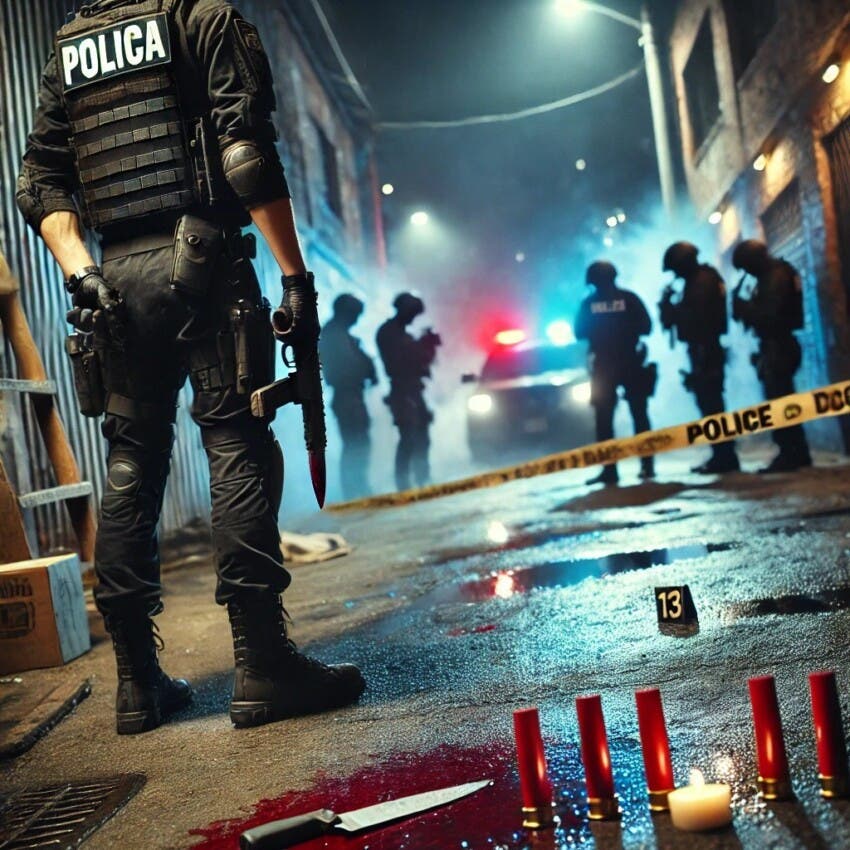
The incident occurred on Wednesday 10 of this month, around 2:30 in the afternoon, after an alleged police persecution that ended in an exchange of shooting in a commercial square on Olympic Avenue, in front of an apartment and business building, according to the police version.
According to the same report, the individuals moved in a white K5 K5 vehicle, from which they would have opened fire against the agents when they arrive at the place.
However, the versions of eye and relatives of some of the victims contradict the official version.
“The police who came took all the cameras of the place. The police action I qualify as 100 % bad. How you think they can come here throwing shots and a young barber who scares and runs out, and who was cutting up kill him, and they didn’t kill him anymore because there were no more people,” said Emil Valerio, witness.
“My husband Julio Alberto Gómez, 28, left my house after eating and came to cut this barber as he did every week. He was a mechanic and lend. He has never had problems with the Dicrim. Damn abusers, now they want to make a screen they came to dock,” said a young woman who identified himself as Eline wife of Alberto Gómez.
This increasingly recurring pattern has lit alarms in civil society and has caused a debate about the legitimacy of these clashes, which for many have become an extrajudicial execution method, which the police use for multiple reasons.
The situation is more complex than it seems to the naked eye, since for some time these police actions have been intensifying without any authority investigating these cases, and although it is true that Dominican society lives an increase in crime and violence, this type of actions is what the atmosphere of tranquility and calm in which it must be lived is worsen.
On many occasions, only Manuel María Mercedes, who is the executive director of the CNDH-RD (National Human Rights Commission of the Dominican Republic) has denounced these actions where the lack of due judicial process in these cases is a flagrant violation of human rights.
Other of the great concerns of citizenship is the impunity that surrounds these “shots exchanges”, since although the law establishes that every time a person dies at the hands of an agent of the order, an investigation must be opened, the reality is that most of these cases do not become clarified.
It is not investigated, it is not sanctioned and accounts are not yielded. This creates a cycle of violence and a message to society that human rights do not matter.
The deceased
The deceased are Elvis Antonio Jiménez Rodríguez, 26; Julio Alberto Gómez, 28 (mechanical and lender); José Vladimir Valerio Estévez (Barbero), 25; Edward Bernardo Peña Rodríguez, 35; and Carlos Enrique Guzmán Navarro, 40.
Exchanges
The so -called “shooting exchanges” of the National Police have left a balance of 170 dead as of September 5, 2025. This figure increases in 18 cases reported in that same period of time last year, according to statistical data of the same institution.
There are many exchanges of shooting starring the police where they have died even military, however they continue to occur with all the impunity without anyone investigating anything. Now the Public Ministry has ordered investigation.
Undercover murder
The undercover or homicide murder disguised is not a criminal figure in itself, but refers to a death that is hidden or presented in a way that seems an accident, in other words, it is where the death of a specific person is hidden within a massacre or a larger violent event to make it random.