The Colombian Civil Code aims to protect the welfare of minors, guaranteeing that they always count With the necessary resources for its integral development. For this reason, when a father or mother does not meet the obligation to contribute food to their children, the law contemplates mechanisms that ensure that responsibility is not diluted or leave unprotected children. What happens to grandparents?
In accordance with article 24 of the Code of Children and Adolescence (Law 1098 of 2006), children and adolescents have the right to receive not only food, but also housing, education, health, recreation and other basic elements for their development. This obligation falls first to parents, but if they cannot comply, the regulations allow it to extend it to other relatives.
This legal design intends to avoid gaps that put the quality of life of minors at risk. In practice, The judges analyze each case, valuing both the economic capacity of the parents and that of other family members who can assume that subsidiary charge.
(Read more: The Colombian people where ice cream is tradition: flavors that are not in another city)
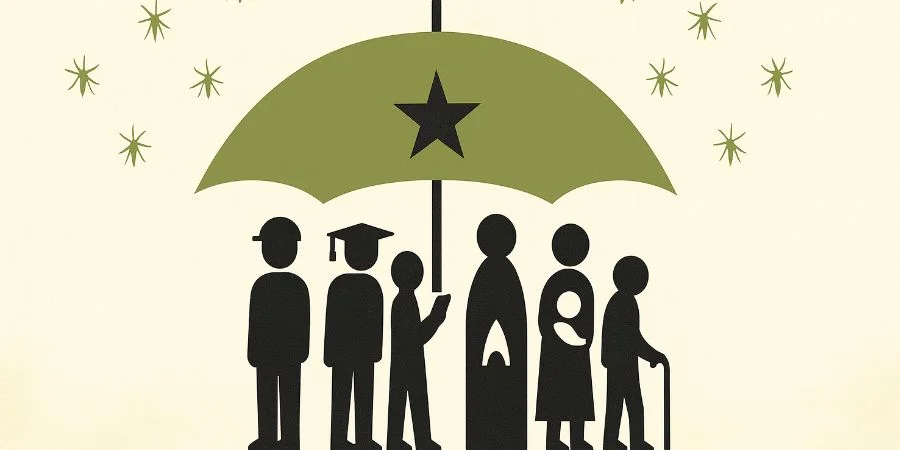
Grandparents
Source: Canva
When should grandparents pay pension according to Colombian law?
Article 260 of the Civil Code establishes that, in the absence or insufficiency of the parents, the food obligation passes to the legitimate grandparents through both lines of descent. This means that if a father or mother cannot guarantee the maintenance of their children, grandparents can be legally required to do so, partially or totally, depending on their economic capacity.
As the legal scope portal points outso that this obligation is activated, it is necessary to demonstrate before a judge the impossibility of the parents to fulfill the food duty. Tests may include bank extracts, income statements, testimonies or evidence of extreme situations such as economic bankruptcy, drug addiction, mental health problems or proven abandonment.
The Colombian jurisprudence, such as the T-2003 guardianship sentence, has already ordered grandparents to cover the food of his grandchildren in cases where the father completely disregarded his obligations.
(Read more: In the US, they do not want to receive them: the Latin American country to which the visa rejects the most)
It should be clarified that the responsibility of the grandparents is subsidiary and not supportive: it is only activated when it is proven that parents cannot fulfill. However, once the judge dictates the measure, the grandparents cannot refuse claiming lack of closeness with the grandson or with their own son. The obligation is imposed according to the best interests of the child.
If grandparents also demonstrate economic impossibility, the law contemplates the extension of responsibility to other relatives, as provided in article 411 of the Civil Code. Ultimately, if no family member can respond, the Colombian Family Welfare Institute (ICBF) can intervene with protection measures.