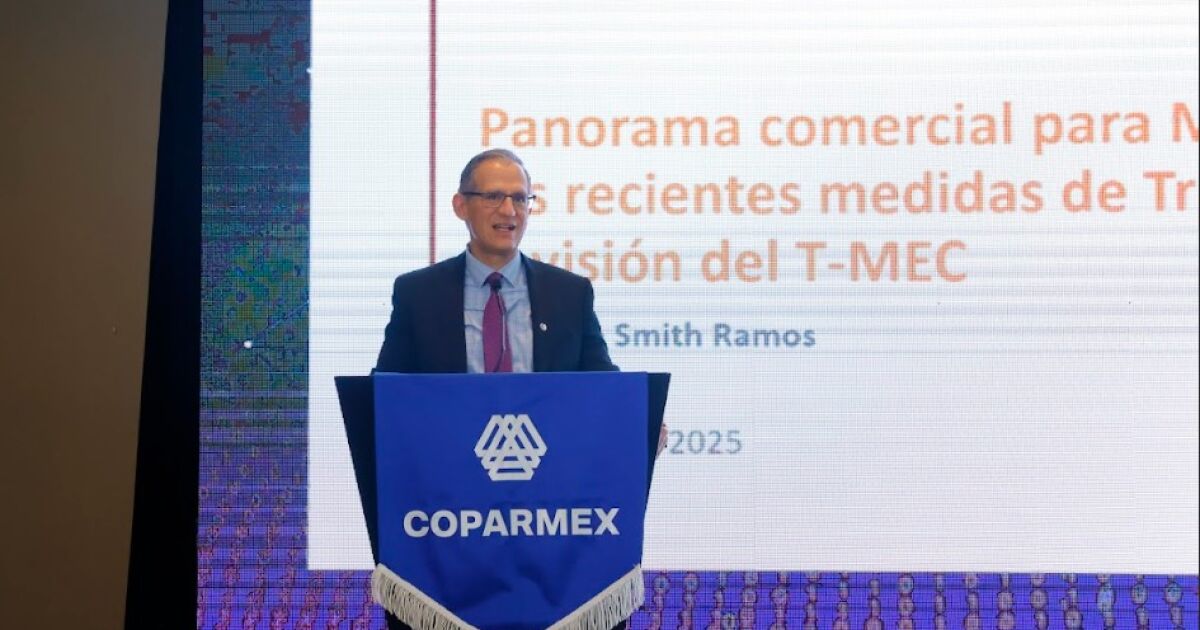
The expert explained, in the Summit of large companies of the Coparmex, which most likely in the review of the T-MEC is a limited reopening of chapters with sustained political pressure from Washington.
And although a break is the least likely, the immediate challenge will be to activate formal consultations to prevent current tariffs (steel, copper, among others) to become a negotiation base. That is to say, that the United States initiates conversations based on the fact that current tariffs will be maintained and will be reduced to the extent that Mexico gives concessions to its main commercial partner.
The four scenarios towards the review of the T-MEC
On stage A is that of a limited review without opening the option to modify the text or corpus of the T-MEC. In this case, said Smith Ramos, the key will be to focus the agenda on competitiveness and unfair practices of third parties.
Scenario B, the most likely, would be a focused reopening of chapters, where the United States would put on the table automotive, labor, controversy solution, cybersecurity and intellectual property.
All this, with an anti China bias that, however, should not be so drastic. Since according to the specialist, the North American region cannot supply multiple supplies from the Asian country. In this case, both Mexico and Canada would have the opportunity to put their own interests and adjustments on the table, as in dairy and energy issues, respectively.
In a scenario C, the expert raised a prolonged negotiation, where the president of the United States, Donald Trump, would maintain pressure and extend terms, that is, an annual review until the ratification or signing of the agreement is reached. In this case, uncertainty would be constant, as long as the Presidency of the Republican lasts, but with the perspective that the treaty will not collapse.
The scenario D, that of the rupture, is the least probable, as it would raise a very high political cost for the United States, in addition to a loss of competitiveness and stability for the entire region.
It is worth mentioning that the review is scheduled for July 2026. If there is no agreement that year, the T-MEC is still valid and the exercise is reopened in 2027 (and again in 2033). The only fatal date is 2036, when the 16 years signed between the three countries are completed.
How should Mexico negotiate?
Kenneth Smith explained that Mexico must request consultations under the rules of the T-MEC to leave legal record that it does not accept the unilateral tariffs that the United States already put the United States to some Mexican products. Otherwise, he warns, negotiation could begin from “de facto” tariffs. In addition, he proposed with caution to new tariffs, in order to contain new impositions without causing a escalation.
In addition, he stated that while the United States presses its partners to cut ties with China, Mexico must use this situation as a barrier of change to strengthen its commercial and productive relations with its US partners.
“What the United States is asking for is that Canada and Mexico close access to China … that implies that Mexico abandons the possibility of receiving hundreds of billions in high -tech investments,” he explained.
That cost, giving up the FDI from China, would only make sense if Washington agrees to accelerate the economic integration of North America. That is, to advance in verifiable cooperation in the containment of unfair practices, “either from China or any other country”, in exchange for concrete steps in productive and regulatory integration.
Likewise, Mexico can take the opportunity to advance in sectoral annexes of semiconductors, mining or artificial intelligence and sow the seed from now so that in the next US or Canadian administration a deeper integration can be materialized.
There are 9 ongoing investigations
Smith warned that the greatest risk is not only what is already in force, but what is coming. “Today the United States is carrying out nine separate investigations in national security matters,” he said. The sectors under the magnifying glass are strategic: semiconductors, pharmaceuticals, heavy trucks, wood and plane turbines.
The problem, he added, is that the “partial preference” that Mexico has in front of other countries is not armored in the treaty, but depends on the discretion of President Trump.
“Tomorrow you can get up and decide to impose 100% tariffs on agricultural exports of Mexico, which has not touched for the moment and therefore we cannot say that we are in a stable situation,” he warned.
In this scenario, Mexico’s task is double, precisely mapping the impacts on trinational chains and using the dispute solution mechanisms to record that it does not accept the “normalization” of the encumbrances.
Fight external uncertainty, with internal improvements
Despite the panorama, Smith raised a scenario in which Mexico could be strengthened.
“If we achieve an exception of all present and future tariffs and a respect for the T-MEC, the treaty takes even more value than the one it has today,” he said.
While the United States maintains tariff wars with Europe and China, the appeal to invest in Mexico increases. That bet, he said, will only consolidate whether the country accelerates at home what remains pending: regulatory transparency, macroeconomic stability and competitive neutrality in front of state companies.
“If we manage to maintain the T-MEC and the United States continues to fight with Europe and China, invest in Mexico to enter the US market will be even more attractive,” he summarized.
Mexico, without complete equipment to negotiate
Kenneth Smith regretted that Mexico lost most of the specialized negotiators who led the country to sign the T-MEC. And therefore he pointed out that Mexico needs to reinforce places in the Ministry of Economy, reactivate the room together and professionalize the relationship with the private sector of the United States, so that it is that same lobby that presses Congress and in the states in favor of the permanence of the treaty.
It should be remembered that President Claudia Sheinbaum published this week, in the Official Gazette of the Federation, the notice that opens a consultation process in Mexico for 60 days (from September 17 to November 16, 2025), with the possibility of extending it 30 days. The governments of Canada and the United States will also have their internal consultations, in the face of formal review, in 2026.