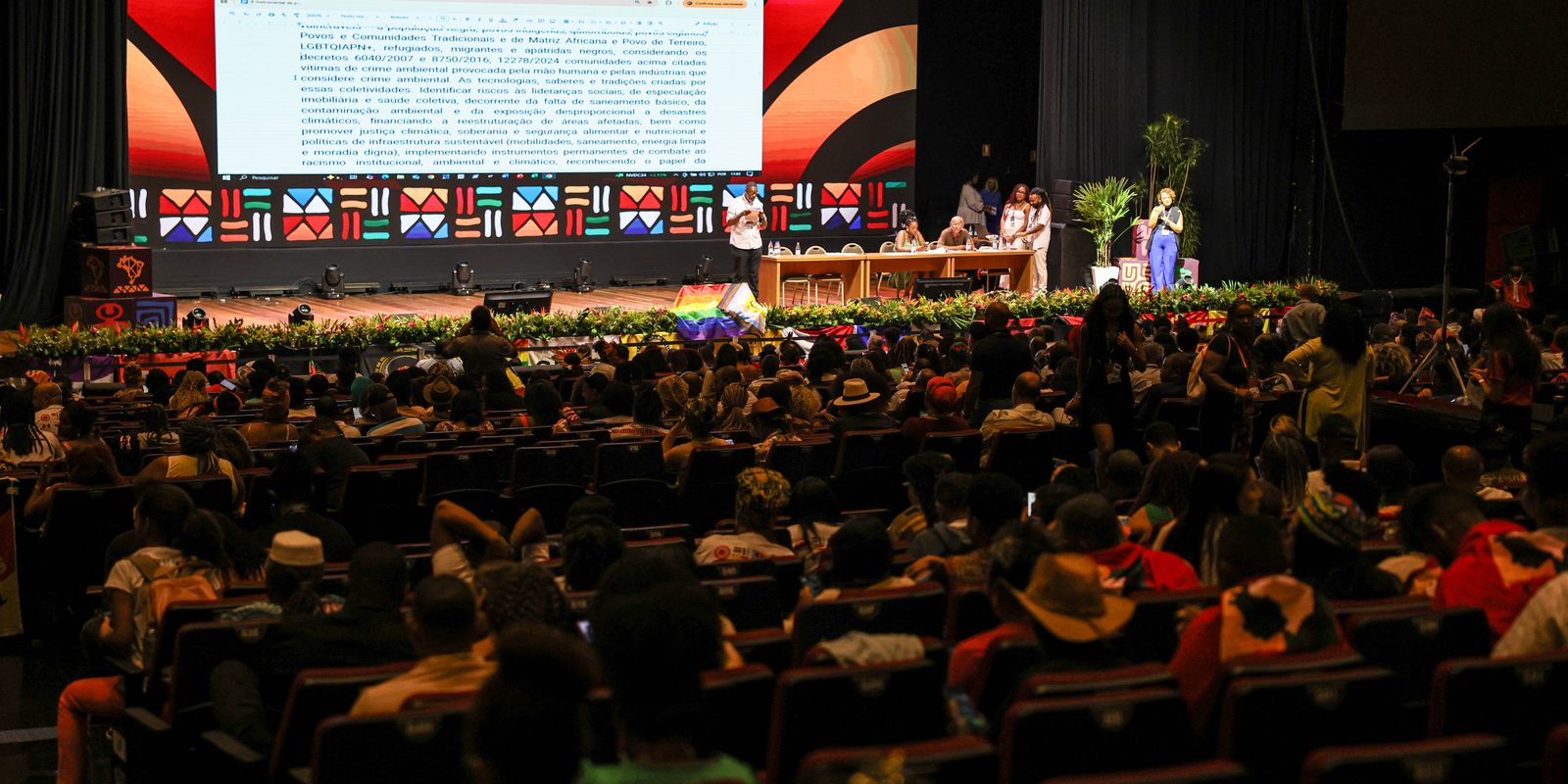
The delegates of the 5th National Conference on Promotion of Racial Equality (Conapir), gathered in Brasilia, present today the final document with the proposals that will be sent to the federal government. These are guidelines and recommendations for the formulation and improvement of public policies of equality, democracy, historical reparation and racial justice.
The meeting, which ends this Friday (19), brings together about 2,000 people from all over the country. There are 1,700 elected delegates, 200 guests and 50 observers who debated the 740 proposals approved in the previous stages in municipal, state and regional conferences.
On Thursday, the Planary Meeting honored the sociologist and militant of the black movement Luiza Bairros, deceased in 2016which was chief minister of the Secretariat of Policies for the Promotion of Racial Equality of Brazil (SEPPIR) between 2011 and 2014.
At the deliberative meeting, the proposals were submitted to the vote of all present delegates and the texts were adjusted to reflect the collective will.
After consensus, the recommendations were inserted in the final text of the conference to be taken this Friday (19) to the government.
Thursday’s official program was alternated with spontaneous demonstrations of social groups. The African Matrix Religion Terreiro Communities – Candomblé and Umbanda – occupied the corridors and took “their axé” to the plenary stage with songs and clothing and adornments to ask for respect for ancestral knowledge and be resistance.

The 5th National Conference on Promotion of Racial Equality (5th Conapir) ends today (19), at the Ulysses Guimarães Convention Center, in Brasilia, with the theme Equality and Democracy: Repair and Racial Justice. Photo: Marcelo Camargo/Agência Brasil – MARCELO CAMARGO/AGENCY BRAZIL
Mother Gilce de Oyá, Ribeirinha da Cotijuba Island (PA), wants the Federal Constitution of 1988 to guarantee equality to the black people.
“We are in the 5th Conapir so that our laws are effective, get out of paper and live in our bodies protecting us. The laws already exist, but they have to be guaranteed for repair and well to live. I wish the constitution to ensure what is still lacking.”
Following, in the wheel, the capoeiristas joined in choir to claim the appreciation of the Capoeira craft.
In a peaceful protest of timps and flat, music by Berimbaus, Pandeiros and Agogôs, Delegates in Conapir suggested that capoeira be inserted into school curricula as a celebration of Afro-Brazilian culture, which conveys tradition, ethics and values. Not to be seen only as a tourist attraction.

Capolymen ask for the sport to be inserted in school curricula. Photo: MARCELO CAMARGO/AGENCY BRAZIL
João Moreira, Professor of Physical Education at the Greater ABC Paulista, popularly known as Mestre Pelé, defends the struggle, characterized by Ginga, which was created by the enslaved in Brazil. “Today, capoeira educates, teaches to have respect for others and the discipline of its own person.”
Mestre Pelé praised the griós, wise storytellers, as experienced and respected figures. “The masters, even without ever being able to go to a university, started all this educational process with capoeira.”
A conference. Two thousand faces. A diverse nation
Gypsies Marisa and Nardi Casanova Calim, from Curitiba, regret being invisible by civil society and the Brazilian state. They say they have their rights to health, education, housing and public security neglected frequently.

Brasília (DF), 09/17/2025 – Marisa Calin, participates in the 5th National Conference on Racial Igualade Promotion. Photo: José Cruz/Agência Brasil
“Being a Gypsy should be living everyday life with your clothes, with your identity, which are your costumes, with what you have of traditions, the customs. But generally people do not understand this kind of culture, so we are a discriminated people and we suffer many prejudices. ARRIVE!
There are several ages of Conapir delegates. Niterói student (RJ), Marta Lúcia Briola de Souza, 22, brought her 6 -month -old son Felipe José. She represents the youth, the black and peripheral mother at the conference.
The joke of calling his child “the youngest delegate of V Conipor” gives way to his son’s fear suffering discrimination for having the black body.
“I am afraid of confusing my son with a bad guy if they judge him for his color, because the target always has, in the middle, black. Our bodies do not have to die that way. We have to live. Our body needs welcome,” says the university.
Delegate Marta Lucia justifies her fear for secular history of the Brazilian people. “Genocidan slave ships came from Africa. Here, with the colonization of the Portuguese, our bodies have been suffering 500 years ago. I am afraid of public safety. And there are racism and prejudice, yes.”
Young Marcia’s feeling is endorsed by the life experience of another delegate, Duque de Caxias (RJ). Luana Evanderlina, 74, is a member of the Municipal Council for the Defense of Black Rights and the promotion of Caxias’s racial and ethnic equality and knows the context of violence well. Reality is abundantly exposed to Luana Evanderlina, for the 40 -year work as a social worker in four slums of Baixada Fluminense.
“The wickedness is proportional to the person’s skin tone. The darker, if it is a black retainted, then, the more wickedness, the greater perversity. The black man has no right to open his mouth. They kill first and ask later,” the militant lamented.

Evanderlina Luana July, participates in the 5th National Conference on Promotion of Racial Equality. Photo: José Cruz/Agência Brasil
Luana Evanderlina sees Conapir’s days as an opportunity to fight for equal rights and demand reparation for historical damage caused by racism. “Brazil literally is a black country. This legacy is ours, because the one who made this country was the black people Retanto. But many people always have in mind the European model of our white colonizers, which delays the understanding that this country is ours.”
Eliane de Lima, from Campina Grande (PB), Lóla, knows other faces of racism, from the perspective lived by domestic workers, within quarters, marginalized in the so -called families of families.
Currently, Eliane is part of the Campina Grande Domestic Workers Association, and went to the event to demand compliance with Complementary Law No. 150/2015 that unified the rights of domestic workers, equating them to those of other urban and rural workers. Rights that the domestic worker knows at the tip of his tongue, but does not see them universalized. These include nightly, working hours control, FGTS, unemployment insurance.

Brasília (DF), 09/17/2025 – Eliane, participates in the 5th National Conference on Promotion of Racial Equality. Photo: José Cruz/Agência Brasil – José Cruz/Agência Brasil
“We work too much and earn little for being a domestic worker. Our strength is not valued in the job market,” says Eliane de Lima.
Psychologist and indigenous teacher Mick Aimirim Poti left Caruaru (PE) to represent her Karaxuwanassu people at the conference. In the federal capital, she joined other groups to demand the inclusion and permanence of indigenous peoples in the Racial Equality Statute as a way to broaden the reach of public policies to indigenous people.
“We have come from various states with the awareness that our struggle, as indigenous, is much greater than individual struggles. Our perspective is that this change, to include the indigenous people, will make us all in Brazil can access the public policies we need and have the right.”
Discrimination on various fronts and religious intolerance lives daily the young Vinny Obaluaê of the Unified Black Movement (MNU) in Bahia. In the sight of prejudice are your gender identity, gay; the color of your skin, black; Your belief of African matrix.

Brasília (DF), 17/09/2025 – Vinny Obaluaê, participates in the 5th National Conference on Promotion of Racial Equality. Photo: José Cruz/Agência Brasil – José Cruz/Agência Brasil
With rain-arc color range in hand, Vinny circulated in Conapir environments, drawing attention. He wants to expand black representativeness in spaces of power, decision and visibility, such as politics, the media, the arts, the labor market and in academic communities.
“We are struggling to occupy our spaces increasingly. Today, it is already possible to see black, gay and lesbians in posts like those of a doctor, judge, or judge to have voice. And yet it is difficult.”
Another social worker in the city of Niterói (RJ), Thaísa Bento Ferreira, brought her 6 -month -old daughter to set the example. The racial literacy that Thaisa had at the university, she wants to teach little Livia.
“I think maternity can not be an impediment for us to continue fighting public policies that will benefit my daughter in the future.
Thaísa Bento wants hope of a better and worthy future through racial equality. “I build this space with her here, thinking that Lívia will also build it, at some point, fighting for her own rights and the rights of her children. With that, we will teach our next generations.”
Check out the closing schedule of V Conapir for this Friday (19) here.