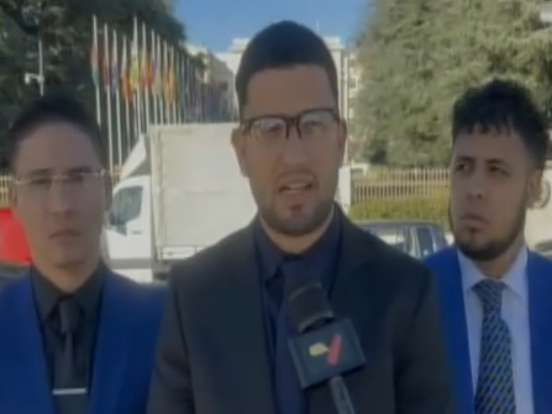
Venezuelan migrants who were rescued from the Terrorism Confinement Center (CECOT) in El Salvador held a private audience in the Wilson Palace in Geneva, Switzerland, with Matías Peña, head of the Subdivision for America, Europe and Central Asia of the Office of the United Nations High Commissioner for Human Rights.
At the meeting, they reported the conditions of seclusion and denounced violations of their human rights suffered both in El Salvador and in the United States.
Direct testimonies before international instances
During the audience, Arturo Suárez, one of the rescued Venezuelan migrants from the CECOT, offered his testimony about the conditions lived in the detention center. “We were locked up without knowing why, without access to lawyers, without communication with our families. They treated us as criminals without having committed any crime,” said Suarez.
The young man said he was arrested in El Salvador after having crossed several countries in search of opportunities. “They put us in the Cecot without explanations. We slept on the ground, without light, without enough food. Many of us sick and we do not receive medical attention,” he added.
Complaints about systematic human rights violations
Venezuelan migrants also denounced that they were victims of degrading treatment during their transit in the United States, including prolonged arrests and family separation. At the meeting with Matías Peña, they requested that research on the detention conditions in the CECOT be opened and that international protection is guaranteed for those in vulnerability.
The hearing was held within the framework of the efforts of human rights defenders who accompany the cases of migrants arrested in high security centers. The testimonies will be incorporated into the reports that the High Commissioner’s office presents before multilateral instances.
The participation of Venezuelan migrants in this private audience represents a step in the visibility of detention conditions in the CECOT and other similar centers. The complaints filed with the UN seek to activate international protection mechanisms and generate diplomatic pressure to guarantee respect for the human rights of migrants.