Looking at the photos of the Villalón Park, in El Vedado, I remembered the many times that I passed by in my university years. In a corner, the Amadeo Roldán Theater; In the other, the house of Máximo Gómez.
Every time I have returned to Havana, I approach that place in search of my own ghosts. Merodeo the park attracted by the figure of José Ramón Villalón, wishing to find me. I travel their columns, scraping in search of pieces of your memory to turn it into a literary character. One day I even touched the bell of the house where I had lived, in front of the park.
What could I say about those ruins Eusebio Leal, whom one day I asked for Villalón and, to my surprise, I knew they were relatives. Now only souls walk between the rubble: ladies and gentlemen of yesterday that observe, self -absorbed, the collapse.
A child is going through what he once had to be lawn; A lady who returns from searching for bread has already forgotten that the park is called Gonzalo de Quesada and Aróstegui, Villalón’s patriot friend, as a descendant was written in easy -to -find documents on the Internet, including the one entitled The Wilson Book.
There is no forgiveness for memory, and it clings to melancholy. I imagine that, for those who grew up in the surroundings of the Villalón Park, for those who keep memories linked to each bank or each plant, the destruction, the garbage dump, the oblivion must be painful.
Desidia opens the way to dismemberment, and this carcome as the saltpeter. The ruin could become dust one day, and do not hesitate that this dust ends up buried by a modern construction, perhaps designed for tourists who may never arrive, or for millionaires who are already forged in the shadow of the bureaucracy, of ideology, of the ghosts of history.
But, what’s with José Ramón Villalón. For me it was a surprise to know that he had been the creator of a piece of artillery used during the War of Independence. Maybe Juan Padrón will take him for his character Oliverio, the comic inventor Elpidio Valdés.
Surely Oliverio embodies the many inventors who participated in our independence contests, including engineer José Ramón Villalón. When I immersed me in its history, while tieding ends and evoked characters and moments, the real events were mixed, liquefying in my imagination. Thus, I also share fragments of what I composed about the life of this man: patriot, founder, blood of our national blood.
An episode: the Villalón pneumatic cannon
Villalón’s pneumatic cannon was of the SIMS -Dudley type. He had made some adaptations, he had put three tubes, two that allowed the evacuation of compressor gases and one for the expulsion of the projectile. In addition to dynamite, he used nitroglycerin. His creation kept him occupied for months in an apartment overlooking a bleak, but fresh street mouth, and for the tests he went to Long Island Sound with his assistants, because he was in New York. Next to the Hudson River activated the piece and produced the first shot, but the piece would prove its effectiveness the next day in the pastures of the island, so Villalón had to go to Florida to embark in search of that test to the Cuban coasts.
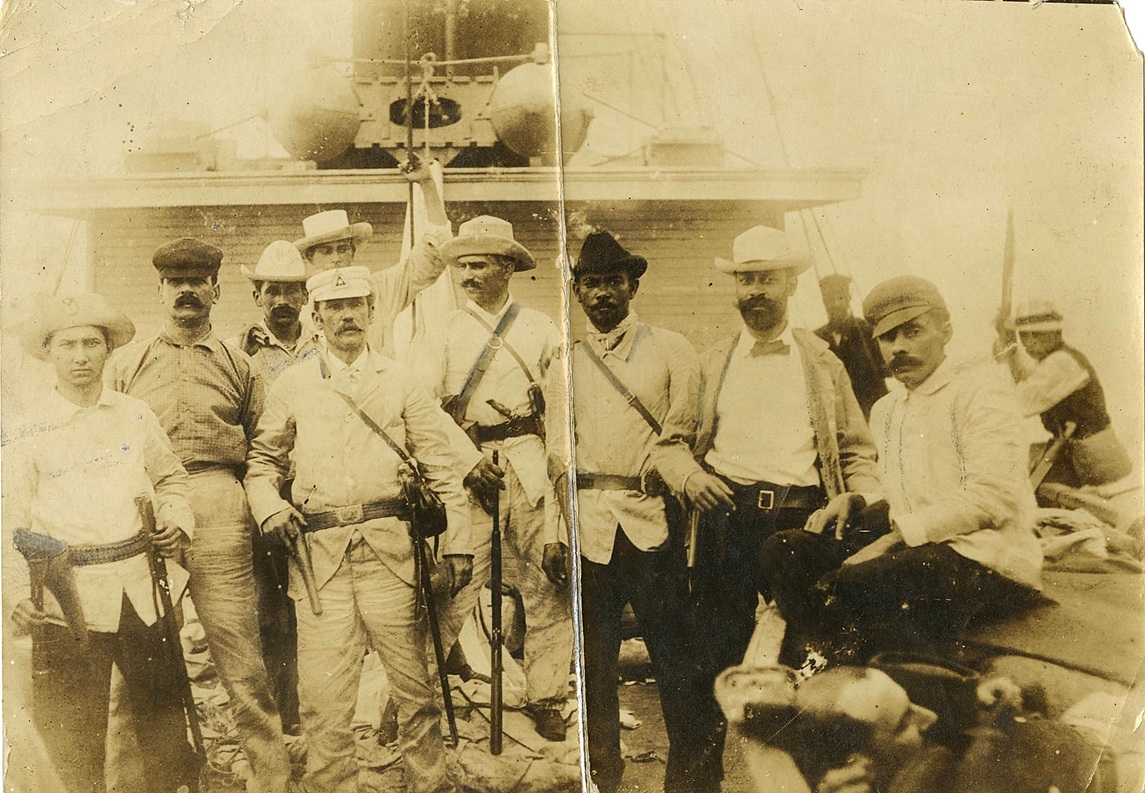
In addition to the cannon, steam Three Friends He had a thousand weapons on board: modern rifles, thirdols, Máuser and Winchester, five hundred thousand shots and two thousand pounds of dynamite. The expedition had two bosses: one of the sea, General Castillo Duany, and another of land, the Puerto Rican General Juan Rius Rivera, a tanned man in the Great War, where he had fought under the orders of Calixto García, whom, by the way, José Ramón had sent one of his assistants with a good team of gunners. That man was called Frederick Funston, but that is another story.
We are on the high seas and the expeditionaries have been divided into four groups. José Ramón, with degrees of Captain, had eight men under his command, the four assistants who accompanied him from New York and four soldiers who would take care of the mules on which he had to move the load. He wore a Jipijapa hat and cotton shirt. He remained most of the time in silence, and meditated, but in the sunrises he escaped through the ins and outs of his formality the Creole essence of his character.
Sometimes he agreed on deck with a boy named Francisco, whose conversations made him look older than he had. It was the fourth son of Máximo Gómez and had accompanied José Martí in his perplaces for Cayo Bone, Tampa, New Orleans, Costa Rica, Panama, Jamaica and the Dominican Republic. José Ramón took great affection.
Five days after having sailed from the left bank of the Saint Johns River, in Jacksonville, the expeditionaries discovered in the distance the irradiation of a lamppost. He arrived from a camp in Cabo Corrientes, and in that direction they directed course, so that the boats led the group of patriots to a cove on a beach called María la Gorda, where the landing happened.
The stay in that coast lasted more than a week. The goal was to reach Antonio Maceo’s troops. The road was tortuous, the dog tooth broke his boots and tried to open the belly to one of the mules; Then there was the ciénaga: the caleta grape and the guano concentrated the solo. The legendary general was eager to verify the effectiveness of the reinforcements and received them with joy.
One day, not too far from that, the explorers discovered a strong occupied by a Spanish column and organized the action. Maceo longed to try José Ramón’s cannon and he hurried to the gunners. The maneuver caused excellent impressions, but the true power of the weapon was yet to be checked, grown with nitroglycerin bags, whose noise produced fright in the opposite ranks. A great battle approached: black eyebrow.
The troops received a cruel onslaught in the rain, not only lost the flag bearer, but the fire became brave and the men began to fall on the battlefield. José Ramón himself came to be seen without half of his endowment, the enemy squads managed to ambush the Cubans, who were accompanied by a large number of civilians who, confused by the maneuver, left the river where the enemy was waiting for them, and children, women and old people were victims of a crossfire.
General Pedro Vargas urgently called José Ramón. “You have to do something with that artillery,” he shouted. He pointed to an elevation where the enemy seemed impregnable, but the gunners had to arrive, and arrive. Pneumatic cannon discharges make the ground climb, it is not enough for Weyler’s troops to go back. The power of the attack causes bewilderment. Terror. Maceo orders a load to the machete. He has escaped. There is blood running through the stream. The smoke of the gunpowder is mixed with the mist, which dilutes the bloody scene.
José Ramón receives orders that his artillery is more accurate; You must take advantage of time and produce ammunition. Maceo intuits a new offensive, and time is scarce. The days become dizzying for him, who has been promoted to Commander and must leave with the lieutenant and his team of gunners. The famous pneumatic cannon has in check the town of Artemis, its other great performance. Dynamite again; The fire causes panic, again the mambises surprise with their bombing.
Maceo receives orders and crosses Mariel’s trail to Majana in a boat in which a narrow group of collaborators goes. It is December 1896 when a bullet impacts its body so many times tested by the shrapnel. Chief Mambí falls in San Pedro before the eyes of a detachment, and when Francisco knows, that boy with whom José Ramón had talked so much, runs next to the body. The opposite troops lurk and that is when the boy extracts his role on which he writes: “Goodbye, loved ones, I will love them a lot in another life like in this, their Panchito Gómez Toro, serve friend or enemy, to send this role of a dead man.”
American painters colored war in Cuba: vision of a soldier (II)
José Ramón feels that something collapses in his soul. It is consumed by the Congo and prevails in it the feeling that war is brutal and unfair. The republic itself seems broken, rarefied by intrigues that enemy generals and get tangled over hearts as a thorny climb that advances between darkness, and that one day discovers the glow of a burst: Maine bursts like a symptom in Havana’s bay.
And as José Ramón had been elected to integrate the assembly, he was appointed as one of the five members of the commission that would negotiate in Washington the licensing of the Liberating Army, his recognition. He was thirty -four when he returned to New York, and was in efforts that seemed to fructify with his four companions, when he was surprised again: Calixto García, the most veteran of the independence leaders, the central figure of the group he belonged to, died, leaving the commission desolate and causing José Ramón to reproach, once again, the fate of his compatriots and his own.
“What is a revolution for?” I wondered sometimes. “What has war earned?” As group secretary had too many responsibilities and could not be lost in disquisitions. Life does not expect, and those who still have the fortune of having it must hurry the step to be up to it.
***
José Ramón Villalón Sánchez was born on September 8, 1864 in Santiago de Cuba. He lived in Barcelona and Colombia, where he worked on the railroads. He studied at Lehight University, United States, and trained as a civil engineer. He was a calculation professor at the University of Havana and Secretary of Public Works during the First North American Interventor Government, a position he returned to occupy during the first government of Mario García Menocal. He died in 1938.