However, Hill defended that this crisis offers an opportunity to review what works, correct what not and prepare international trade for the next decade. “Three quarters of the goods in the world are still protected by the WTO rules, he recalled. That is, he said, the base on which the system is still sustained.
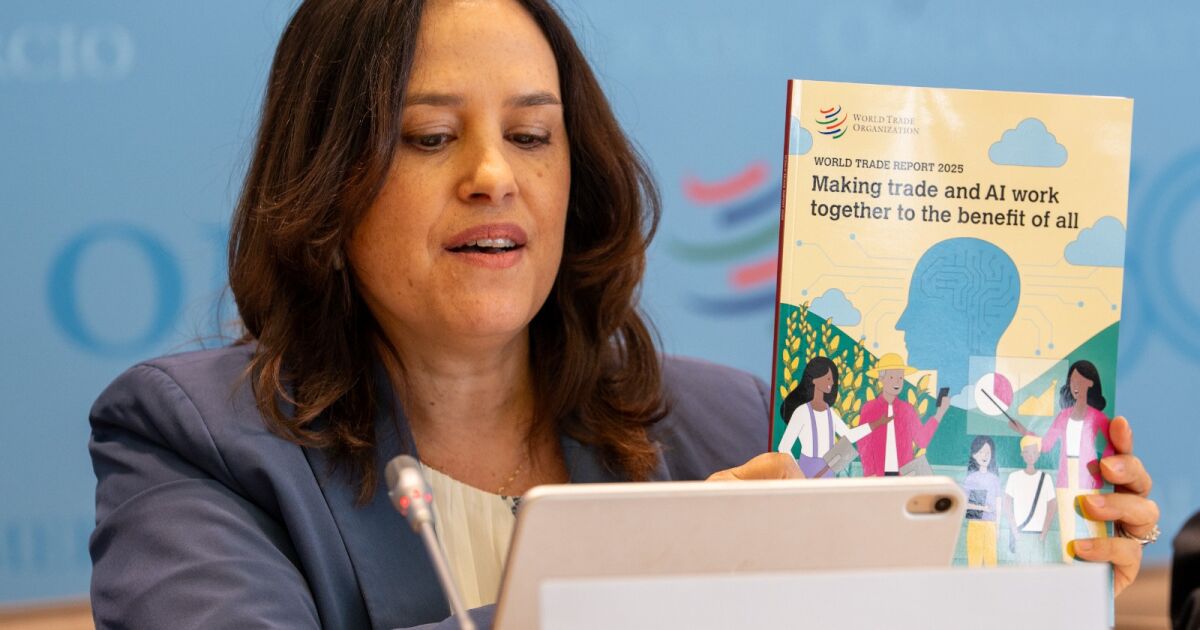
Within that framework, the World Commerce Report 2025 He chose to focus on a phenomenon that redefines the exchange of goods and services: artificial intelligence (AI). The decision responds to the urgency of understanding a transformation that advances faster than the ability to regulate it. If trade lives turbulent times, AI can become the engine that helps stabilize and, above all, make it more inclusive.
The report deepens the study that the WTO published in 2024 under the title Trading with Intelligence. That research examined how AI can reduce costs, increase productivity and open access to global markets. Now, the agency goes a step further, because it analyzes how the benefits of that revolution are distributed and what policies can guarantee that no one is left.
New WTO simulations estimate that the use of AI can increase cross -border flows of goods and services by 2040, a finding that the researchers baptized “40 by 40”. In addition, a survey conducted with the International Chamber of Commerce showed that 90% of the companies that already use specific benefits in their operations related to trade.
The impact is not limited to large corporations: micro, small and medium -sized companies express greater optimism regarding the possibility that AI allows them to access international markets.
The report also provides relevant data on the so -called AI qualifying goods, from critical minerals to semiconductors, whose trade reached 2.3 billion dollars in 2023. Access to this infrastructure will be decisive so that low -income economies can reduce their digital divide and participate in the new economy.
If these countries manage to close half of the gap with high income nations and adopt AI massively, they could see a 15% increase in their income, compared to 12% in rich countries. Without that convergence, the growth of the most lagging countries would be limited to 8%.
But the potential of AI is not automatic. The report warns that inequalities in digital infrastructure, education and training can expand the gap between winners and losers. Therefore, the recommendation is to invest in connectivity, develop labor adjustment policies and maintain an open and predictable commercial environment.