For several months, Colombia faces a known and discussed dilemma to fatigue and that is increasingly pressing, focused on compliance with the fiscal rule through cuts to public spending or breaching it and going to more debt. All this, starting from which analysts and authorities have asked to the Petro government that spends less, but from the house of Nariño they have made deaf ears.
In this sense, a recent report published by the Bank of the Republic warns thatalthough both routes imply costs, the path of indebtedness is much more burdensome for the economy and confirms that fiscal policy does have a direct impact on the economic dynamics of the country.
Also read: Tax Reform: These are the new changes that the Petro government would accept
This is the Economics Draft No. 1324, prepared by a group of economists from the Central Bank in collaboration with the Ministry of Finance and the International Monetary Fund, which presents the Coffee Model (Colombian Framework for the Economic Evaluation of Fiscal Policy for its acronym in English), a tool that allows simulating the effects of different tax decisions on the Colombian economy.
A new model
The first thing to say is that the study is clear and argues that the sacrifice of reducing public investment cools the economy in the short term, but avoiding adjustment and resorting to more debt unleashes a vicious circle of greater country risk, increasing credit and deeper fall in private demand.
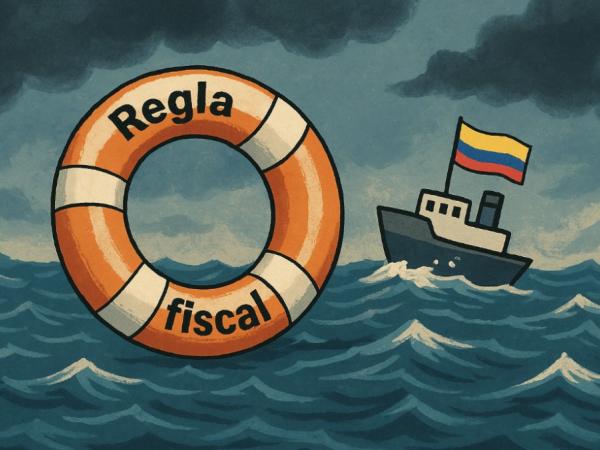
Adjusting the expense must be an urgency for the local economy.
Chatgpt image
It should be noted that the Bank of the Republic has been working on models for years that allow us to understand how monetary and prosecutor policy interact in an open and vulnerable economy to external shocks and on that path, Coffee represents a qualitative leap, thanks to a dynamic model that includes in great detail the various aspects of the national economy, such as tax revenues, public spending and debt.
“Coffee represents an important evolution in macroeconomic modeling tools from Colombia. Previous models, such as Patacon.
More information: Who lose and who earn in Colombia with a dollar of $ 3,900
They also emphasize that “more recently, the 4GM model introduced semi -structural characteristics adapted to an oil export economy, incorporating the decomposition of inflation and stylized shocks. Coffee complements these frames adding greater fiscal granularity and realism of debt, and better capturing the joint dynamics of the fiscal, external and monetary sectors”.
A painful adjustment
One of the most revealing findings in this report focuses on the difference in the impacts according to the type of response adopted by the government. In this sense, they say that when public investment is cut to meet the rule, the immediate effect is a fall in domestic demand, accompanied by a reduction in inflation and monetary policy interest rate.

Adjusting the expense must be an urgency for the local economy.
Chatgpt image
However, they make it clear that the adjustment, although painful, preserves the path of fiscal credibility and prevents the country from entering a more risky spiral of indebtedness and that “the way in which the Government implements these adjustments has substantial effects on the economy, given the important role of fiscal policy.”
The second scenario is the one that most worries the authors of the study, who emphasizes In that if the government decides to maintain the expense without adjustments and finance it with debt, the initial relief is soon transformed into a heavy load by means of the public debt is increased, the sovereign risk premium rises, the external credit is more expensive and, as a consequence, the private investment suffers.
See here: Dollar cuts the losses that led him to be below $ 3,900 this Friday
The result is an economy with less capacity to grow and with greater vulnerability to external shocks. In simple terms, kicking the can is much more expensive than immediately face the adjustment.
An intertwined economy
To better explain their findings, the investigators in charge of the report indicate that all of the above means that the tax dilemmas are not limited to an Excel sheet in the Ministry of Finance, but that they have real effects on the confidence of investorsin the cost of credit for companies and in the provision of households to consume.

Adjusting the expense must be an urgency for the local economy.
Chatgpt image
Likewise, they disregarded that breaching the fiscal rule not only calls into question the institutional framework built to give stability to public accounts, but also sends a negative signal to international financial markets, where the perception of risk translates into higher interest rates and lower access to resources.
The authors explain that the relationship between debt and risk premium is fundamental To understand the cost of indiscipline, arguing that “greater public indebtedness increases the risk premium and depreciation of the exchange rate, which amplifies the adjustments made by households with access to financial markets and companies.”
It may interest you: Decathlon premieres in Colombia format for intermediate cities
This without counting that “inflation exceeds the levels observed in previous tax adjustments, resulting in a higher official interest rate that further restricts private consumption and investment, thus prolonging the economic recession”, generating a vicious circle in which more debt generates more risk, and more risk makes the debt more expensive, which in turn restricts the space for productive spending.
The study also highlights the role of oil in fiscal sustainability and says that being one of the main sources of income of the State, fluctuations in its international price directly affect the government’s ability to fulfill its balance goals.

Adjusting the expense must be an urgency for the local economy.
Chatgpt image
“When crude oil prices fall, tax revenues are reduced and debt pressure increases, which makes it even more important The existence of a fiscal rule that prevents the accelerated deterioration of public accounts, ”they said.
Beyond the numbers, the document raises a clear message and that is that fiscal sustainability does not admit shortcuts and that adjusting the expense can be unpopular and cool economic activity in the short term, but guarantees credibility and stability, since breaching the rule can give a temporary break, but confidence mine and ends by punishing investment and growth.
Daniel Hernández Naranjo
Portfolio journalist