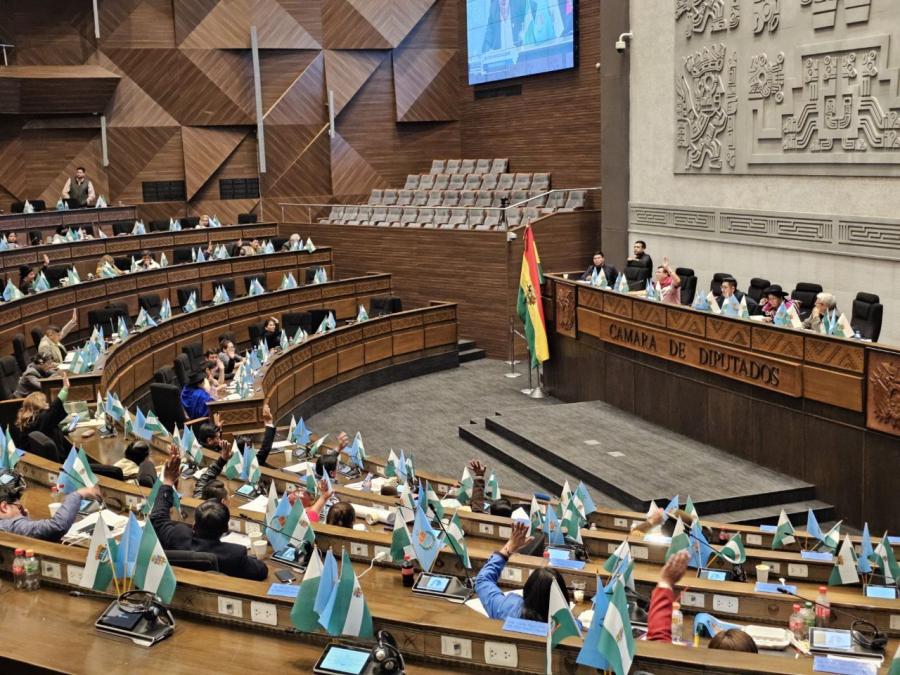
Less than two months after concluding his term, the Chamber of Deputies drags one of the greatest legislative congestions in its history: 619 bills remain stagnant in commissions, 88% of the total presented in Legislature 2024-2025, according to a report by the Secretariat of this instance. The current parliamentarians cease functions on November 7 and will leave a heavy inheritance of unhappy legislative initiatives.
However; The paralysis of the bills in commissions is not new. According to the data of the last four legislatures, the lag has become a constant in the Chamber of Deputies with a growing trend.
In the 2020-2021 management, 368 bills entered, of which only 50 were approved and 19 reached sanction, 299 pending, that is, 81%. The following year, 2021-2022, the figure remained similar: of 461 projects, only 61 were approved and 29 sanctioned, leaving 371 earrings (80%).
The situation worsened in 2022-2023, when 583 projects entered and 510 were left without treatment, which raised the lag at 87%. In the following legislature, 2023-2024, 676 projects were recorded, of which 582 did not advance (86%).
Experts and legislators attribute this stagnation to structural deficiencies, bureaucracy and internal conflicts within the political parties.
The head of the Citizen Community Bank (CC) in the Chamber of Deputies, Enrique Urquidi, said that the low legislative production responds to the Lack of leadership in commissions To define the agenda for the treatment of bills, as well as the bureaucracy generated by consultations to the Executive Body, whose responses may take up to three months.
“This issue of consultations is also another of the causes for which the bills cannot be analyzed, discussed and dispatched by the commissions more quickly, when the commission decides No instance, fundamentally of the Executive, complies with the planned period And the consultations can take one, two, three months and sometimes the answers are totally superficial and without a clear position by the Executive, ”he explained.
The legislator considers that most of the rules proposed by opponents were dilated through this mechanism. “Indirectly they have rejected them, because they are sent to the Executive and They block you the possibility that your projects continue to thrive and go to the plenary instance. That has an impact on the efficiency of legislative management, ”he said.
In commissions
Most of the projects entered into the Chamber of Deputies were sent to the Planning, Economic Policy and Finance Commission, which received 250 initiatives, of which only 37 were resolved. It is followed by the commission of nations and indigenous peoples, cultures and interculturality, with 131 bills, but only 15 with response.
In the Commission of Plural Economy, Production and Industry, 79 legislative initiatives were derived and only 5 were resolved to the Commission of Constitution, Legislation and Electoral System arrived 56 projects, of which 8 were attended; while the Education and Health Commission received 41 initiatives and barely resolved 1.
The Amazon region, land, territory, water, natural resources and environment had 39 projects and resolved 2; The social policy received 32 and resolved 2; and human rights attended 3 of the 30 projects that were derived from it.
As for the Commission of Government, Defense and Armed Forces, of 20 projects received, 5, and the Commission for International Policy and Migrant Protection resolved 4 of the 6 that reached its instance.
Finally, the Plural Justice, Public and Legal Defense Commission of the State received 33 projects, and the territorial organization of the State and Autonomies 11, but in both cases none was resolved.
According to political scientist Franco Gamboa, The Bolivian Parliament faces a “structural inefficiency.” He explained that, beyond the work in commissions, only 5% of the projects entered into the Chamber of Deputies became treated in Plenary – whether for approval or rejection – that is, only 40 out of a total of 701 legislative initiatives.
“The fact that almost 95% of the projects do not advance beyond commissions, shows a parliament with a minimum legislative capacity. The figure of what is called in political science, the ‘Legislative Leviathan’: a hypertrophied congress that controls everything, ‘does not apply’; on the contrary, There is an ‘unproductive gigantism’. All legislators have at least one advisor who is not fulfilling an efficient function, ”he said.
Gamboa remarked that the Bolivian Parliament was characterized by having majorities without efficiency, which exposes internal blocks. “Although there may be an absolute majority in a chamber, that does not translate into efficacy. The majority Does not convert projects into lawsrevealing internal blockages, fragmentation and an excess of procedural formalism. This inefficiency goes beyond the confrontation between arcists and evidence, ”he said.
The route of a legislative initiative begins in a chamber of origin – deputies or senators -, from where it is derived by correspondence to the respective commission, it in turn sends it to a committee in charge of discussing its approval or rejection, after which the project returns to the commission for a new treatment, if it manages to approve, it passes to the plenary session. In case of receiving the approval in the vote, the legislative initiative is sent to the review chamber – senators if it originated in deputies, or vice versa – where the same procedure follows before being sanctioned or rejected in the plenary.
Previous efforts
In the 2020-2021 legislature, the commission that received the most bills was the planning, economic policy and finance, with 143 initiatives. He was followed by indigenous nations and peoples, with 51; Plural economy, with 33; Education and health, with 32; and Constitution, legislation and electoral system, with 21. The other commissions received less than 20 projects.
During Legislature 2021-2022, the Planning, Economic Policy and Finance Commission led with 195 projects again. He was followed by indigenous nations and peoples with 75; Plural economy with 63; Constitution, legislation and electoral system; and plural justice, with 31 each; Education and health with 30. The other commissions received less than 25 projects.
In Legislature 2022-2023, the Planning, Economic Policy and Finance Commission again led with 212 projects, followed by indigenous nations and peoples with 99, plural economy with 84, and constitution, legislation and electoral system with 68. The Plural Justice Commission; and education and health received 36 projects each. Other commissions had less than 25 projects.
In Legislature 2023-2024, planning, economic policy and finance, the list with 251 projects headed again. It was followed by indigenous nations and peoples with 114, plural economy with 67, constitution, legislation and electoral system with 62 and plural justice with 46. The remaining commissions were derived less than 39 projects.