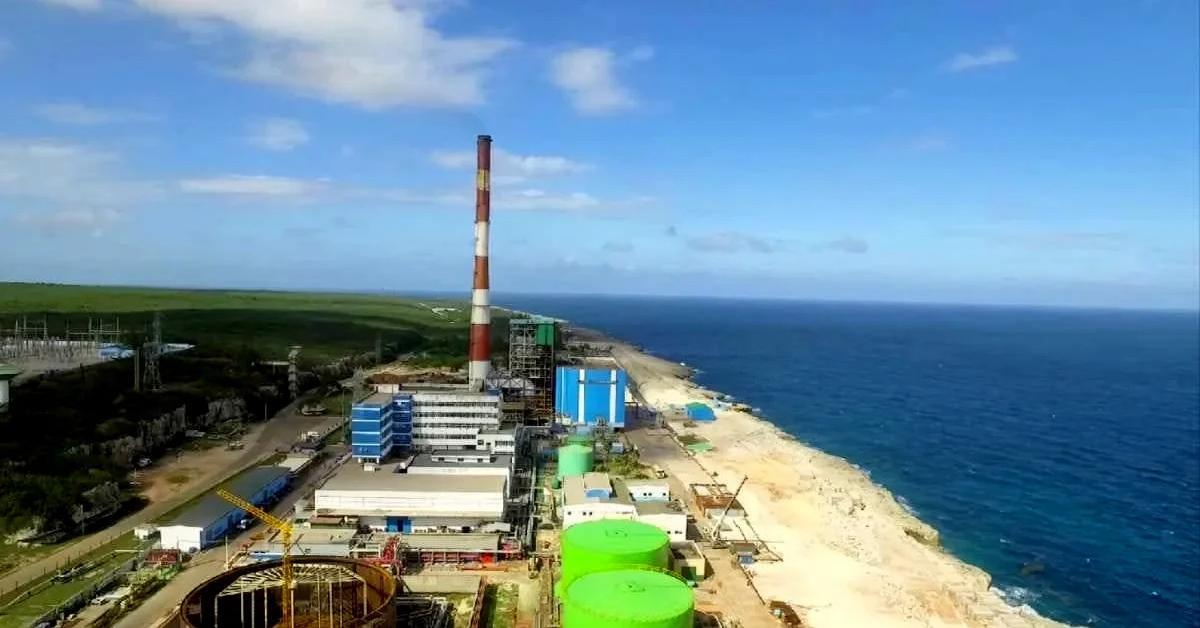
Havana/The Antonio Guiteras thermoelectric plant, considered the cornerstone of the National Electrical System (SEN), will be out of service at the end of the year for six months to undergo capital maintenance, he announced This Thursday The program Round table. The news comes in the midst of an energy crisis that has already caused five national blackouts in less than a year and daily scheduled cuts that exceed 20 hours without electricity.
This Saturday, nine of the 16 generation units installed in the seven thermoelectric plants (CTE) that still work in the country are stopped by breakdown or maintenance. These are units 3 and 4 of Cienfuegos, the 3 and 5 of Renté (Santiago de Cuba), 1 and 2 of La Felton, the 5 and 8 of Mariel and the 2 of Santa Cruz del Norte.
The general director of the Electric Union (UNE), Alfredo López Valdés, explained that the repair plan will cover 18 fundamental aspects of the boiler and the turbine of the plant. The reheating will be completely replaced – a critical piece with 15 kilometers of pipes through which steam and gases circulate – the burners and pins will be renewed, pumps and air ducts will be changed, a chemical washing will be made to prevent corrosion and new high pressure heating will be incorporated.
The plant, located in Matanzas and built in 1988 with French technology, is the most powerful unit block in the country, with an installed capacity of 330 megawatts (MW), although it has been years for lack of maintenance for years, it does not work at its maximum power. Its paralysis for six months represents a direct blow to the fragile national electricity. “It does not mean that we will have a new boiler, but a team in better conditions to stabilize the system,” said López Valdés.
The panorama is complicated by the impact of the rains, which reduce the productivity of the 30 new solar parks installed in the country
The problem is what will happen in the meantime. The SEN already reports generation deficits that approach the 2,000 MW at the time of maximum demand and the UNE has warned that this Saturday 55% of the country will suffer simultaneous blackouts in the afternoon-night. He announced deficit For this Saturday it is 1,868 MW at the peak schedule. This Friday, the maximum affectation reached 1,939 MW at 8:40 pm – superior to the planned – for new unforeseen exits.
The UNE ensures that it will try to cover the hole with other thermoelectric plants and structures of the so -called “distributed generation”, but these units are smaller, less efficient and also have maintenance problems and lack of spare parts. In addition, many of those mini centrals are out of service due to lack of diesel or fuel.
The panorama is complicated by the impact of the rains, which reduce the productivity of the 30 new solar parks installed in the country. In optimal situation, at Máximo Sol schedules, these facilities have a power of 654 MW and can produce up to 3,270 megawatts/hour in one day. According to the last part of the UNE, the 30 solar parks reached, on September 12, a maximum power of 523 MW and delivered 2,323 MWh.
The official press celebrated as A historical achievement The synchronization of solar parks with the contribution of generation distributed in Granma and Sancti Spíritus, but avoided mentioning that most of the country’s photovoltaic plants are not designed to operate autonomously when Sen collapses. The “worked” test, admitted managers, although it was made with a limited number of investors and under controlled conditions.
The discomfort grows throughout the country and manifests itself in social networks
The Energy crisis It has been crawling for more than a decade, but has sharpened in the last five years due to the lack of investment and the age of thermoelectric plants, which mostly exceed 40 years of exploitation. The “lack of foreign exchange” has prevented adequate maintenance, which has caused chain breakdowns and the fall of the electrical system on several occasions.
Independent experts estimate that Cuba would need between 8,000 and 10,000 million dollars to modernize its energy infrastructure, a sum of which the Government does not have because it has dedicated huge resources to the construction of hotels despite the RESPECTED FALL OF TOURISMwhile the country lives an unprecedented economic crisis, with a contraction of 11% of national production in the last five years.
The Government insists that the maintenance of Guiteras is indispensable to guarantee the future stability of the system and calls the population to “understanding and discipline” during the coming months. However, discomfort grows throughout the country and manifests itself in social networks, with even more force than in the days prior to the great protests of July 11, 2021, when thousands of Cubans took to the streets to the shout of “freedom” in several cities.